Log in to save this article and keep your favorite resources in one place.
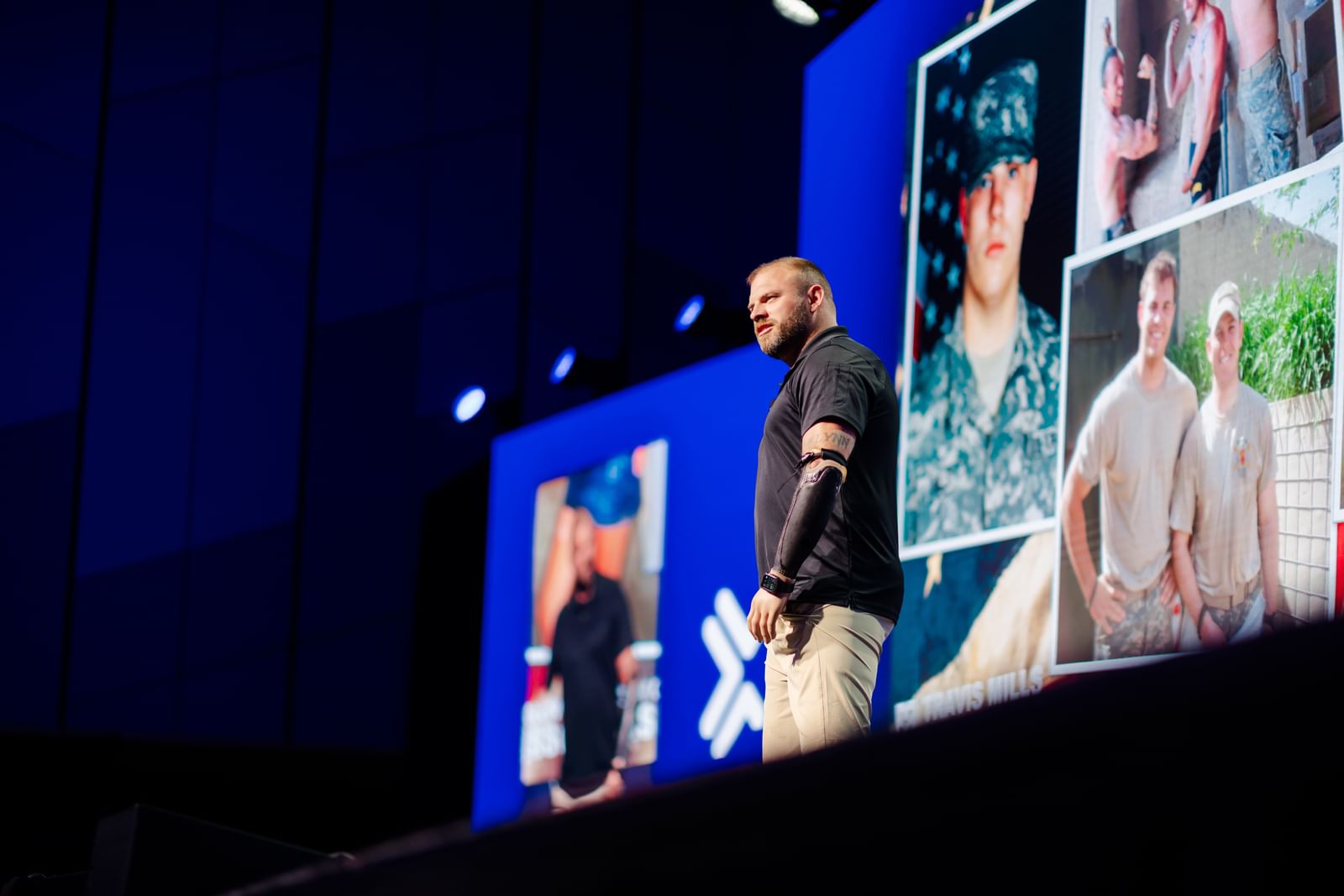
When retired U.S. Army Staff Sergeant Travis Mills talks about tough days, he frames them with striking simplicity: “When I have a tough day, I’m like, well, at least I get to have a tough day.”
That perspective comes from overcoming the unthinkable. In 2012, while on his third tour of duty in Afghanistan, Mills was critically injured by an improvised explosive device (IED) blast that took portions of all four limbs.
He’s one of only five quadruple amputees from the wars in Iraq and Afghanistan to survive his injuries. Since retiring from the U.S. Army the following year, Mills has rebuilt his life around gratitude, family, and a new mission: proving to others that resilience and leadership grow out of adversity.
Mills—who gave the celebrity keynote address at the 2025 edition of SAP for Utilities, Presented by ASUG, held in Denver, Colorado this month—doesn’t sugarcoat his recovery in a related interview with ASUG. Physical therapy was grueling. Asking for help was humbling.
Seven weeks after first arriving at Walter Reed National Center, where his wife Kelsey and daughter Chloe were by his side along with both their families, Mills started walking again; he spent a total of 19 months recovering at the facility. Yet he learned early on that focusing on why me? led nowhere. The real question was: what now?
“We can’t always silence the tough thoughts about how we got here — but we can always choose how we see it,” Mills often says. “Perspective is power.”
Mills emphasizes how much of his journey was made possible by others, from friends and family to those in his support network also helping him with daily tasks. It’s hard to ask for help, he said — but also essential. In September 2013, Mills and his wife founded the Travis Mills Foundation, with the mission of helping veterans and their families adapt to life after injury.
Resilience, Mills emphasizes to ASUG, isn’t simply a lone-wolf behavior. From medics who saved his life on the battlefield to friends who have continued to support him throughout recovery, he has come to see community as a stabilizing force.
Today, that belief drives the foundation, which hosts retreats in the great Maine outdoors for veterans and their families. Activities are designed to be adaptive—kayaking, climbing, or cycling—proving that limitations don’t mean exclusion.
“Seeing is believing,” says Mills. “When someone sees another person with similar injuries doing something, it changes what they believe is possible.”
The author of New York Times-bestselling memoir Tough as They Come, Mills also consults for business leaders around the country, sharing principles of strong leadership in the face of change. He describes great leaders as “chameleons”: empathetic enough to appreciate where their colleagues are at, firm enough to hold them accountable without lowering their expectations. He also stresses the importance of building teams and trusting them to lead day-to-day. “Trust but verify,” he says. Delegation, for him, isn’t a sign of weakness — it’s a show of strength.
Leadership, from his perspective, means balancing compassion with decisiveness, flexibility with discipline. It’s also about resilience, though he clarifies that it would be unproductive to treat every obstacle as an endurance test — resilience also means knowing when to let go.
Mills once explored acquiring a college campus to expand his foundation, but when the numbers didn’t work and people whom he trusted shared their own reservations, he walked away. This wasn’t a failure, he says; it was realism. For Mills, leadership is about adapting to what’s in front of you, not clinging to what isn’t, and knowing when to pivot.
To that end, Mills says, a leader’s resilience should be grounded in daily principles:
- Focusing on today, rather than getting lost in regrets or “what ifs”
- Surrounding yourself with people who are stronger in areas where you are weaker
- Asking for help when you need it
Such habits can sustain your momentum at work far more effectively than one-off bursts of inspiration or focusing too obsessively over little details.
For Mills, resilience hasn’t just been about recovering from trauma—it’s about building purpose beyond it. His foundation, speaking career, and family life all circle back to the same theme: reframing hardship as opportunity, turning setbacks into strength.
“I don’t think of myself as unlucky,” he says. “I think of myself as someone who got a second chance — and I want to make it count.”
For leaders navigating change, his message is simple yet resonant: don’t dwell on what’s been lost. Focus on what’s still possible and build from there.
You Might Be Interested In

Log in to save this article and keep your favorite resources in one place.
Log in to save this article and keep your favorite resources in one place.

Log in to save this article and keep your favorite resources in one place.
Log in to save this article and keep your favorite resources in one place.