Log in to save this article and keep your favorite resources in one place.
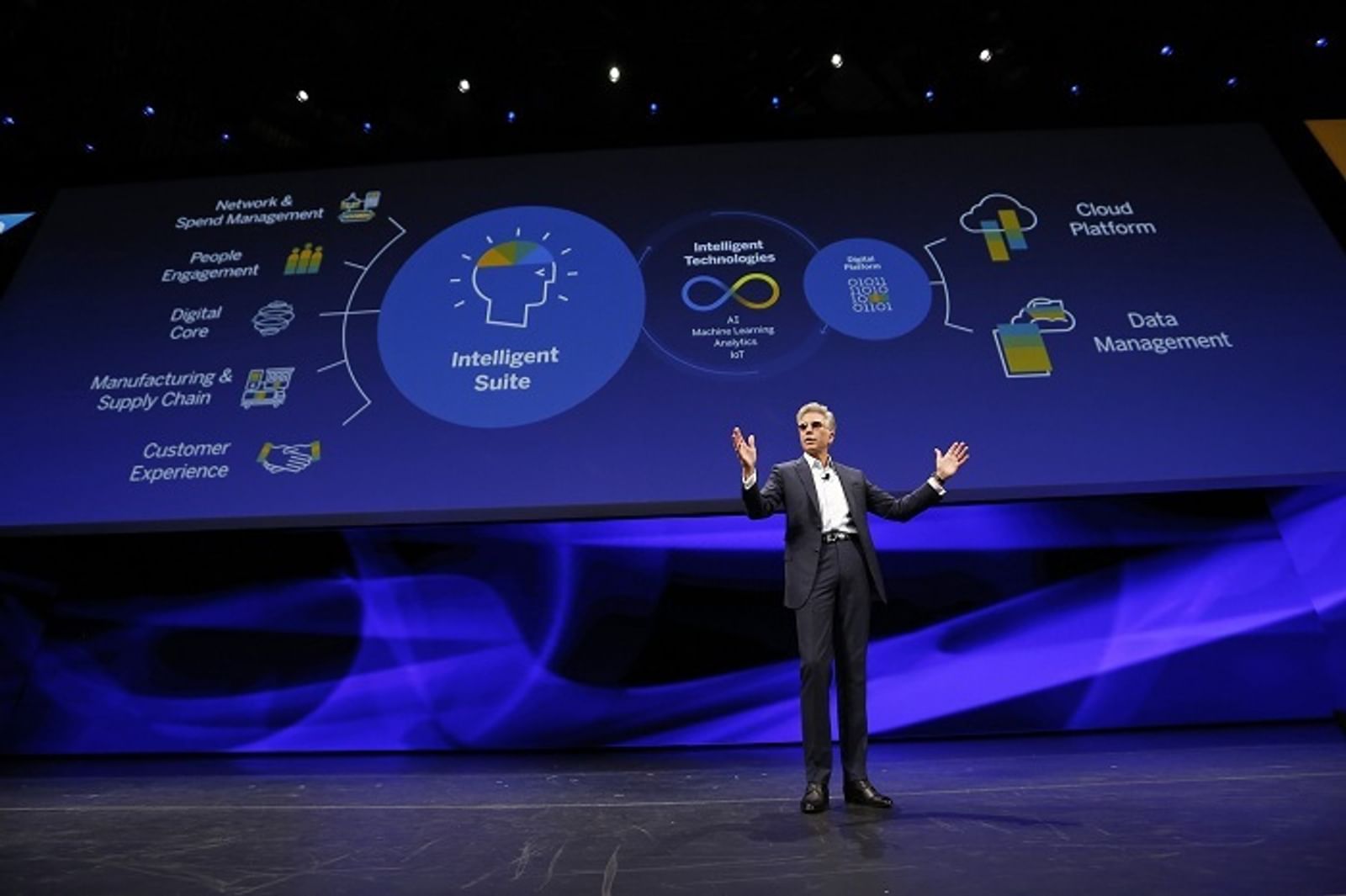
Photo Credit: SAP
Technology pundits, industry analysts, and enterprise technology providers are fond of sharing their visions for how next-generation businesses should operate. At the 2018 SAPPHIRE NOW and ASUG Annual Conference, SAP introduced its own vision, described as the “Intelligent Enterprise.” But what does this term really mean? And what does it mean for SAP customers?
Data-Driven Accelerated Outcomes
SAP defines the term like this: “Intelligent enterprises effectively use their data assets to achieve their desired outcomes faster — and with less risk.” The speed comes from automating complex processes within the business and bringing them together around a united core of master data in the cloud.
Organizations need to buy into certain philosophies for this approach to work. SAP identifies four key enablers to the intelligent enterprise:
1. Customer-centricity
2. Data that drives differentiation
3. Digitized processes
4. A cloud-first approach
Business Processes + Intelligent Technologies
When you consider SAP’s Intelligent Enterprise vision, it functions a little like a formula. It serves these key business processes through its intelligent suite of products:
- Customer Experience
- Manufacturing and the Supply Chain
- Digital Core (ERP)
- People Engagement (HR)
- Network and Spend Management (procurement)
Then, where businesses want to apply intelligent technologies like artificial intelligence, machine learning, the Internet of Things (IoT), and more, they’re able to add those through SAP Leonardo. Finally, businesses need to go through the process of making sure their data is not only harmonized but moving much of it to the cloud, so they can manage it efficiently.
Intelligent Enterprises in Practice
Given SAP’s focus on financial ERP applications, it often cites the example of invoice and payment matching, along with all the related approvals and subsystem ratification procedures such as separation of duty. We can now almost completely automate these procedures, while leaving a gateway for human hand-offs when we need to resolve anomalies. Of course, these anomaly resolutions can also be significantly automated as needed.
Customers today can start to use this intelligent software-supported automation to shoulder repeatable, definable tasks. Embracing this change will allow companies to free up employee time and empower them to do more meaningful and strategic work.
Deeper Human-Like Intelligence
As mechanized and back-end as these technologies are, customers can use SAP products to bring a human-like front end to the intelligent automation now being engineered into the enterprise. For example, we can create personalized and unique customer experiences using AI, chatbots, and other related voice technologies.
Companies that want to apply these intelligent technologies can turn to SAP for frameworks to make this happen, such as SAP Conversational AI, an end-to-end toolkit for training, building, and monitoring chatbots. According to SAP, “These chatbots can be integrated with SAP and non-SAP systems and are available as preconfigured industry-specific bots. So far, users have built 60,000 SAP Conversational AI chatbots.”
The Crucial Cloud Connection
The cloud is the essential connection across the entire intelligent enterprise. Whether on premises, public, or hybrid, the degree to which the intelligent enterprise gets smarter is a direct factor of the amount of secured network connectivity it engineers into the fabric of its new computing stack.
Part of this “connectedness factor” will set customers up to harness new innovations like blockchain. SAP says it has recognized the part that blockchain plays in creating more-intelligent enterprises, so it’s developed SAP Cloud Platform Blockchain. This offers blockchain as a service, delivered at the right power and scope, based on individual customer needs.
Not sure you fully understand blockchain? Here’s what you need to know about blockchain today.
According to SAP, “About 65 companies participate in the SAP blockchain co-innovation initiative to help customers use manufacturing and supply-chain products augmented by blockchain to enhance transparency, safety and collaboration in industries such as transportation, food, and pharmaceuticals.”
The Intelligent Enterprise Adoption Curve
Ultimately, becoming an intelligent enterprise is about adapting and changing so you’re ready for what’s ahead. These types of enterprise-wide changes require significant investments and culture shifts, so SAP acknowledges that customers will adopt these changes in phases. And some organizations will undoubtedly move faster than others, acting as the early adopters.
But the nature of these changes can start to create a virtuous cycle. As organizations adopt technologies such as automation controls, chatbots, blockchain, and machine learning (ML) to gather more information, they will get smarter — continuing to speed up the cycle of innovation.
Many customers will still have a way to go before they become full-on intelligent enterprises. But these technologies exist, and SAP is ready to help customers start getting the most from them now.
You Might Be Interested In

Log in to save this article and keep your favorite resources in one place.

Log in to save this article and keep your favorite resources in one place.

Log in to save this article and keep your favorite resources in one place.

Log in to save this article and keep your favorite resources in one place.