Log in to save this article and keep your favorite resources in one place.
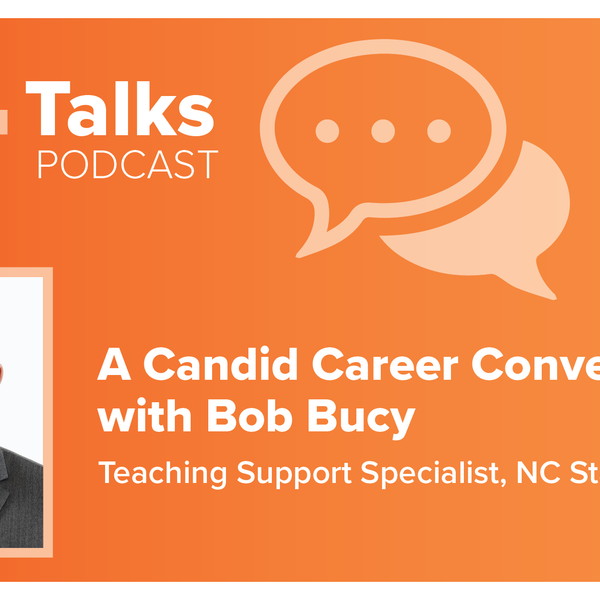
In this ASUG Talks episode, we talk with Bob Bucy, N.C. State University Teaching Support Specialist, about his career and academic pursuits.
In this ASUG Talks episode, we talk with Bob Bucy, N.C. State University Teaching Support Specialist, about his career and academic pursuits.
ASUG Talks: Candid Career Conversations
Episode 12
Jim Lichtenwalter:
I’m excited today to be joined by Bob Bucy. Bob, thank you so much for joining me.
Bob Bucy:
Glad to be here.
Lichtenwalter:
Bob, to kick things off, I’d love to know about your current role and the work you do each day.
Bucy:
I am currently in a role supporting supply chain systems for a global diagnostics company. The primary focus in that role is on SAP, but it includes support of other connected systems. In today’s world, SAP is seldom the only system involved in any company of any size and integration is a common theme.
Lichtenwalter:
Has working in integration something that you’ve always been doing or is that relatively new?
Bucy:
There’s always been some level of it over the years, but it’s changed over the years. Certainly SAP originally was created as one piece of software that was going to run your company and that has evolved over the years and integration has become a more prominent theme in the SAP ecosystem.
Lichtenwalter:
Even by SAP’s included more work on integrating with other solutions so what you’re using on SAP and what you’re using on maybe another software solution.
Bucy:
They recognize that this trend is not going away, and they’ve embraced it with things like BTP.
Lichtenwalter:
Let’s talk about when you first encountered SAP. Where were you in your career when you first encountered SAP?
Bucy:
I was actually a credit analyst in a manufacturing company, so a finance person. And I’d been involved in other technical projects in that department. I was actually hired partly for my financial experience and partly for my technical aptitude because I was kind of credit analyst/first line technical support in the department.
When that company was putting together their first SAP project, they went around looking for people from every area of the business to represent their area on the project and they looked for those with more technical aptitude. They came to me and asked me if I would be part of this project and I was a bit of a computer geek and building PCs and stuff on the side. And I was kind of like, oh cool. Get to play with new software, this sounds like fun. Had no idea what I was getting into. Not only that, but they asked me to do it part-time. That pretty much turned into two full-time jobs for a year and a half.
It was the hardest thing I’d ever done, but it was also the most rewarding thing I had ever done. And it became pretty clear by the end of that project that I had a much more promising future in SAP than as a credit analyst. I pretty quickly found my way to a role on an internal SAP project at IBM.
Lichtenwalter:
How do you pivot from credit analyst to working in the SAP ecosystem? Is that something you talked to your superiors about? Or did they already know that you had the acumen?
Bucy:
None of us getting into that project knew anything about SAP. They actually gave us all a photocopy of an article out of the Wall Street Journal explaining what SAP was and that was our introduction to SAP. And then we had our first organizational meeting with the project team who started explaining more about what SAP was. So, it really was based on the people that, first of all, had good knowledge of their business area. So, they understood what the business needed, but they also had a demonstrated aptitude for jumping into new things like SAP and making it work.
Lichtenwalter:
Along this the same line, since you first started using SAP, how has the organization, its software, its priorities, shifted and changed over the years?
Bucy:
Like many things, I think it’s moved in cycles. Those original five guys at IBM, their vision was the best of breed era. That was when you bought your big iron from IBM. And then you started hanging applications on it and had an army of programmers and write interfaces and Cobalt to put them all together. And they had this vision for this one piece of software that did everything. The Swiss army knife of business applications. And when I got into the SAP world, it was a core application that had all… It had finance and sales and manufacturing and all of the other things that it needed to have to run a business.
And then that started evolving. And when we got into the my SAP and they started rolling out the dimension products. And then we had supply chain management as a separate application and supply relationship management as a separate application. And that went on for the next 10 plus years until S/4 started really maturing.
And now they’re coming full circle and bringing those things back into the core S/4. Now, instead of having your separate supply chain management server with extended warehouse management, now extended warehouse management is part of the core S/4 application. Now planning is part of the core S/4 application again.
So, it’s all come full circle. And there’s obviously now the much greater emphasis on cloud technology. And true software is the service products, which is I think, probably the biggest dynamic change in the SAP world. Because when I started, it was all on premise applications sitting on a server. So, now we true softwares of service products.
Lichtenwalter:
Can you talk a little about a particularly noteworthy or challenging SAP project that you worked on? I’d love to know some of the specifics and then how you were ultimately able to be successful on that project.
Bucy:
I think the most challenging project that I worked with was rolling out a global template to a site that had been acquired a number of years earlier. It had been four or five years earlier, but there’d never really been anything done by the acquiring company to integrate that site into the culture of the company. And when we still got there, they still viewed themselves as the other company.
And they’re like, we’re not company XYZ. We’re company ABC. And I’m just like, well, I’m sorry, but the sign on the outside of the building now says company XYZ. But they just didn’t want to embrace that. And they still retained the culture of their previous company and had a lot of resentment over being acquired in the first place. And it’s probably the greatest level of conflict that I’ve ever encountered in a project. It required a lot of diplomacy, a lot of communication, all of that I could muster.
We tried to focus on selling the benefits of the project and how it was going to benefit the site to be more integrated with the rest of the network of the company that they were now a part of, which has turned out over the years to be exactly the case for that site. It’s driven more business to them. They’ve benefited hugely from that integration into the systems of the acquiring company.
And most importantly, there were people there who embraced the change, right? And those that actually embraced the change, their careers have benefited from it. They were the ones that were smart enough to say, hey, you gave me lemons. I’m going to make some lemonade. So, it really was the best learning experience that I’ve ever had in organizational change management on a project.
Lichtenwalter:
Change management’s just so hard. Do you have any recommendations or what did you all do to ensure change a management?
Bucy:
I think a lot of it boils down to really listening, to having empathy with the people who are going to be using the system that you’re eventually going to implement and actually really understanding their concerns because nobody likes change. It’s uncomfortable to everybody. Everybody right out of the gate feels threatened by change.
And so, you have to really work to sell the benefits of what you’re doing and show them how it’s actually going to help them. There’s no such thing as too much communication.
One of the things that I tell people a lot is people have this idea that the only people who are really salespeople are those that have sales in their job title. And the reality is that we’re all salespeople.
We all go to our jobs every day with ideas that we want to try and sell to our coworkers and sell to our management because we believe they’re going to be in the best interest of the company. And so, that’s just a mindset that I take into any kind of a project like this.
Lichtenwalter:
You have to sell ideas and you have to approach it the same way that as you’re selling to a customer because how else are you going to get an idea off the ground if you can’t sell your internal organization?
Bob, I want to pivot for a minute. As I was lurking on your LinkedIn page preparing for this podcast, I noticed that you were a lecturer for a semester at North Carolina State University. Would love to know about how you came about that opportunity, what it was like and what exactly you were lecturing about?
Bucy:
So, I’ve known Dr. Maryanne Bradford there for a number of years and she teaches ERP classes, both undergraduate and NPA level there at NC State University. She’s the person who brought that topic to the university. She’s been teaching in that space for over 20 years. And I’d been a guest speaker for her over the years. And she came to me actually a couple years in advance, actually spring of 2017, to say that she was planning to take this sabbatical. She needed somebody to teach the class who actually understood ERP and SAP because they are a member of the SAP University Alliance.
And I’d always had an interest in teaching, but I’d never really acted on it. And it was actually Maryanne who really saw my potential to do it and gave me the kick in the pants that I needed to do it.
So, I taught the course the way Maryanne teaches it. I see it as much more of a business course than an IT course. It actually sits within the accounting department in the [inaudible] College of Management. And so, while we certainly want students to get a good dose of SAP, I think the main benefit of the class is the focus on good business process, as well as practical advice on package and vendor selection and the importance of standardization wherever possible.
And it’s always great when we get feedback from students. There was one student we had in spring of last year who was one of our really, really good students. I happened to see her birthday come up on LinkedIn. So, I sent her a note. Hey, happy birthday. I hope the job’s going great and everything. And she came back and said, hey, all that stuff I learned in that class… Because she’s actually in audit now at KPMG.
And she’s like, I’m doing IT system audit on SAP systems. So, a whole lot of stuff that I learned in that class is really helpful.
Lichtenwalter:
That must be so gratifying to have someone say that to you.
Bucy:
Yeah. That was pretty cool. Definitely makes it worthwhile.
Lichtenwalter:
But you work right now in supply chains.
Bucy:
Yep.
Lichtenwalter:
Obviously right now we are in a time where supply chains are in great flux. I guess my question for you as someone who works specifically in this space, how are you seeing organizations leverage technology to not only improve, but also bolster their supply chains?
Bucy:
I’m kind of on the fringes of that and not necessarily in the trenches with our supply chain management people in my organization who are every day trying to figure out where to find a shipping container or how to get whatever from point A to point B. But certainly I think that what I see is technology that was already in use just became more important.
So, for example, third party logistics was already something that’s certainly been a standard practice in life sciences where I work, and I think it’s become a standard practice for pretty much everybody.
I think that third-party logistics continues to be extremely important and that companies are probably leveraging the expertise of the really big 3PL providers even more than they were before all of this stuff happened.
SAP certainly continues to raise the bar with products like extended warehouse management. I point that out because if you look at my experience on LinkedIn, I’ve spent a lot of time in the warehousing space. So, that’s something that’s near and dear to my heart.
Obviously, planning has become really huge during this time period, probably bigger than ever before. Demand driven MRP is a growing topic in the planning space. There’s other products and applications out there besides SAP that specialize in that, but SAP certainly become aware of the importance of that methodology and my understanding is have bolstered the capabilities around that in IBP.
Lichtenwalter:
Great. Bob, you’re obviously such a wealth of knowledge and experience in the SAP ecosystem. What advice do you have for other IT professionals who are either encountering SAP for the first time, or are entering their careers in the IT space? How do you recommend that they understand the ecosystem and dive in?
Bucy:
I think a common theme that I see among IT professionals is there’s a tendency to see SAP primarily as a technical exercise. And I think that’s a mistake. And I realize that I work in IT now. Fundamentally I view myself as a businessperson who just happened to learn some SAP along the way.
And I view ERP as the combining of business and technology to achieve a desired business outcome. So, I would really encourage other IT professionals to embrace SAP as a business exercise and really work to build relationships with their business customers who are going to be using the system to really understand the business processes and how the system is being used.
So, I was once asked to help improve the receiving process in a company. And when I went and started talking to the people that worked in receiving there, I decided I really needed to spend some time with them. So, I met one of the senior members of the team one morning and spent the morning unloading trucks with her. And allowed me to see some shortcomings in the RF transactions that they were using that we were ultimately able to improve upon.
There’s just so many things about how your business customers use your system and basically the problems that they have with it that you’re never going to know about sitting at your desk. There’s so many things that you just can’t learn sitting at your desk. You’ve got to get out in the business with the people who are using the application and figure out what works and what doesn’t.
Lichtenwalter:
Great. Bob, last question for you. You are an ASUG volunteer, very involved in the ASUG community. I would love to know about your ASUG origin story and what you do and how you’re involved in, how it’s helped you throughout your career?
Bucy:
So, I first, I think, discovered ASUG, I think maybe around 2000, 2001. And I just happened to attend a local meeting because it was close to the office. That was helpful, but it didn’t really get plugged into it at the time. It was a few years later that I went to my manager and said, hey, I think this is something we should consider being part of. And my manager agreed and embraced it, found the funding for us to join. And it was actually around, I think maybe, 2008 to 2009 timeframe. I was at one of our meetings at NC State University, which is some place that we’ve frequently had our spring meeting.
And that’s where I met Maryanne Bradford, who came to our meeting to share with us what she was doing, teaching ERP there at NC State. And she was asking for volunteers who’d be willing to come and be guest speaker in her class as well as to contribute to her textbook.
So, I took her up on that and I started being a guest speaker pretty much every semester and started out with actually a warehouse management presentation I would do about warehousing and SAP because that was my focus at the time. I did start making some small contributions to her textbook and that increased from edition to edition along the way. That’s just one of many important relationships that go back to somebody that I met at an ASUGG meeting.
And I just can’t stress enough how important it has been, the number of people that I have met and the professional relationships, as well as just the personal friendships that I’ve developed over the year that have been hugely beneficial throughout my working years. Getting involved as a chapter volunteer, which I think was around 2009 or so, just gave me more opportunity to do that. And frankly, just more opportunity to be of service to my fellow SAP people in the Carolinas and has just given me a platform to help people, to connect people with information they needed occasionally with jobs, which is very rewarding. It’s safe to say that I really don’t think I would be where I am in my career without the involvement and the relationships that I’ve built over the years at ASUG.
Lichtenwalter:
Well, that is encouraging to hear. And on that sterling recommendation note, I think I’m going to bring this podcast to a close. Bob, thank you so much for joining me today and sharing your perspective.
Bucy:
Well, thank you for having me. I’ve really enjoyed it.
You Might Be Interested In
Log in to save this article and keep your favorite resources in one place.
Log in to save this article and keep your favorite resources in one place.
Log in to save this article and keep your favorite resources in one place.
Log in to save this article and keep your favorite resources in one place.