Log in to save this article and keep your favorite resources in one place.

The following ASUG Partner Insight was authored by Darren Shaw, North America Vice President of Marketing at SNP Group.
Another year, another SAP Sapphire in sunny, hot, and humid Orlando, Florida. Same old, same old? In some ways, yes, but definitively not in some very important areas.
Some things will never change about Sapphire: too many late nights, too many sessions to attend (and not enough time), so-so food, and lots of hype. There was, as always, an impressive line of keynote speakers (Jensen Huang, of NVIDIA, was particularly interesting to listen to). And it wouldn’t be a proper Sapphire without a glimpse into SAP’s future as shared by SAP CEO Christian Klein.
He made it clear this year that artificial intelligence (AI) is the foundation of the product strategy going forward, promising real business value from Joule (and calling the generative-AI copilot “ready for prime time”) while emphasizing the capabilities of the AI Hub in SAP Business Technology Platform. Joule is the new front-end and user interface for all SAP applications, touted as the “largest productivity engine for users.” According to Klein, over 27,000 are already using SAP’s Business AI. While this sounds like a large number, it is less than 10% of SAP’s entire client base. Additionally, ongoing AI innovations are only going to be available to RISE and GROW customers in the cloud.
It is no surprise that nearly every booth had the letters “A” and “I” side by side, sometimes prefaced by “Generative” or “Business.” It is the buzzword of the decade, and if you aren’t talking about it in some form or fashion then you aren’t speaking with too many customers, because they all want to separate fact from fiction when it comes to the requirements and expected outcomes of a successful AI strategy.
Clean Core, Better Data, and ‘Less Tire-Kicking’
The hyperscalers made impressive announcements at Sapphire this year. Microsoft and SAP announced the expansion of their partnership by creating a unified experience with Joule and Copilot. SAP BTP, SAP HANA Cloud, and SAP Datasphere will run on AWS Graviton processors for better performance and energy efficiency. Google Cloud said new memory-optimized X4 instances will provide the largest SAP-certified compute instances in the cloud market. These are all significant steps forward; the more complex AI solutions become, the more processing power will be required, and that isn’t going to come from an internal data center.
Of course, the “Clean Core” concept was reiterated loudly and clearly, and SAP announced new tools and capabilities in support of it. There are new low-code/pro-code tools in SAP Build and ABAP Cloud to minimize customizations, ABAP Developer capabilities in Joule for generative AI-assisted ABAP coding, and guided workflow tools in SAP Build Work Zone for automating processes without custom code.
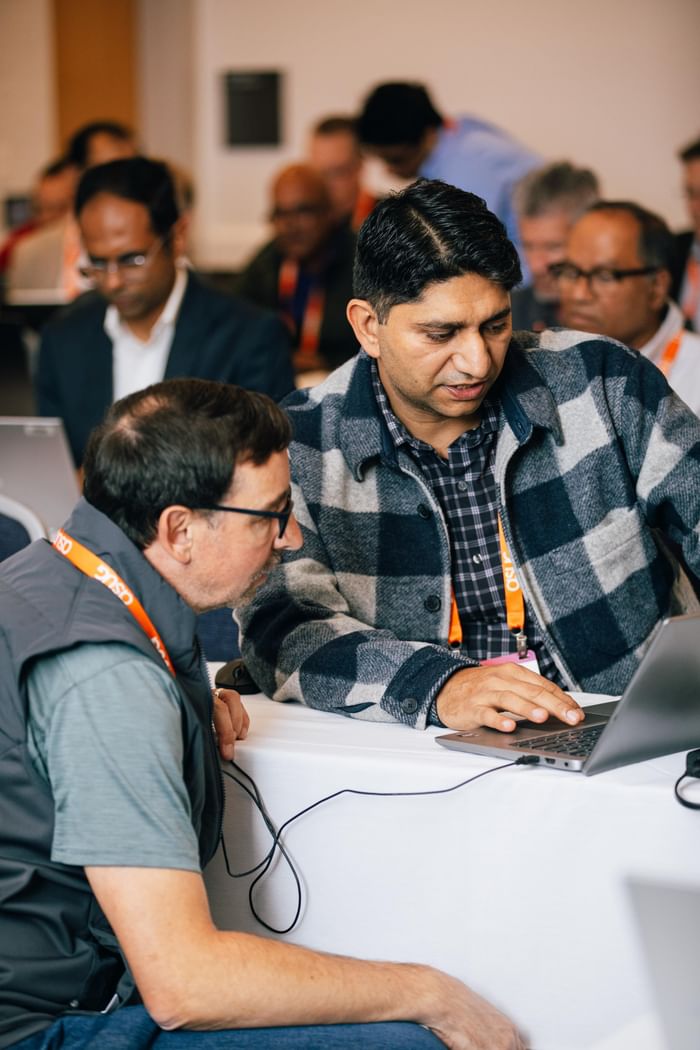
I mentioned upfront that there were distinct differences at Sapphire this year. One of the key differences was far less tire-kicking. I can think of only one incident where a person came to our booth and asked “So, what do you do?” Customers came to us with much clearer end goals in mind, along with very specific challenges that they knew would impede progress toward those goals.
Another noted difference was that, unlike in prior years where the focus was almost entirely on functionality, this year there were far more questions (and concerns) about data. While the level of true understanding about what AI is and what it can do varies greatly, what appears to be commonly understood is that the adage “garbage in, garbage out” applies. Prior analytics and “big data” projects have left customers with big price tags and no ROI, and none of them want to be a part of the AI business case failure percentages recently highlighted by McKinsey and Harvard Business Review. They know their data is in bad shape, and they know it is not just an SAP data problem. They have data challenges within a host of legacy applications that have to be dealt with before pouring millions of dollars into generative AI solutions.
Going About Transformation the Right Way
A final difference was the acknowledgment that the clock is ticking. Candidly, nobody had been concerned about the 2027 support deadline until recently. The customers I spoke with at previous conferences believed that either SAP would eventually cave in and push the deadline out, or that they would be finished with their transformation projects in time. Neither has happened. Project timelines continue to shift right while archaic approaches remain long and risk-laden. SAP does not show any signs of blinking, but this latter point isn’t the reason customers are growing concerned about time.
The real reason is FOMO (fear of missing out). Early adopters of SAP S/4HANA and advanced business technologies who went about transformation the right way are reaping the benefits in terms of higher margins. Companies don’t want to wait two, three, four years, or more to digitize and optimize. Shareholders aren’t that patient.
If there was or is any remaining confusion, it’s generally focused on approach. We heard some of the same concerns as last year about what to do first, when, and how. SAP S/4HANA prerequisite projects, cloud moves, S/4HANA migration, selective data vs. all data, data harmonization, systems consolidation, archiving, legacy system decommissioning, etc. There is still the belief that everything has to be done in a linear, sequential manner, and this is simply not the case.
During Sapphire, SNP offered proof point after proof point that the legacy SAP support deadline could become a non-issue within six to nine months, that all the aforementioned activities could be executed in a single go-live, and that the only limits to rapid transformation and business benefit were those imposed by cultural impediments, not technology.
Ask five people their opinions about SAP implementation and optimization approaches, and you’ll likely get seven responses. We know the nature of this industry all too well. Customers today are smarter, more digitally savvy, intellectually curious, and dare I say pragmatic. They exhibited these traits to my colleagues and our SNP team in Orlando this year. This combination of characteristics typically results in good conversations and, more importantly, rapid action.
Did you experience the same at Sapphire 2024? Something completely different? Let’s talk about it. Email me at darren.shaw@snpgroup.com.
See you next year!
Darren L. Shaw, North America Vice President of Marketing
This article was brought to you by SNP Group. ASUG develops and publishes insights regularly in partnership with its members and customers. For more information on ASUG sponsored content, contact editorial@asug.com
You Might Be Interested In
Log in to save this article and keep your favorite resources in one place.
Log in to save this article and keep your favorite resources in one place.

Log in to save this article and keep your favorite resources in one place.

Log in to save this article and keep your favorite resources in one place.