Log in to save this article and keep your favorite resources in one place.

As technology leaders across the SAP ecosystem explore ways to better plan and strategize to optimize their business performance, Intel’s expertise in driving SAP success has emerged as a powerful enabler for enterprise-level innovation.
Building upon decades of co-innovation, the partnership between Intel and SAP reflects a shared vision of providing transformative solutions for customers, bringing together Intel’s cutting-edge hardware and SAP’s robust software capabilities to deliver unparalleled performance, scalability, and efficiency.
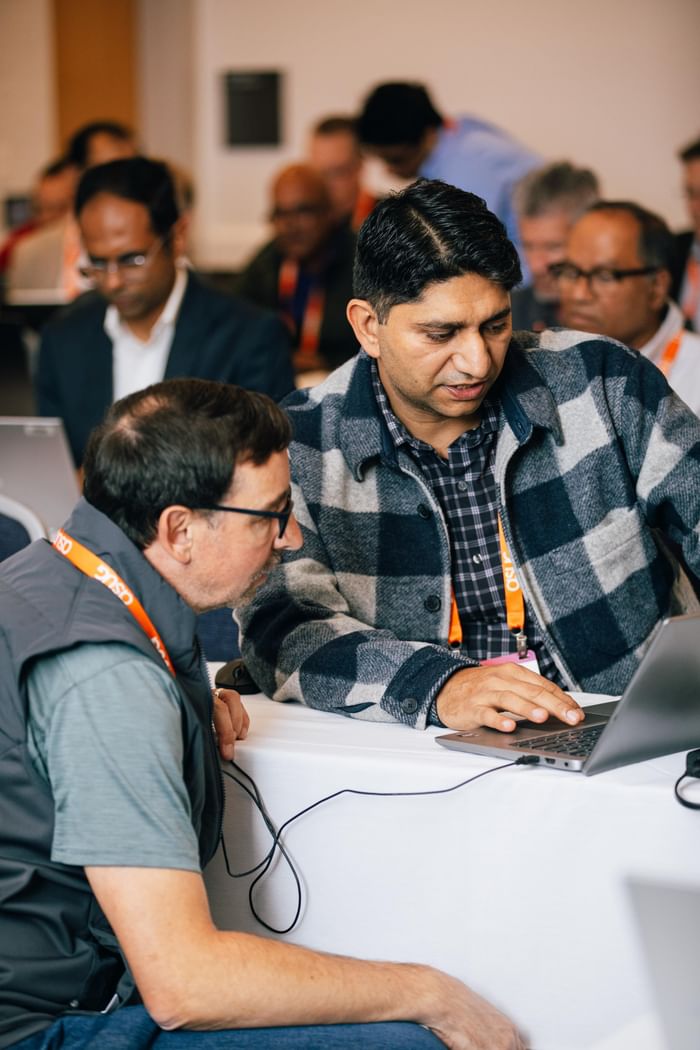
Together, Intel and SAP can help enterprises to unlock growth, agility, and competitive advantage across various industries. The strength of this alliance was on full display at SAP Sapphire & ASUG Annual Conference in 2025, where 13,000 members of the SAP community converged on Orlando in hopes of learning better how to bring out the best in their businesses.
At the outset of the event, ASUG and Intel brought together experts from the community to discuss their strategic planning, success stories, and the power of enterprise partnerships to ensure shared customers can navigate the emerging challenges of a modern world, from confidential computing and complex digital transformation to cloud ERP and generative AI.
These interviews, jointly released by ASUG and Intel as an exclusive video series, provide critical insight into topics shaping the future of enterprise computing, including the zero trust architecture security framework, unique customer-data-center options for deploying SAP Cloud ERP, and the areas—from AI to memory systems, computational storage, and security—where Intel is pushing boundaries for SAP customers.
Bringing together leaders from SAP, Intel, Microsoft, HPE, Energy Transfer, Deloitte, and AWS, these videos are essential viewing for enterprise professionals now in the process of pursuing technology modernization.
Protecting Your Data in Use: Understanding Confidential Computing
As SAP customers seek to protect their landscapes against cybersecurity threats, especially while migrating critical workloads to the cloud, many are moving to adopt confidential computing solutions. To effectively address the security needs of enterprises running SAP cloud applications, Intel and SUSE are collaborating to encrypt “data in use,” protecting not only application and infrastructure layers but the underlying systems as well.
At the heart of Intel and SUSE’s collaboration is the “zero trust infrastructure” security framework, also known as a “never trust, always verify” approach. In an interview at SAP Sapphire, Brent Schroeder, Head of the Office of the CTO, CTO Americas at SUSE; Diego Akechi, VP of SAP Solutions at SUSE; and Jan Krueger, SAP Account Director and CTO at Intel, discuss how the partnership between SUSE and Intel has guided the evolution of confidential computing while building security assurance with shared customers. Learn more.
The Power of Choice in SAP Landscapes
Given the depth and strength of the partnership between SAP and Intel, reflecting on the evolution of collaboration between these two technology leaders serves as a productive lens through which to examine the evolution of the SAP HANA database.
20 years ago, SAP and Intel embarked on a mission to develop an in-memory database that could revolutionize the ERP market, delivering unparalleled business value through the high performance that only processing data directly in-memory could allow. With Intel’s Xeon processor family providing the requited compute and acceleration capabilities, as well as unmatched resilience and security, to support the data growth of the SAP customer base, engineers from SAP and Intel have worked closely to deliver game-changing results.
In this interview, Stefan Bäuerle, SVP, Head of BTP, HANA & Persistency at SAP is joined by Patrick Messmer, Account Director SAP at Intel, and Jan Krueger, CTO Team SAP at Intel, to reflect on the power of “Intel inside” in fueling SAP’s transformation into a cloud company, the AI capabilities available in SAP HANA that Intel supports, the recent SAP-landscape revolution ushered in by Intel’s Xeon 6 processor family, and much more. Learn more.
The Power of Three: Unlocking Synergies in the Age of AI
As today’s enterprise leaders work to modernize and update their technology infrastructure, balancing strategic and operational challenges with business imperatives is more important than ever before. As the AI revolution transforms the global technology landscape, global IT spending is surging; the importance within this wave of updating infrastructure around cloud computing, cybersecurity, and data analytics cannot be overstated.
In this interview, three technology leaders—Deb Bhattacharjee, Global Semiconductor COE and Senior SAP Leader at Deloitte; Jeremy Kloubec, SAP Global SI and Strategic Advisory Leader at AWS; and Akanksha Bilani, Global Sales Director for AWS GTM and Business Development at Intel—gather to discuss why leveraging infrastructure refreshes at this present moment is a winning approach for longer-term business growth and stability.
As business leaders navigate the demands of emerging AI technologies, these experts offer insights into moving to the cloud for scalability and security, integrating data sovereignty with economies of scale, and how the “power of three” represented by Deloitte, AWS, and Intel can unlock competitive value and unmatched performance for SAP customers. Learn more.
SAP's Best Kept Secret for Cloud ERP
With support deadlines fast-approaching, many legacy SAP ERP customers are still in the process of determining the best-available paths for their cloud migration. In this interview, experts from HPE and SAP are joined by Randall Grogan, Sr. Director IT SAP & Financial Applications at Energy Transfer, to discuss the reasons why this midstream energy leader selected SAP Cloud ERP Private Edition (formerly RISE), Customer Data Center (CDC) option, running on HPE infrastructure-as-a-service powered by HPE GreenLake, in their own datacenters.
As early adopters of SAP S/4HANA, Energy Transfer was committed to leveraging AI capabilities in cloud ERP, while also requiring a hybrid approach to SAP solutions that could provide robust governance, cybersecurity risk management, and a customized implementation strategy tailored to their needs and priorities. Through the CDC option, Energy Transfer has discovered a pathway for running mission-critical operations in the cloud through its own data center.
In conversation with Jim Loiacono, Global SAP Private Cloud Sales Lead at HPE, and Christian Blaim, Technical SAP Account Lead at Intel, Grogan compares the CDC option to the hyperscale cloud and reflects on the greater control, reduced risk, and seamless integration that distinguished his chosen solution. Learn more.
Deploying SAP with Confidence: Intel and Microsoft's Three Pillar Approach
To serve innovative growth for SAP workloads, Intel partners closely with Microsoft, with a focus on prioritizing “three pillars” of performance, resilience, and reliability. Designed for memory-intensive workloads, particularly SAP HANA, Microsoft’s Azure M-series virtual machine family offers large amounts of memory and processing power, making them an optimal fit for running SAP HANA and other large in-memory databases.
Built on fourth-generation Intel Xeon Scalable processors and Azure Boost, the M-series VMs can deliver improved performance for SAP workloads — making them a foundational example of the deep, long-lived engineering relationship between SAP, Intel, and Microsoft. In this interview with Bryan Hiestand, Global Cloud Manager at Intel, and Juergen Thomas, Partner Architect Lead at Microsoft, the two leaders reflect on the evolution of this strong, sustained collaboration and how the evolving hyperscale-cloud landscape has fueled key innovations in areas such as power consumption, Azure core deployment, and in-memory database platform development. Learn more.
You Might Be Interested In
Log in to save this article and keep your favorite resources in one place.

Log in to save this article and keep your favorite resources in one place.

Log in to save this article and keep your favorite resources in one place.
Log in to save this article and keep your favorite resources in one place.