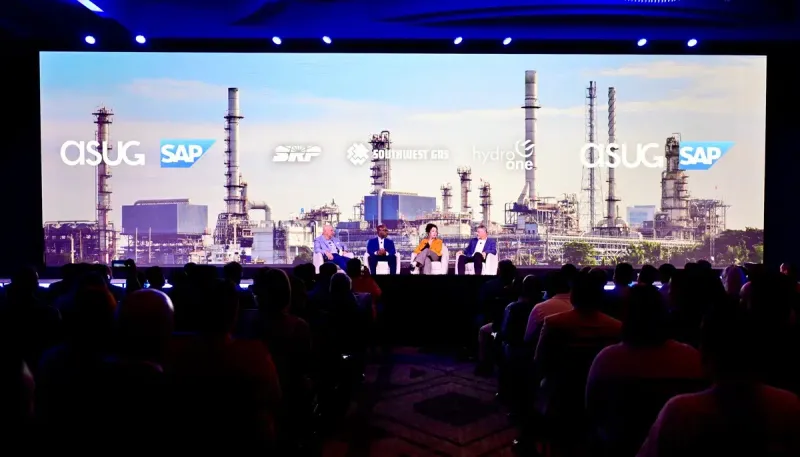
Last month at the SAP for Utilities, Presented by ASUG conference, utility professionals gathered to explore the latest innovations from SAP and share implementation experiences with their peers.
The topic of many discussions was SAP S/4HANA Utilities 2025, the latest release of SAP's ERP flagship for the utilities industry, which replaces the older IS-U solution and offers a new architecture with features like AI, cloud integration, and simplified processes. Addressing market deregulation, prosumer complexity, and rising customer expectations, the release particularly benefits from AI-driven service capabilities, streamlined architecture, and enhanced analytics capabilities.
AI-Powered Customer Service Takes Center Stage
One important feature in this release is the Utilities Customer Self-Service Agent powered by Joule. This intelligent agent is capable of accessing the full range of customer information within the system—from contract terms and rate structures to usage history and product portfolios—delivering informed, real-time responses to natural-language queries.
Market deregulation and prosumers have multiplied the complexity of customer inquiries, driving up both inquiry volumes and service costs. The Joule Agent aims to acknowledge the realities of this pressure by delivering fast responses in multiple languages without compromising service quality. General availability is slated for Q4 2025.
SAP also added Joule Co-Pilot for documentation search. Users ask questions in plain English and get instant answers from SAP Help Portal content, eliminating the need to hunt through technical documentation.
Simplifying the Tech Stack
SAP's clean core strategy comes to life by integrating two major add-ons directly into S/4HANA Utilities, eliminating separate installations and simplifying how systems connect.
Market Process Management for Utilities is now part of the core S/4HANA Utilities system. Companies can run supplier switches, exchange meter data, and manage internal service orders all in one place. The Application Process Engine handles the back-and-forth with smart meter systems and market partners. When regulations change, process versioning keeps everything compliant without rebuilding workflows from scratch.
Prepayment for Utilities also moves into the core. Everything about a prepayment customer—their usage, payments, and any outstanding debt—lives in a single document. The system watches account balances and acts when they hit certain levels: sending payment reminders, flagging potential disconnects, or triggering reconnections once payment is received. The approach works whether customers have smart meters or older equipment.
Smarter Sales and Contracts
The Sales Integration Interface received several practical upgrades. The system now restarts automatically when temporary disruptions occur. Sales orders have also been simplified. Companies can process them using device serial numbers and sold-to-party addresses instead of requiring installation IDs.
Sales teams gain more pricing flexibility through one-time discounts applied directly in condition records. The system handles locked object calls automatically, retrying after a set waiting period rather than failing.
The Utilities Product Integration Layer now supports price guarantees through enhanced appointment management. Companies can configure guarantee periods at the UPIL level and manage period control data with greater precision. New customization options for date fields improve management of contract durations, renewal timing, and related data.
Extending Without Breaking Things
SAP's key-user extensibility approach lets companies customize while preserving system health. Customer Fields and Logic functionality now extends to Point-of-Delivery master data and BPEM clarification cases. Business users can add custom attributes and implement specific logic using ABAP for key users while maintaining the clean core philosophy that keeps upgrades smooth.
Business Events for technical objects provide clean integration hooks for external applications. The release adds business events for six technical objects: premises, connection objects, device locations, installations, devices, and points of delivery. These events notify connected applications whenever one of these objects changes. Utilities can integrate third-party systems without adding complexity to their core architecture.
The Business Partner Financial Overview app added a budget billing plans facet, displaying documents from statistical procedures, partial bills, payment plans, and payment schemes in one place. This enhancement surfaces industry-specific data directly where users need it.
Integration with SAP Datasphere unlocks utilities sales contract data for comprehensive analytics. CDS views pull contract details, product information, and order data, feeding into SAP Analytics Cloud for business intelligence that supports strategic decision-making.
Key Takeaways
This release gives utilities companies the operational foundation they need to keep pace with market transformation. AI-driven service, simplified systems, flexible commercial operations, and clean extensibility are all designed to deliver capability without accumulating technical debt. For utilities planning their digital roadmap, the 2025 innovations warrant serious consideration.