Log in to save this article and keep your favorite resources in one place.
You’ve likely heard that you need to move to SAP S/4HANA by 2025, but do you really know what it is or why it matters to your business? There are constant advances in technology that come in all shapes and sizes, leaving organizations to figure out what’s important for them to do now and what can wait for another day.
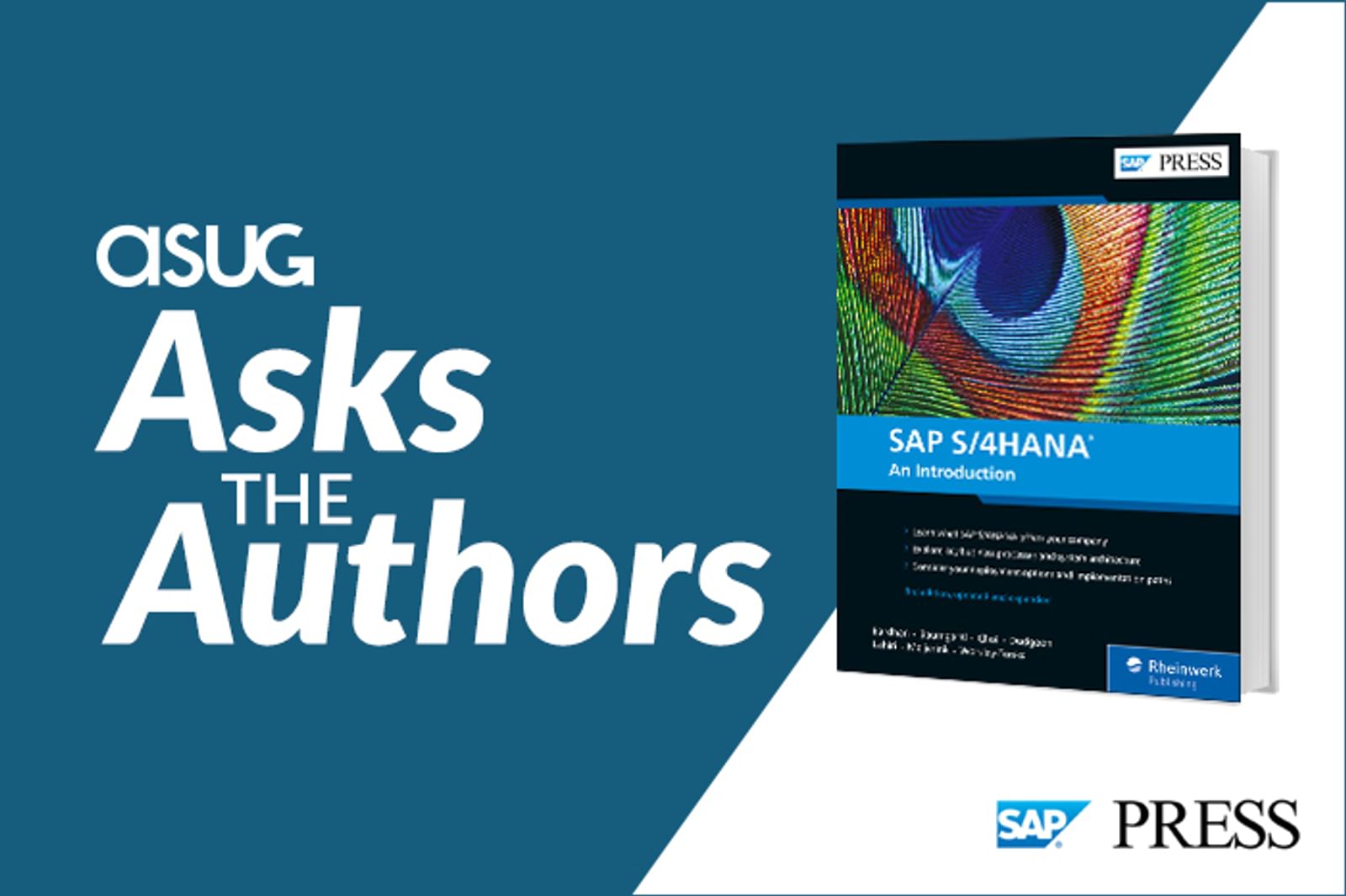
ASUG News sat down to ask the authors of “SAP S/4HANA: An Introduction,” a book from SAP Press, to share their insights about what makes the latest ERP system different and what value it brings to SAP customers. Andrew Worsley-Tonks, SAP chief architect and global SAP S/4HANA transformation lead for IBM Services and Asidhara Lahiri, CTO for SAP Application Development and Maintenance Innovation, in IBM Global Services, walked us through how to define the business value for SAP S/4HANA, build a business case, and understand the how the entire SAP S/4HANA landscape fits together.
Sharon: What is the most significant change customers can expect when moving from SAP ECC or an older system to SAP S/4HANA?
Asidhara: The most noticeable change customers will experience are the benefits that come with running on SAP HANA, which is an in-memory database. In addition to a single source of truth and increased speed, you will have access to real-time data processing, which leads to informed decision-making.
Sharon: What business value does SAP S/4HANA bring?
Andrew: Let’s talk about the value drivers starting with the technical ones. There are three that I want to discuss. The first being the in-memory platform — SAP HANA database — which allows speed. The second driver is the simplification at the core, which eliminates functional, technical, and data redundancies. The third driver is around user experience and design. With the introduction of SAP Fiori, you get simplified and improved role-based processes.
When we look it from the business side, we think about the customer-centric experience it can help you create. SAP Fiori apps provide a single entry point for all users to work from any device and they are simple and seamless to use.
You also gain business value from customer insights that help you make better decisions. Through digital transformation, it’s not only important to improve the user experience, but also to better understand customer behavior so you can offer a tailored service or product. Collecting data, making it available in real time, and creating actionable results based on the analysis and prediction of that data is key.
The in-memory database, along with the simplified data model allows for a single platform across the different line of business solutions with one copy of data and less integration effort. These insights are available in real time to help drive better decisions.
Sharon: What key points would you highlight in a business case to switch to SAP S/4HANA?
Andrew: There is no single answer to this question, as each organization will need to define its own business case. One thing that will be true across the board is that SAP S/4HANA powers an organization’s digital transformation and its ability to create future-proof business models.
When you build your business case and justify its components, you need to make sure that you know your audience. Frame the opportunity in terms of the scope and business objective, considering what the people who will be reviewing and approving it will want to know.
More importantly, rather than just focusing on some of the SAP S/4HANA value drivers I just discussed, make sure your business case is aligned to your company’s strategic vision. Your business case should connect directly with your ERP and IT road map.
Sharon: Can you briefly describe each of the different deployment options for SAP S/4HANA? What should a customer consider when deciding which option is best for them?
Andrew: There are three deployment options: On-premise, cloud (public or private), or hybrid.
Let’s start with on-premise, which gives organizations full control over the hardware and software, as well as maintenance and upgrade schedules. It is an internal platform and is more of a traditional SAP S/4HANA client management solution where you have flexibility and control over customizations.
The cloud deployment option breaks into two more choices: private or public cloud. If you’re running on a private cloud—SAP Cloud Platform or a partner-managed cloud — this is similar to the on-premise version. You have control of the application. You can do thorough configuration and customization, and you can install what you want onto your SAP S/4HANA platform.
The public cloud option, which is a multitenant choice, is a software as a service (SaaS) model where there are quarterly updates that you must take on. It is a fit-to-standard approach, and therefore a very different SAP S/4HANA system in terms of functionality, maturity, objectives, and so on that clients need to factor in.
The third deployment is the hybrid option, which is a combination of both on-premise and cloud deployments.
When it comes to what’s the right way to decide, I think you need to look at understanding your existing pain points and business challenges. What are you trying to solve with SAP S/4HANA and would any of these deployment options help achieve that? Are you looking at a fit-to-standard approach? Is standardization one of your key priorities? Do you really want to run SAP as a SaaS model going forward? Are industry solutions a component for you? What about your security? Do you need customized processes or not? You need to ask all of these these questions factor the answers into your decision.
Sharon: How can customers keep up with new functionalities available in SAP S/4HANA Cloud? What are some compelling reasons why customers would want to deploy in the cloud?
Asidhara: SAP S/4HANA Cloud has quarterly releases with different functions for different countries being churned out continuously. SAP offers What’s New Viewer, an online resource to help you understand what the current release includes.
As for why customers should consider SAP S/4HANA Cloud, it comes back to innovation. SAP is focused on pushing out all innovations through its cloud solutions first. The cloud option provides a fit-to-standard solution implementation with very few customization requirements and allows for a faster time to market. Last, but not least, it is a more cost-effective approach.
Sharon: What kind of industry solutions are available and how do they help with an SAP S/4HANA implementation?
Andrew: SAP has made it a priority to provide more functionality within each new release of SAP S/4HANA. The goal is to move the industry solutions that once were add-ons to SAP ECC into the core of SAP S/4HANA. This allows users to apply multiple industry solutions on the same instance without causing conflict. This new approach is often referred to by SAP as the “industry-to-core” concept.
Some of the industry solutions available include oil and gas, retail, fashion management, aerospace and defense, automotive, and banking. All of these have different levels of maturity, and some of them have restrictions.The SAP notes highlight the restrictions for each of those industries.
One of the big differences here is that you’re in a position now to combine multiple industry solutions in SAP S/4HANA. So, for example, an oil and gas SAP customer can activate retail at the same time.
SAP is also looking to provide the ability to activate several business functions within some of these industry solutions that weren’t available before. So, when you look at what you’re getting out of SAP S/4HANA, it’s the ability to extend and expand what you can do with your ERP.
Sharon: How does SAP S/4HANA work with other SAP products and services such as SAP Ariba, SAP Fieldglass, SAP Concur, SAP SuccessFactors, SAC C/4HANA, and SAP Leonardo?
Asidhara: Today’s landscape is a hybrid of systems. You have SAP S/4HANA as the core, but then you also have all the SaaS products like SAP Ariba, SAP Fieldglass, SAP Concur, SAP SuccessFactors, and SAP C/4HANA. And then you have SAP Leonardo, which is a service that provides additional innovation solutions.
Each of the SaaS solutions address specific functions — network and spend management, people management, manufacturing and supply chain management, and customer experience — but can be combined in an intelligent suite. The true value comes with end-to-end integration.
Sharon: Can you summarize “SAP S/4HANA: An Introduction” in a couple of sentences?
Andrew: The book will help you navigate through your SAP S/4HANA journey. It helps you understand how and where to start, how to build your business case, and what functionality is available based on the release you’re trying to move toward. It also helps you understand what the best adoption options are for you, and then which methods are available as part of the deployment.
The book is really your one-stop shop that covers your SAP S/4HANA road map from start to finish.
ASUG Members can log into their accounts to get their discount on the SAP S/4HANA: An Introduction book from SAP Press. If you’re planning to attend SAPPHIRE NOW and ASUG Annual Conference, don’t miss the day of learning about Moving to SAP S/4HANA, A Practical Discussion, an ASUG Pre-Conference Seminar. Register today and save your spot.
You Might Be Interested In

Log in to save this article and keep your favorite resources in one place.

Log in to save this article and keep your favorite resources in one place.

Log in to save this article and keep your favorite resources in one place.

Log in to save this article and keep your favorite resources in one place.