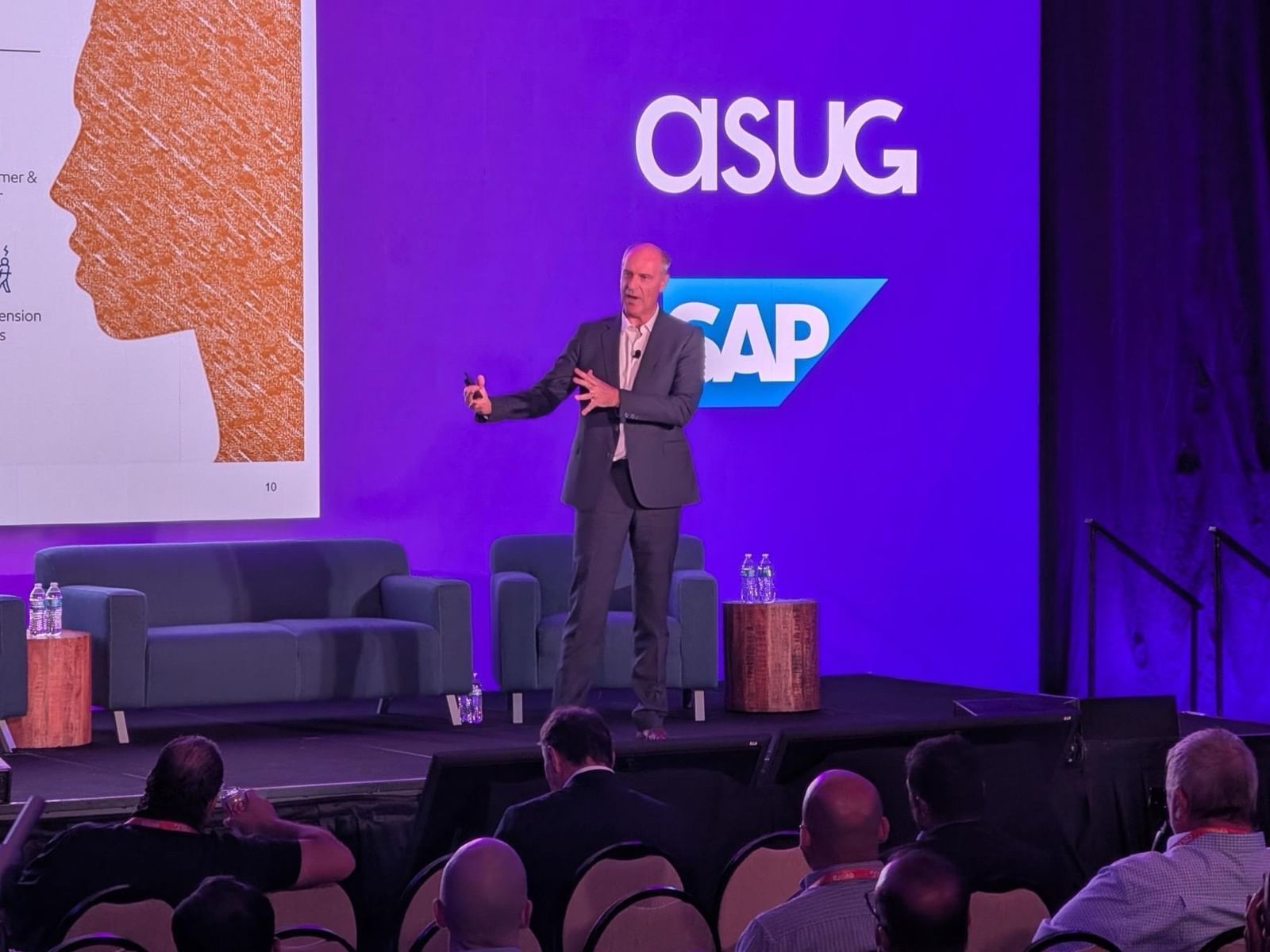
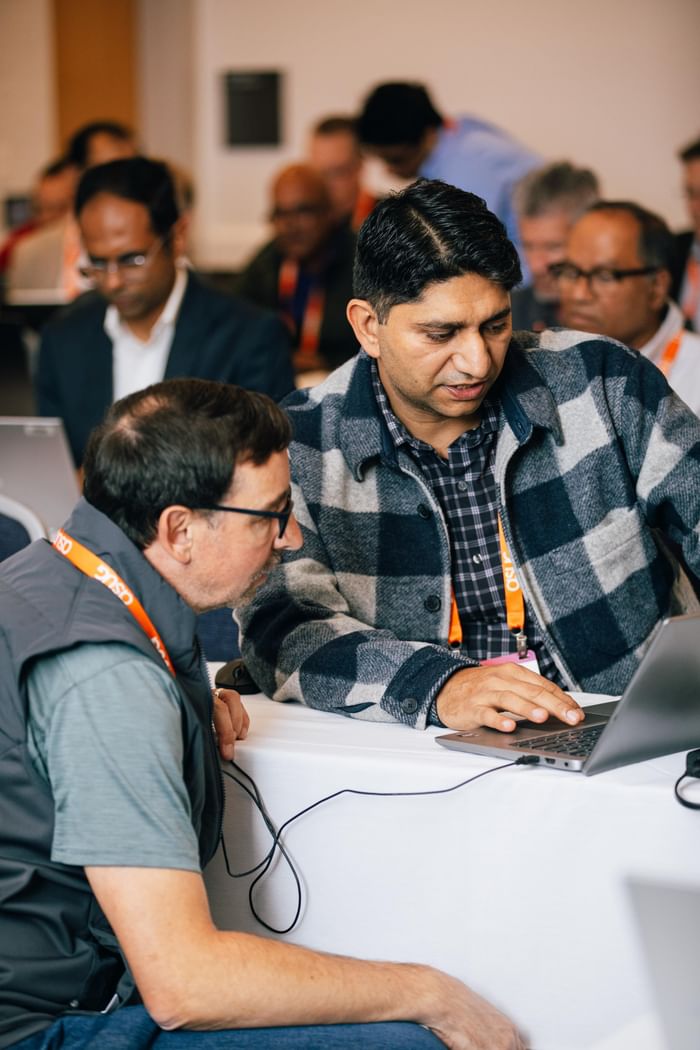
Leaders from across the oil, gas, and energy industries gathered in Houston last week for the ASUG Best Practices for Oil, Gas, and Energy conference, a destination gathering for SAP professionals across North America.
Customer journeys, expert insights, and SAP roadmaps were key areas of focus at the three-day event, providing attendees with numerous opportunities to learn how SAP technology is driving resilience, efficiency, and sustainability at today’s leading oil and gas companies. As these industries navigate the complicated landscape of digital transformation, the conference showcased oil, gas, and energy companies that are modernizing their operations to achieve operational excellence while ensuring reliable and affordable energy for their customers.
For the event’s opening keynote, experts from SAP and ExxonMobil took the stage, including:
Kurt Aerts, Director of Plastics and Product Life Cycle at ExxonMobil, who shared how his organization shifted mindsets, aligned data, and tapped process owners to achieve digital transformation.
Stephane Lauzon, Head of Oil, Gas, and Energy at SAP, who led the panel discussion while sharing a demonstration of Joule capabilities in field logistics for oil and gas.
Sumanth Gurumurthy, SAP’s Managing Partner with the ExxonMobil team; and Klaus Borkenstein, Head of Product Management for OG&E at SAP, both of whom participated in a discussion with Aerts on how ExxonMobil’s transformation project is influencing the product roadmap at SAP.
New Capabilities, Requested by the Customer
Kicking off the opening keynote for ASUG Best Practices: Oil, Gas, and Energy, Lauzon demonstrated new SAP solution capabilities for the oil and gas sector, which he stated has been designed collaboratively with SAP customers.
“We’re very privileged, actually, in oil and gas, because our industry capabilities—we like to say—we build with customers, or ‘with industry, for industry,’” Lauzon explained. “This is the industry that has been driving a lot of that discussion, in terms of our development roadmap capabilities.”
Lauzon started off with dedicated Joule capabilities available in Field Logistics for SAP S/4HANA Cloud Private Edition, showing how the AI copilot enables customers to fetch current quantity, location, and other details for stock and non-stock items, gaining greater visibility of available materials across different purchase orders. This functionality, delivered within the last few months, enables oil and gas companies working within SAP’s existing Field Logistics application to leverage Joule functionality to see their supply process, from first demand to work order, to aligning materials, and even returning or redeployment.
“Field Logistics is really helping you understand, from a supply process but also from a return process, how you move equipment and material: from your first demand signal, whether it's a project or a work order, and then how it moves out to your remote location — and for things that you’re not consuming, then you want to be able to return it back and possibly redeploy it or return it to a given vendor,” Lauzon explained.
“For example, if it’s a rental, you certainly want to know that you’re returning it. You want to not just know when you started your payment but most importantly know when to stop that payment,” he said.
Within SAP Service and Asset Manager, customers had requested the ability to view inventory, warehouse activities, and field logistics remotely. SAP worked to fulfill this request over the past year, and this feature is now available, Lauzon added.
Within the area of services procurement, another update requested by oil and gas customers has also led SAP to combine materials or goods with services—which had historically existed in two different documents, as two different objects—a single document that can represent either. Users can build out their hierarchies through the entire end-to-end process, and more capabilities for service entry sheets now allow for comments and documents attached not only to headers but also line items, while new capabilities around limits have been introduced for those as well.
ExxonMobil Prioritizes Industry Best Practices
During his keynote address, Aerts gave a detailed overview of how ExxonMobil has accelerated business transformation at scale across the past few years, highlighting that success with any large-scale transformation requires engagement from stakeholders across the enterprise. In his role, while specifically involved with ExxonMobil’s approach to plastics and their sustainability strategy, Aerts worked to coordinate the business side of the project, working closely with IT to turn their shared vision of agility and operational excellence through cloud transformation into a reality.
Historically, ExxonMobil’s technology landscape had included a dozen SAP-run ERPs that were highly customized due to vendor gaps, country requirements, and specific business requirements that accumulated over the years. These complex systems made it difficult for ExxonMobil to upgrade technology capabilities and unlock data-driven insights globally.
According to Aerts, ExxonMobil is currently using RISE with SAP to harmonize data and enhance agility while pursuing cloud transformation. Throughout this process, the company has streamlined core processes and adopted cloud-based innovation to bring its technology stack into the future — and be ready for whatever comes next.
As the largest U.S.-based oil and gas company, the enterprise had much to consider: numerous lines of business (LoBs), $350 billion in revenue, $450 billion total asset value, and 60,000 employees. How Aerts and other key stakeholders approached widespread transformation was important. “You don’t do this in one big go; you actually make this part of a big strategic activity,” Aerts explained.
That activity started back in 2017, when Darren Woods came on as CEO and began pivoting the way ExxonMobil’s teams worked internally to establish a more centralized organization supporting end-to-end value chains. Aerts cited this focus on value chains as one key to earning buy-in from business stakeholders and making transformation possible.
Process transformation was another piece of the puzzle, standardizing processes to align with industry standards and best practices. “Why would that not apply to ExxonMobil?” Aerts reflected.
Decision-Making Power, Shifting Mindsets
Change management at ExxonMobil helped to drive this digital transformation process.
As part of standardizing processes, the company created enterprise process owners to wield decision-making power. “Otherwise, you tend to end up with a negotiation, you tend to end up with a consensus, and then you’re optimizing,” Aerts said. “You’re not transforming.”
Rather than optimize processes in silos, the company’s leaders encouraged its teams to be open to industry best practices, consider doing away with pre-existing processes, and work together to integrate processes across the organization. Tension points arose throughout the process, which was an added benefit, according to Aerts, because they revealed specific issues the organization needed to address.
Next, change leaders tackled data transformation processes to harmonize the enterprise’s data structure and simplify the system landscape in a cloud environment. By doing so, they aimed to improve both the user experience of the employee to eliminate low-value work and the experience of suppliers, vendors, maintenance contractors, and logistics providers.
Change at scale was only possible at ExxonMobil when business leaders started operating as one team. Between LoBs, vendors, data providers, and trusted partners, all had to work together, with shared priorities and goals, to achieve successful enterprise-wide transformation.
Additional key milestones in ExxonMobil’s on-going transformation, as noted by Aerts, included:
Global process design phase that looked at 10 process areas and industry standards, started in 2023
Detailed design and build phase, with testing and data conversion, communication, and training all happening in parallel to the project
Early deployment using a transition state, learning lessons along the way, with the full ERP ecosystem changeover happening 2026-2028
For its financial reporting, ExxonMobil needed to streamline its 1,400 company codes and 15,000 profit centers present across its existing 12 ERPs. In seeking a solution to this large-scale issue, ExxonMobil leaders decided to establish the future data structure first, using industry best practices as a guidepost to achieve group reporting.
“The outcome is making sure that your data mapping and your data structure is solid. The system will come afterwards,” Aerts said.
Out-of-the-box functionality will help with achieving industry standards and best practices, but ExxonMobil’s data consistency has proved challenging, he added. Strong data governance is helping to guide the enterprise forward in its data strategy.
Initially, the company had also set its sights on a 90% clean core, seeking to minimize customizations at every turn, yet it has exceeded this lofty goal—now running at 96%. To achieve this, ExxonMobil collaborated closely with SAP on security and operational checks, as well as seeking input from SAP on clean core guidance with the future of its digital landscape in mind.
Partnership as a Program Pillar
Following ExxonMobil’s presentation, Lauzon invited Aerts back to the stage alongside Sumanth Gurumurthy, SAP’s Managing Partner with the ExxonMobil team, and Klaus Borkenstein, Head of Product Management, OGE at SAP, for a deeper discussion on how the transformation program and product roadmap are advancing in lockstep.
Asked about critical success factors, Aerts named three. First: “commitment from the top,” he said. “This is part of a corporate strategy. This is part of a corporate priority. There is no opting out.” Second: clear decision rights in a matrix organization to avoid unproductive churn. Third: governance that embeds partners like SAP at every level.
That governance extends to roadmap acceleration—an unusual dimension for a transformation program. Roadmap acceleration means ExxonMobil is helping to shape what SAP builds for its estate, rather than just implementing what already exists in a standard format. Borkenstein described how the system-integrator, ExxonMobil, and SAP project teams continue to collaborate in design workshops to establish fit-to-standard principles and filter requirements.
What tends to emerge from those design workshops are “perceived functional gaps,” which SAP’s customer engagement services team assesses before making what Borkenstein called a “disposition decision.”
“We have so far accepted more than 160 roadmap acceleration [areas of focus,”] Borkenstein said, “and of those, more than 50 have already been delivered,” with more planned through 2027. The scope spans industry-specific capabilities like PRA (production revenue accounting), IS-Oil, and field logistics—including document AI for what Borkenstein called “zero touch data management”—as well as broader investments in service procurement, APM (asset performance management), and SAP Ariba Category Management.
Joint testing sessions on enterprise asset management, procurement, and field logistics have helped to create “multipliers” and “ambassadors” within the organization, Aerts noted, further accelerating adoption.
Measuring What Matters
When the discussion turned to metrics, Aerts emphasized both the necessity and the risk contained within certain KPIs. “You get what you measure,” he said. “And so we need to make sure that these metrics obviously illustrate the right commitment—the skin in the game—but they also drive, overall, the right behavior and the right outcome.”
Transformation programs typically involve three conflicting priorities—quality, cost, and schedule—and alignment around which matters most is essential to avoid optimizing the wrong area. ExxonMobil tracks both outcome metrics that reflect transformation ambition and process execution metrics that monitor progress. The latter includes detailed design and build completion, testing performance, and integrated change management milestones.
Vendor delivery, including SAP’s road map commitments, receives the same scrutiny. Once ExxonMobil and SAP agree that certain gaps belong in the roadmap and commit to delivery windows, both sides follow through with disciplined monitoring.
Gurumurthy described the governance supporting this process, noting the complexity of planning consumption and testing across RISE with SAP S/4HANA Private Cloud innovations and public cloud releases like SAP Ariba and APM. Another challenge: scheduling upgrade windows within an aggressive program timeline moving at “100 miles an hour.”
People at the Center
While much of the discussion in this opening keynote focused on processes, data, and technology, Aerts made clear that transformation ultimately depends on people. “At the end of the day, it’s the people that matter, right? And the people will have to execute it.”
Change can provoke resistance, especially when transformation means significant shifts in how work gets done. ExxonMobil has put an integrated change management program in place that spans two phases. The front end captures changes during design, assesses impact by persona and audience group, and prioritizes them to inform communication and training plans. “We all know in communication, it’s seven times seven different ways,” Aerts said, “Make sure you don’t do it too early, but don’t do it too late.”
The second phase, management of change, translates those plans into detailed execution. Some items have long lead times, like reopening customer contracts to standardize service levels; others cluster closer to cutover, like updating access rights, process documentation, and business continuity plans. ExxonMobil’s value chains and centralized organizations will execute the management of change, with the project providing best practices, measuring progress, and stepping in to resolve obstacles.
“The first question that they will have is, typically, ‘What’s in it for me?” Aerts said, “Clearly, we need to make sure that we take that into account.” Getting people through the change curve quickly and sustaining their engagement will determine whether the transformation delivers its intended business value.
Closing the afternoon session, Lauzon highlighted the growing role of AI across SAP’s oil and gas portfolio, noting that Joule will serve as the front-end foundation for agentic AI capabilities. SAP recently announced 14 new agents across finance, supply chain, and procurement, with more on the way for commodity trading, asset management, and field operations.