Log in to save this article and keep your favorite resources in one place.
As advancing technology continues to push enterprises in the SAP ecosystem to modernize their operations, shift to cloud environments, and adopt AI solutions, the role of the enterprise architect (EA) is becoming increasingly vital.
To differentiate themselves from other technology professionals and find success in such rapidly evolving times, enterprise architects must not only ensure their technical expertise but elevate soft skills related to communication and collaboration, ensuring that they can look at their businesses holistically.
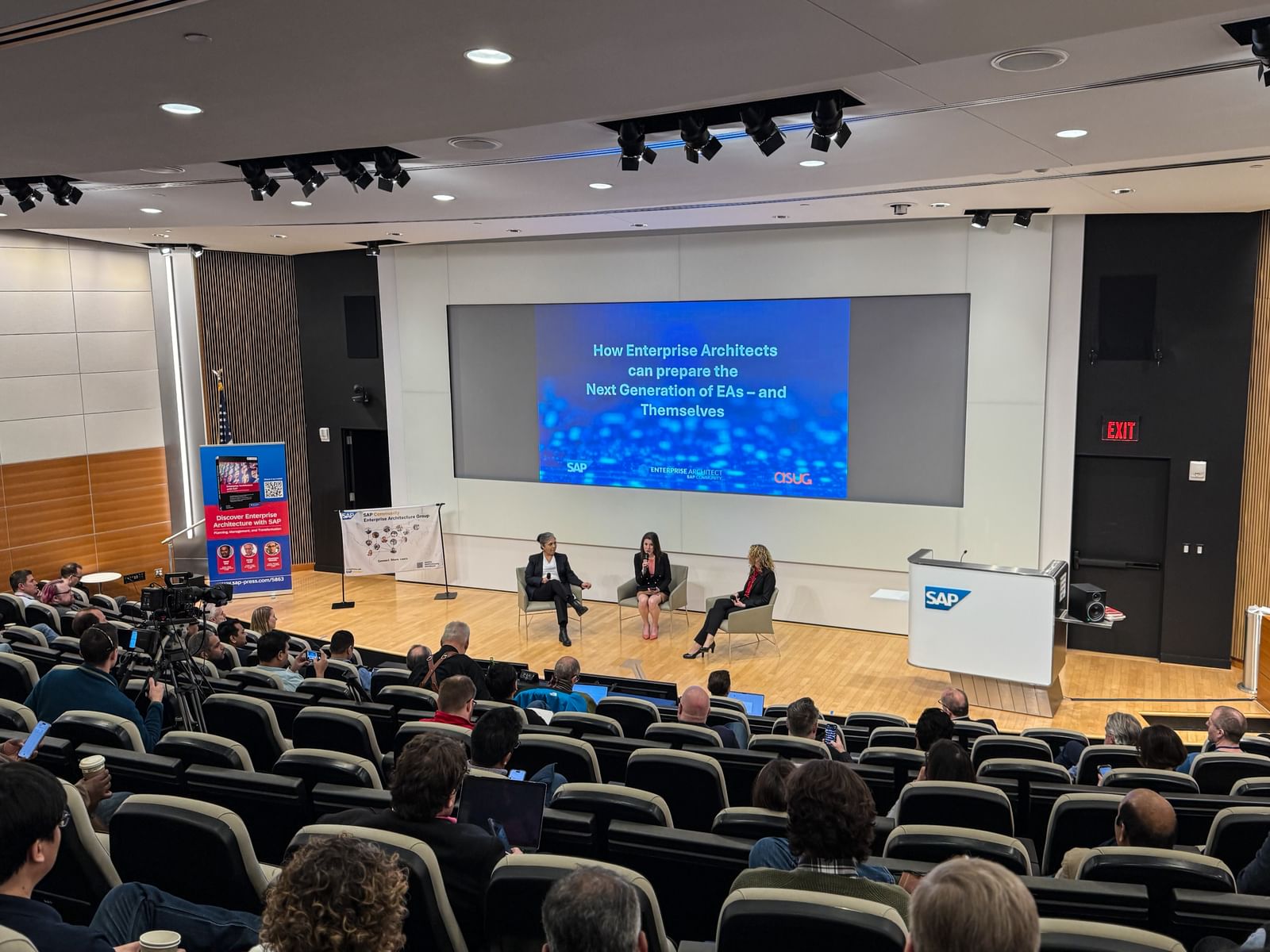
At the recent, three-day Next Generation SAP Enterprise Architect Summit, hosted at SAP’s North American headquarters in Newtown Square, Pennsylvania, three experts in enterprise architecture—Michele Krom, VP of Enterprise Architecture Northeast at SAP, Claudia Fernandez, Director at Deloitte, and Whynde Kuehn, Founder and Managing Director at S2E Transformation — dedicated a panel discussion to exploring what lies ahead and the essential skills that EAs need to excel.
Intentional Business Design Amid Change
In guiding the discussion, Kuehn first recommended that enterprise architects ask themselves a foundational question: “What are the forces of change that will impact this role?”
One such change, she outlined, involves the discipline of business architecture and how such a holistic framework for understanding and designing an organization’s structure, processes, and information flows has become more relevant for enterprises eager to align strategic objectives with operational realities amid business transformation.
From growing adoption of business architecture practices across organizations to the way in which organizations are then ingraining those practices to establish a discipline for more roles throughout the business, increasing awareness of the strategic value that business architecture can bring is opening the door for greater collaboration across companies.
For example, businesspeople are increasingly turning to business architecture practices when considering strategy, execution, and transformation in their roles, given how frameworks can unlock synergies and drive results.
“There’s opportunity to lean into intentional and integrated business design,” Kuehn said. This goes beyond mapping, instead also weaving together people, processes, and technology in support of those business models and their strategic evolutions.
As a business scales, it can become fragmented in its design. Kuehn shared that there are opportunities to step in and design businesses more intentionally, through interdisciplinary collaboration. “A true business architecture fluency involves thinking business first, not as an afterthought,” she said.
The enterprise architect can specifically bridge the gaps between silos of a company, using an understanding of various disciplines to better create an organizational and experience design. “It’s almost a renaissance set of skills to open our minds as architects,” she said.
Krom added that, when enterprise architects can bring together multiple disciplines and different points of view, they can view a solution more holistically. “It’s all to make sure we’re looking at it from all angles and not missing a perspective or missing a view, so that what we bring forward is the best collective product that we can,” she said.
Knowledge sharing in a culture also produces excited, engaged team members, the panelists reflected, which can bring out the best in a business and add further value. “When we put our heads together, we’re better,” Krom said.
Soft Skills to Help EAs Excel
Throughout the Next Generation SAP Enterprise Architect Summit, various sessions addressed recent developments in SAP technology, such as the announcement of SAP Business Data Cloud. As always, with new solutions rolling out, technology professionals must work hard to keep up with the pace of change.
“I felt a little bit of frustration,” Fernandez acknowledged. “There’s another solution? What do I do with my existing landscape? What does that mean for me?” Enterprise architects need to learn to be adaptable to provide those answers to business and IT stakeholders alike in the face of constantly advancing technology, she said.
Fernandez emphasized that an understanding of human psychology is going to be increasingly necessary for those in the profession moving forward. Particularly since the pandemic, mental health awareness in the workplace has become a more prominent part of team discourse at organizations across industries. Major disruptions — from the advent of work-from-home/remote employment to the implementation of new software solutions — always bring about charged emotions in stakeholders. “Being able to understand and communicate in a way that is calming and bringing in alignment will require some understanding of psychology,” Fernandez said.
Effective communication is another soft skill that will prove important, especially as it relates to storytelling, which is at the core of the EA profession.
In the past, enterprise architects often worked with little information housed across an organization in disjointed ways. But in the future, as organizations move to the cloud and data becomes more centralized, there will be too much information at everyone’s fingertips, Fernandez said. The enterprise architect will need the proper skills to effectively tell a story and summarize information succinctly for executive-level stakeholders.
Krom echoed these sentiments. The enterprise architect is most successful in their role when they can influence the business into making decisions that truly align business needs with IT requirements; “where we spend our time and energy is going to require more of those soft skills” to accrue that level of influence, she said. Krom also emphasized that research skills will take on greater importance.
As artificial intelligence becomes more established in the tools that enterprise architects use, EAs will benefit from knowing how to leverage it in the moment. But they also need to have the research skills to verify the output that AI models provide, rather than simply trusting the algorithm.
Developing Talent Accordingly
Fernandez added that the education provided to the next generation of EAs will need to change significantly in response to emerging trends in the SAP ecosystem.
Multidisciplinary and practical education, especially in universities, will be useful, the panelists agreed. Fernandez spoke of her personal experience, having attended high school in Bolivia; standardized in the curriculum were psychology and philosophy, which she found to be helpful for her career. Adding courses like these could similarly enrich the skillsets of candidates pursuing higher education in North America and Europe, she added.
In the workplace, developing SAP talent should also continue to be a focus. Fernandez advised doubling down on coaching, mentorship, and apprenticeship to instill a mindset and culture of continuous learning in emerging professionals.
Kuehn echoed the importance of practical education around these concepts and recommended architecture hackathons, even for grade-school learners, to introduce the idea of this career path early on. Applying an architecture mindset to help others, and leveraging those business problem-solving skills from the corporate world to help social organizations and initiatives to successfully start, scale and sustain, is a core aspect of Kuehn’s work at S2E Transformation, where she refers to the concept as “architecting for good.”
Architectural Tools
While many forces are contributing to changes in the role of enterprise architects, the tools that EAs use to complete business tasks are evolving in surprising ways, and success in this field is also dependent on a certain level of creativity in determining where to use emerging technology.
When enterprise architects talk with business users to understand requirements of various platforms, one historical school of thought has been to keep those conversations at a high level rather than diving deep into technical specifications, Fernandez said. But neuroscience tools that UX experts leverage principles and insights from to design better user experiences can similarly help to guide the thinking of enterprise architects; considering emotion and motivation, cognitive load, memory, and other types of neuroscience principles can help EAs think more deeply about what the end users need and want from their software.
Existing technology such as digital twins could also help enterprise architects to simulate a future state of a company’s software stack and walk future end users through it — much more effectively than a PowerPoint presentation, she added.
Diverse Thought, Great Product
“We all believe in the power of diversity and what it brings to us,” Kuehn told attendees, reflecting on her personal experience of working on a team of 100 business architects.
When hiring for a certain type of architect who could do it all, the team actually uncovered blind spots in their criteria for this envisioned role. Groupthink got in the way of building relationships across the business that were required for truly understanding what type of architect could best serve the organization’s needs, she said, and part of that stemmed from a need to prioritize principles of diversity, equity, and inclusion into their approach to hiring.
Fernandez spoke also about coaching she has done for women professionals, who have often said they feel like they’re at a disadvantage in the workplace and still have to advocate to ensure they’re in the relevant meetings to advance their professional goals. “First of all, take a seat at the table,” she said. “Share your ideas. And listen to other people’s ideas. That’s how you get a seat at the table.”
One observation the panelists discussed is how difficult it can be for young professionals to get noticed at work. But as a young, female, Latin business professional working in a paper mill in Canada, “I saw my being different as an advantage,” Fernandez said. As such, she worked to actively cultivate relationships and see her colleagues as allies who could support her success. Critical to her work in this regard was being inclusive of all around her.
“Yes, we can do diversity, and we need to have a place for everyone,” Fernandez said. “There’s enough work to be done out there, for all of us.”
Krom echoed that a positive mindset is key, asking “how many times have we let ourselves get in the way?” Bringing one’s best self to work is part of how companies can come together to truly make a difference.
In the end, the enterprise architect should aim to leverage diversity and collaboration to help customers as much as possible, she said.
Krom doesn’t only adhere to exact numbers or KPIs on hiring for gender or cultural diversity, for example; instead, she approaches team-building from the perspective of ensuring different points of view are represented and can be brought together. By maintaining diverse skill sets and backgrounds on a team, the ideal enterprise-architecture practice can emerge.
“It’s about creating a collective whole that is truly going to be able to outshine and produce the greatest result for our customer, together,” she said.
You Might Be Interested In

Log in to save this article and keep your favorite resources in one place.

Log in to save this article and keep your favorite resources in one place.

Log in to save this article and keep your favorite resources in one place.

Log in to save this article and keep your favorite resources in one place.