Log in to save this article and keep your favorite resources in one place.
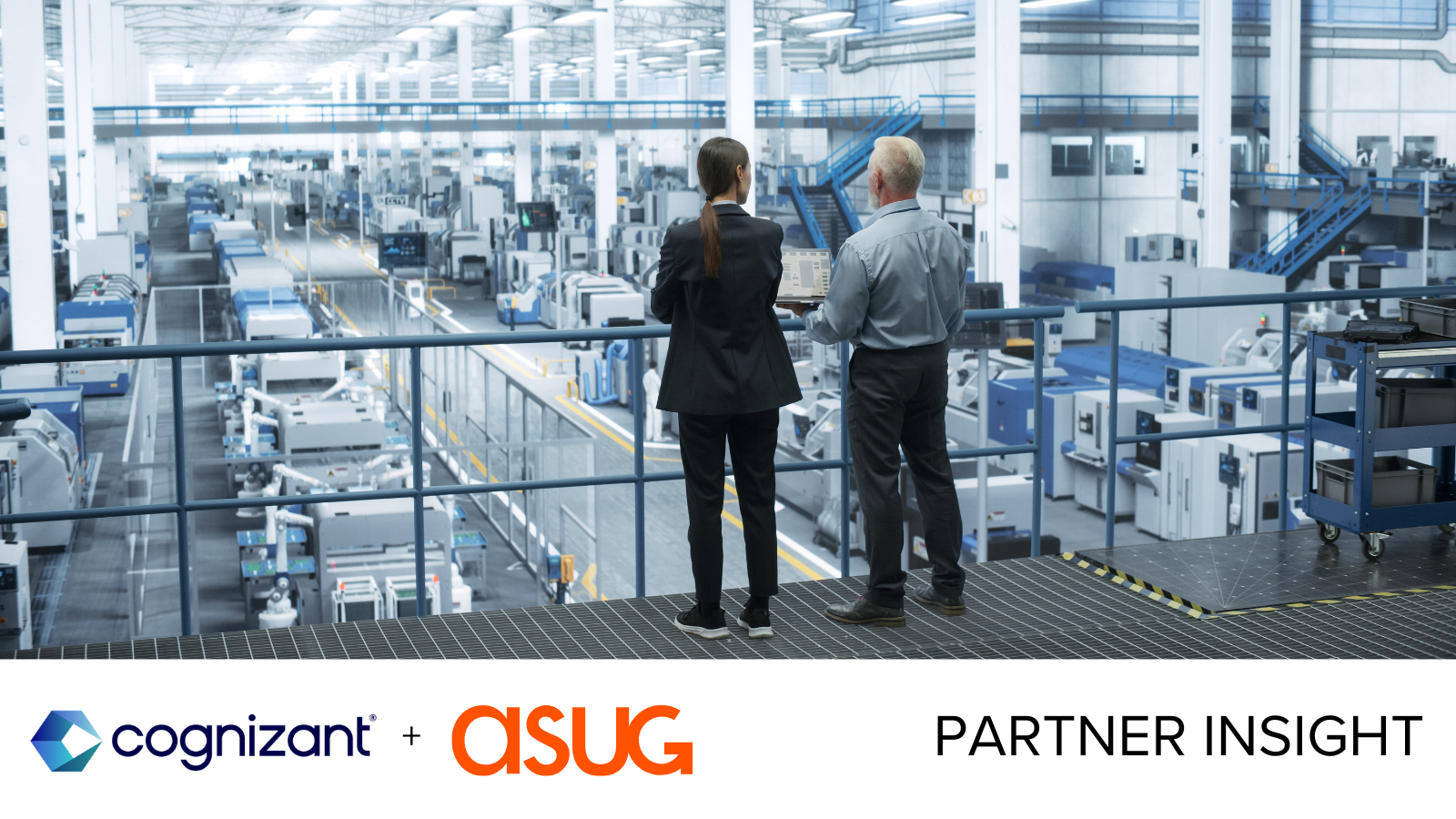
The following partner insight was authored by Vincent Wang, Senior Manager, AI Enterprise at Cognizant, and Cal Kailasam, SAP Manufacturing Service Line Leader at Cognizant.
Imagine slashing exception-handling time by 30% and cutting training effort by a whopping 80%.
That’s exactly what a leading energy utilities company is set to achieve, thanks to Cognizant’s agentic-AI-driven case management solution. Certified by SAP Business AI and already making waves — as evidenced by recently winning second place at the 2025 SAP Hack2Build global event — this powerful solution is scheduled for go-live in October 2026.
According to Cognizant’s industry benchmarks, these time-saving improvements could mean over $2 million in cost savings. What’s behind these impressive results? It’s Cognizant’s commitment to treating enterprise AI not just as the latest tech trend, but as a smart, ongoing investment in business excellence.
In 2023, Cognizant committed $1 billion to enterprise AI initiatives, staking out the company’s position as an early investor in AI, even before the boom period that followed the mainstream release of ChatGPT. These investments fund Cognizant’s AI Lab for research, Agent Foundry for deploying AI agents, and AI Training Data Services to ensure ethical data quality.
The scale of that commitment was recently evident in Cognizant’s companywide Vibe Coding initiative, which set a Guinness World Record earlier this year for the largest online generative AI hackathon, with more than 53,000 participants. Meanwhile, TIME Magazine named Cognizant CEO Ravi Kumar S. to its 2025 TIME100 AI list, highlighting him this year as one of the most influential people shaping the future of AI.
Behind those milestones operates a disciplined system for translating experimentation into enterprise-grade results. Cognizant’s operating model combines strategic direction with field-level experimentation, which the company describes as a bottom-up and top-down approach. Leadership sets the vision while teams across business units explore AI applications relevant to their industries, from life sciences to manufacturing to communications.
As companies flock to deploy AI, the business news headlines are full of AI initiatives that fail to deliver business benefits. Why? Because they start with technology, instead of business use cases, lack workflow integration, and/or define no measurable outcomes. Cognizant’s approach inverts that pattern.
Teams start with the user journey and measurable outcome, not with the algorithm or platform. Within SAP landscapes, common opportunities exist in repetitive, exception-heavy processes where AI can relieve people of highly manual work. Cognizant creates solutions that serve as “AI digital workmates,” like a personal assistant or coach that simplifies work, accelerates resolution, and reduces the learning curve.
Another thing that can derail AI pilots is trying to transform everything at once. Success depends on identifying one high-value use case, proving its value, and expanding only after results are visible and trusted.
As it turns out, what works in the exciting world of AI may actually be quite boring. Cognizant has a guiding principle in selecting a use case that is likely to succeed: fit AI to how your people already work — making the most complex or manual work easier, to save them time and energy.
AI Readiness: A Framework to Ensure Measurable Results
Turning that philosophy into consistent performance requires a structured framework.
Cognizant uses a capability maturity model that moves organizations through three phases:
- Labor arbitrage, where automation augments human effort through tools like robotic process automation;
- Technology arbitrage, where business value management and observability create machine-first operations alongside human oversight; and
- Autonomous operations, where agentic AI allows systems to manage themselves while people intervene only when judgment is required.
This model measures readiness across people, processes, data, and infrastructure by assessing whether organizations have large language models in place, what training programs exist for employees, which tool sets are available, and how current pain points are being addressed. By grounding each engagement in this maturity assessment, teams reduce overreach, control costs, and prevent the high failure rates common in early-stage initiatives. Built-in responsible AI practices such as explainability, confidence scoring, and strict access control reinforce trust at every step.
The case management solution demonstrates the maturity model in action. Beyond the headline savings, the system uses agentic AI to generate business requirement documents automatically, conduct fit-gap assessments, and support test case development. As organizations advance to higher maturity stages, the AI begins connecting incidents across different parts of the enterprise and fixing billing issues without human intervention, all while staying compliant with regulations and cutting the time needed to resolve problems.
The framework has proven adaptable across functions and industries: procurement departments apply it to supplier exception management, supply chain operations use it to address order delays, and finance teams leverage it for regulatory reconciliation tasks. Automation handles the repetitive work in each case, while AI summaries help users act on what matters.
Finance offers a second example. Asset unitization once required extensive manual spreadsheet work to complete a single statement. Cognizant brought in AI-assisted configuration blueprints, automated data mapping, and tools that generate audit-ready financial narratives. The result: what once took extensive manual work now requires about twenty minutes of human review. As organizations move up the maturity levels, the systems become more reliable and handle more work, but human judgment stays involved where it matters most.
The architecture question comes down to this: how do you test new ideas without threatening stable operations? SAP Business Technology Platform (SAP BTP) handles the separation, integrating multiple SAP components: AI Core runs models at scale. HANA Cloud Vector DB retrieves contextual information when needed. Machine learning and LLMs drive the automation and summarization work. Build Work Zone provides dashboards customized for different user roles. Build Process Automation handles workflows, and Joule functions as the conversational copilot.
Testing happens in isolation from production. Teams can try new approaches without risking the systems that keep the business running.
Scaling AI: The Intelligent Enterprise Is In Sight
Agentic AI transforms the architecture’s capabilities. The traditional approach was straightforward but limited — users posed questions to a single system and got answers back, all within one application. Agentic AI breaks down those walls, coordinating work across multiple platforms simultaneously.
A request initiated in an inventory platform can trigger reconciliation in SAP, complete related transactions, and close a ticket in ServiceNow, all while the user remains in Microsoft Teams. AI agents handle the movement of data and actions between systems, freeing people to focus on outcomes rather than administration.
This is the practical meaning of autonomous operations: intelligence that manages routine cases so humans can spend time where their judgment matters most. Unlike traditional static workflows, agentic AI creates dynamic automation that continuously incorporates human feedback.
Yet even sophisticated architectures depend on data quality. Fragmented, unstructured information can stall advanced AI programs. SAP Business Data Cloud addresses that issue by creating an AI-first foundation where SAP and non-SAP sources converge in a single model. With Databricks as part of an OEM solution, Business Data Cloud provides a centralized structure where workflows can draw on accurate, governed data to produce auditable results.
Scaling those capabilities for Cognizant’s clients requires an ecosystem of trusted partners. Cognizant gains early access to technologies such as the HANA Cloud Vector Engine through SAP’s Early Adoption Care Program. Joint programs like SAP Business AI Jump Start, Hack2Build, and the SAP Not Diamond Prompt Optimizer Early Access program compress the validation and certification cycle from months to weeks. Collaboration with AWS and Azure extends similar agility into deployment and marketplace scaling.
Financial stewardship remains another part of responsible adoption. Cloud consumption, model tokens, and processing bandwidth all influence cost. Cognizant treats cost as an engineering parameter, modeling expected usage early and validating assumptions through limited proofs of concept so clients can optimize model behavior before committing at scale.
Moving Forward with Confidence
Utilities and manufacturers beginning their AI journey should take a dual approach: work from the bottom up to identify specific pain points that deliver measurable improvement within a quarter, and from the top down to create a roadmap tied to the maturity model. Organizations should choose use cases that are proven in the industry and can demonstrate clear value before expanding.
By inviting enterprises to participate in AI Use Case Validation Workshops, Cognizant helps de-risk initial adoption for their clients. Not only does the program provide technical guidance from experts across all three organizations, but financial support for ideation and proof-of-concept development is also available.
Organizations seeking faster deployment can join a private Hack2Build program launching in Q4 2025. The program compresses what typically takes months into a matter of days. Participants work alongside Cognizant and SAP engineers and architects to build a functioning SAP BTP prototype. By the end, companies have both a working prototype and a clear path to production. While slots are limited, the program runs quarterly. (Cognizant invites clients to contact their account representative for more information.)
Getting AI right in the enterprise takes equal parts discipline and imagination. Companies need to show users clear value while following a structured path forward. Core systems have to stay stable even as teams experiment at the margins. And moving from pilot to production requires partners who understand both the technology and the business context.
Cognizant’s work in the SAP ecosystem follows this logic, building from targeted automation toward operations where AI comes first with a focus on results you can measure, trust you can verify, and systems that scale.
Vincent Wang is Senior Manager, AI Enterprise at Cognizant, and Cal Kailasam is SAP Manufacturing Service Line Leader at Cognizant.
You Might Be Interested In
Log in to save this article and keep your favorite resources in one place.

Log in to save this article and keep your favorite resources in one place.

Log in to save this article and keep your favorite resources in one place.

Log in to save this article and keep your favorite resources in one place.