Log in to save this article and keep your favorite resources in one place.
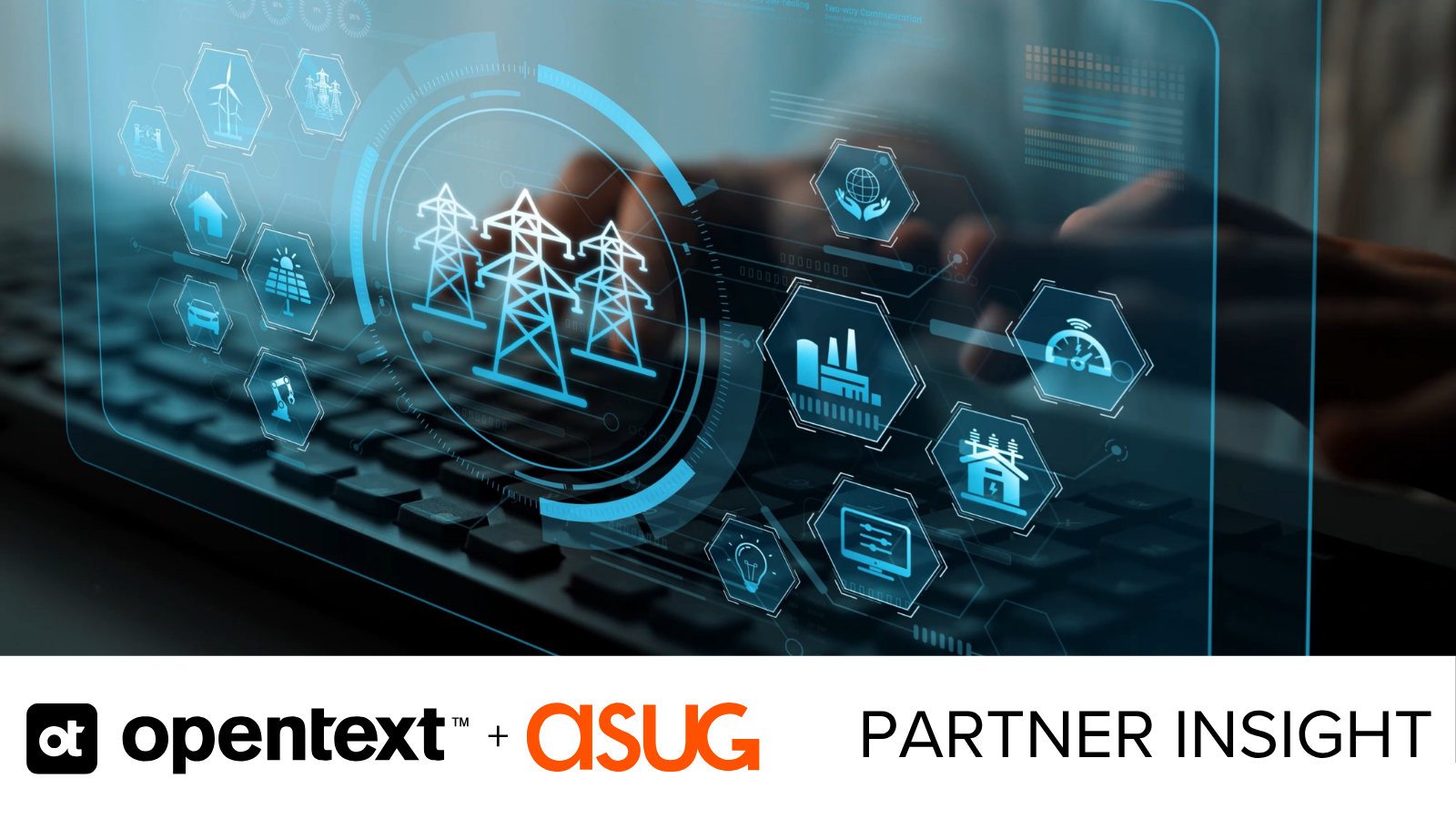
This Partner Insight was authored by Phil Schwarz, Senior Industry Strategist for Energy and Resources at OpenText.
Utilities are navigating one of the most significant periods of transformation in their history. Grid modernization, renewable integration, electrification, workforce turnover, and increasing energy demand are creating new operational and financial pressures. At the same time, organizations are exploring how AI assistants, copilots, and autonomous agents can help improve productivity, accelerate decision-making, and streamline business processes.
As SAP customers look to operationalize AI, one reality is becoming clear: success depends less on the AI model itself than on the information foundation beneath it. Every AI agent ultimately needs trusted information to make decisions, governed authority to act, and secure mechanisms to exchange information across organizational boundaries.
This is where OpenText Solutions for SAP play a critical role. OpenText helps organizations connect content, processes, records, and engineering information directly to SAP business transactions, creating a governed information foundation that enables AI to scale safely and effectively across the enterprise.
As utilities move from AI experimentation to production deployment, three capabilities define what every AI agent requires to operate within a regulated, mission-critical environment: Decide, Act, and Transact.
Decide: Read Trusted Context
Before an AI agent can make a recommendation, it must first understand the situation it is evaluating. That requires access to trusted context.
In utility operations, decisions depend on engineering drawings, maintenance procedures, inspection reports, work histories, asset documentation, compliance records, operational reports, customer bills, and countless other sources. Yet these records often reside across multiple systems and repositories, making it difficult to ensure employees — and AI agents — are working from complete and current information.
The challenge grows more acute as organizations deploy AI. Agents can only make decisions based on the information available to them. If information is incomplete, outdated, or disconnected from business processes, the result can be inaccurate recommendations delivered with unwarranted confidence.
The answer is governed content.
The agent reads governed asset and operational records that are current, complete, and properly organized according to business, regulatory, and operational requirements.
This is where OpenText Content Management becomes foundational. By connecting enterprise content directly to SAP business processes, utilities create a trusted information environment where documents, records, engineering information, and operational content stay governed throughout their life cycle.
When AI agents access content through a governed information layer, they work from approved versions, validated records, and controlled sources. Maintenance teams gain access to current procedures. Engineers work from approved documentation. Field service personnel can quickly locate the information required to support critical decisions.
In an AI-enabled utility, trusted information is not optional — it is the foundation for every subsequent decision.
Act: Ensure AI Operates Within Authorized Boundaries
Once an agent can access trusted information, the next question is whether it should act on that information.
For utilities, governance is the difference between an AI pilot and a production-ready AI capability. Every organization must answer a simple but critical question: What is the agent allowed to do?
The principle is straightforward: The agent does only what you granted — and every action is logged.
Utility business processes require approval controls, segregation of duties, auditability, compliance oversight, and documented accountability. AI cannot operate outside these requirements. Instead, it must function within the same governance framework that guides human workers.
A strong example is OpenText Vendor Invoice Management for SAP Solutions. Invoice processing is a process where organizations want greater speed and efficiency without sacrificing control. Intelligent automation can classify invoices, extract information, validate data, route exceptions, and support workflow execution. However, the system remains governed by established approval processes, business rules, authorization controls, and audit requirements.
Every action remains visible. Every exception remains traceable. Every approval remains documented.
Transact: Give AI a Transaction Passport
Many of the highest-value utility processes extend beyond company boundaries. Capital projects involve engineering firms and contractors, procurement involves suppliers and manufacturers, and commercial operations involve customers and external partners.
As AI evolves, agents will increasingly participate in these exchanges.
To do that, they need what OpenText describes as a transaction passport — the ability to exchange information across organizational boundaries through identity, trust, and verifiable evidence.
A transaction passport answers several critical questions:
- Who is participating in the transaction?
- What information is being exchanged?
- Can the information be trusted?
- Is there a verifiable record of what occurred?
- Can the organization prove compliance later if challenged?
For utilities, one of the clearest examples is engineering collaboration during capital projects.
Engineering drawings, specifications, design documents, redlines, and technical packages routinely move between utilities, EPC firms, contractors, and suppliers. Without governance, these exchanges can create delays, version-control problems, rework, and compliance risks.
Solutions such as OpenText Content Management for Engineering help address this challenge through capabilities including transmittal and submittal management. These processes govern the exchange of project documentation while maintaining traceability, version control, review workflows, approvals, and audit trails.
When an engineering document is shared, stakeholders can verify which version was sent, who reviewed it, what changes were requested, when approvals occurred, and what documentation supports the final decision. The entire exchange becomes governed and defensible.
This same principle applies to the future of agentic AI. Before an AI agent can safely engage with suppliers, contractors, partners, or commercial customers, it must have trusted identity, governed information, and verifiable evidence. In other words, it needs a transaction passport.
Building a Governed Foundation for AI-Ready Utilities
Every effective AI agent depends on three capabilities. It must read trusted context to decide, operate within authorized boundaries to act, and hold a transaction passport to transact across organizational boundaries through identity, trust, and verifiable evidence.
Through its portfolio of SAP-integrated information management solutions and its long-standing SAP partnership, OpenText helps utilities build the governed foundation that connects content, records, engineering information, workflows, and business processes directly to SAP environments.
Ready to learn how OpenText can help your utility establish an AI-ready information foundation for SAP? Speak to an expert.
Phil Schwarz is Senior Industry Strategist for Energy and Resources at OpenText.
You Might Be Interested In
Log in to save this article and keep your favorite resources in one place.

Log in to save this article and keep your favorite resources in one place.
Log in to save this article and keep your favorite resources in one place.

Log in to save this article and keep your favorite resources in one place.