Log in to save this article and keep your favorite resources in one place.
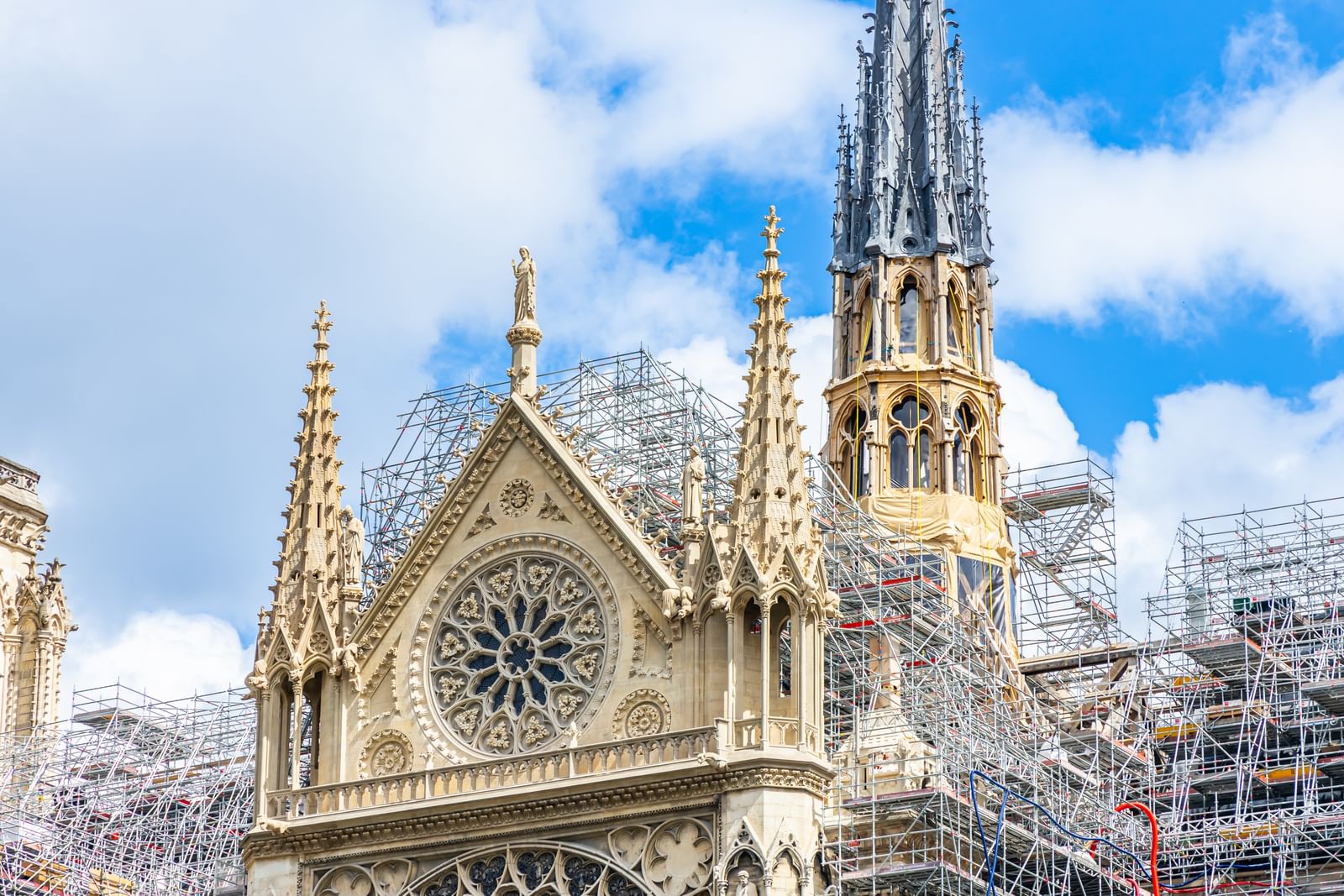
Optimizing an enterprise software landscape requires intention, planning, and vision from enterprise architects; the process of aligning business strategy with processes within an IT infrastructure is, in fact, not dissimilar to the process of rebuilding a physical structure. Both require blueprints, considerations from various specialized teams, and working under timelines and budgetary restraints. EAs can derive insights from studying successful construction projects in the physical world.
Speaking at SAP Enterprise Architect Learning Forum in February, Gaurish Dessai, an SAP EA, compared implementing an enterprise-wide digital transformation to the €1 billion reconstruction of Notre Dame Cathedral in Paris, which was completed five years after a devastating inferno engulfed the landmark. After 800 years in existence, the destruction of Notre Dame in 2019 was a national event and its restoration a matter of cultural importance.
Dessai walked attendees through this analogy, highlighting the importance of gaining buy-in from the top, documenting baselines, and finding the right team will all contribute to the success of an enterprise-wide project.
To stay connected to fellow EAs, join the ASUG Enterprise Architects Community.
Building Buy-In
Immediately after the fire, President Emmanuel Macron set a five-year timeline for Notre Dame’s restoration, to have the structure ready for the Paris Olympics. Here, Dessai noted the analogy and advised EAs to prioritize getting buy-in “from the highest authority,” adding that, “Even across the next five years, [establishing early] the timeline and the commitment is important.”
He cited another recent example in which a client’s CIO was trying to pitch the implementation of SAP S/4HANA at their business and got five minutes in a board meeting to make his case. This CIO focused on making every minute count and highlighting the enterprise-wide benefits to be gained; he ultimately earned the go-ahead he needed for the project to proceed. “You can tell from that five minutes whether the buy-in will come from the board or not,” Dessai said. “If you don’t have the buy-in from the board, there’s no point. You have to appeal to the collective pride of the people.”
Documentation Baselines
In rebuilding Notre Dame, a number of factors needed to be considered: Should the facility be modernized or built from scratch? Should the original color palette be painted? Those types of conversations, Dessai noted, are similar to conversations that happen with customers and internal stakeholders prior to a transformation — but those conversations aren’t the most important part of preparation. The key question to ask, Dessai offered, is: “What is the baseline for the rebuild?”
In the case of Notre Dame, the reconstruction team relied in part on a full 3D model of Notre Dame and surrounding environments that had been originally created for the 2014 video game Assassin’s Creed: Unity. This full scan allowed the Notre Dame team to understand the building’s previous construction in granular detail. The documentation of Eugène Emmanuel Viollet-le-Duc, who rebuilt the Notre Dame after the French Revolution, was also an important part of establishing the documentation baseline. Dessai pointed out the comparison here between the baseline provided by Assassin’s Creed and Viollet-le-Duc to the kinds of baselines made attainable by process-optimization products like SAP Signavio in helping businesses analyze their core processes before beginning transformation.
Notre Dame’s documentation baseline also came from then-architecture student Rémi Fromont, who’d completed a four-year doctorate program solely on the cathedral’s beams. Fromont’s research had allowed him to document precise size and placement of beams. He was chosen to be part of the reconstruction team. Dessai compared this meticulous documentation to LeanIX, which similarly allows companies to map the full scope of their software estate.
Here, as in any major transformation, background expertise is crucial. As Dessai stressed, “You can’t just start a transformation overnight. You have to prepare.” Even before reconstruction started, the building’s collapsed scaffolding had to be cleaned from its lead cladding joints, which can give off harmful micro-particles. “They had people with vacuum cleaners going around and cleaning every structure, making sure that it was safe for people to rebuild,” Dessai noted, “then they had to put support in place. If you have teams who are working on big transformation, you need to have backup teams to support the organization. They had to put support in place so that while they are rebuilding it, the whole structure doesn’t collapse. That is the preparation part of the transformation — before you start the building the new scaffolding, before you start the preparation for the new transformation.”
Preparing the Right Team
Expert teams were also required to, among other things, create the same type of glass that had been made and used for Notre Dame for 800 years ago, as well as finding the same stone used to construct the building. Because no one knew where the stone was sourced from, “they did a fossil analysis of the stone, and checked every stone to find which fossils are in there, and tested fossils all across France to find which was the right stone,” he said. “Because it was not one stone right, as you saw in the starting picture, it was built over time — different types of stones, different quarries.”
The same kinds of issues arise in enterprise digital transformations: “You have teams in India, you have teams in Poland, you have teams in Brazil. They are developing something for you. How do you get all of that in a central place and then combine it and make sure it fits correctly?”
Dessai noted one other unexpected takeaway from Notre Dame’s restorations: with donations of €850 million raised, the final cost turned out to be a lower-than-expected €700 million, with the leftover funds made available to be used for renovations of other cultural monuments. “That is the beauty, that is the success of the rebuild process,” Dessai said.
A skillful team that is dedicated to a successful transformation might also be able to come in on time and under budget. At least today one can pray for such a result at a beautiful cathedral.
Stay ahead with First Five, ASUG’s exclusive newsletter. Subscribe today for a curated email featuring top insights tailored for SAP users.
You Might Be Interested In

Log in to save this article and keep your favorite resources in one place.
Log in to save this article and keep your favorite resources in one place.

Log in to save this article and keep your favorite resources in one place.
Log in to save this article and keep your favorite resources in one place.