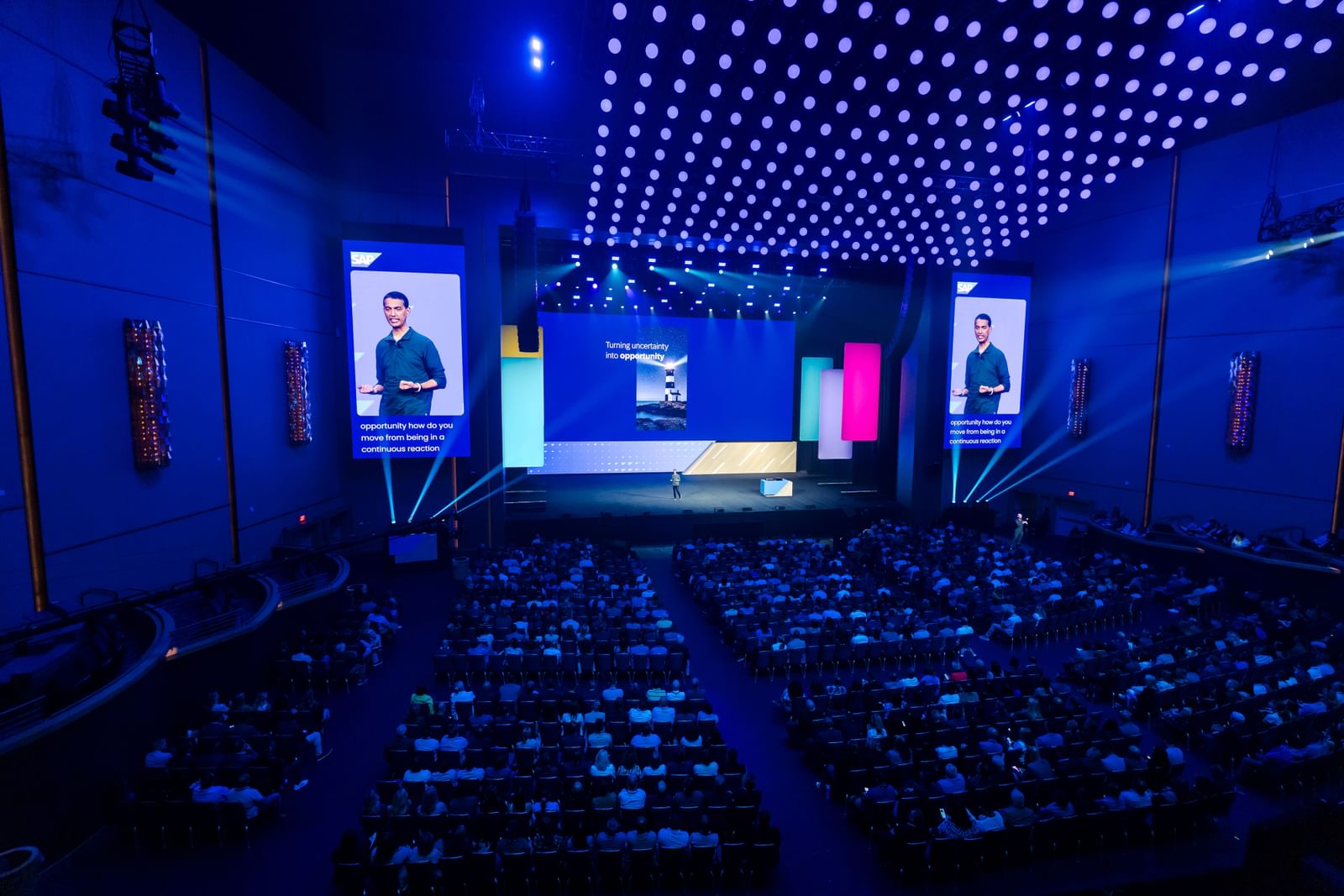
At its inaugural SAP Connect event, SAP advanced its strategic vision for an interconnected, AI-driven, suite-first approach that unifies technology across critical business areas. Held Oct. 6-8 at the Fontainebleau and Resorts World Las Vegas, the event brought together line-of-business leaders across its core business suite, from finance and supply chain to spend/procurement, human resources (HR), and customer experience (CX).
Signaling a shift away from piecemeal "best-of-breed" integrations toward a unified, intelligent enterprise platform, SAP leaders outlined strategies for embedding AI, data, and applications into its core business suite. "To thrive when volatility is the new normal, businesses need more than a patchwork of disparate best-of-breed applications," said Muhammad Alam, Member of the Executive Board of SAP SE who leads the SAP Product & Engineering Board area.
"Our announcements demonstrate the power of SAP Business Suite, where AI, data and applications come together in an experience to propel smarter decisions, faster execution and scalable transformation."
Major announcements for SAP users and system stakeholders included:
- Role-aware assistants in Joule that coordinate across business functions, to partner with people in their specific roles, orchestrating and invoking Joule agents to complete tasks.
- 14 new specialized Joule agents, embedded across core business processes in finance, HR, procurement, and supply chain.
- Intelligent applications—including Finance Intelligence, Spend Intelligence, Supply Chain Intelligence, and Revenue Intelligence—intended to support decision-making across key operational functions.
- SAP Business Data Cloud Connect, which allows bidirectional, zero-copy data sharing between SAP Business Data Cloud and partner platforms such as Google BigQuery.
- SAP Engagement Cloud, a new "unified system of engagement" that gives organizations a comprehensive view of marketing, sales, service, and commerce.
- SAP Supply Chain Orchestration, an AI-native application that combines Joule with a network knowledge graph to analyze real-time signals across multi-tier supply chains, detect risks and issues, and proactively coordinate responses.
- Next-generation SAP Ariba capabilities, including a simplified user interface with a central SAP Ariba launchpad, new AI tools, automated sourcing, enhanced 360-degree supplier profiles, and a new central intake management feature.
- SAP Ariba and SAP Business Network are now housed on SAP Business Technology Platform for easier integration.
Role-Aware AI Assistants in Joule + New Joule Agents
One of the most foundational announcements out of SAP Connect was SAP's expansion of its Joule AI framework to include role-aware assistants that coordinate across business functions.
Partnering with specific business users to support them in fulfilling tasks across SAP Business Suite, these AI assistants (intended to act as personal copilots tailored to users' functions) are capable of identifying relevant business objectives — then configuring, orchestrating, and managing specialized AI agents behind the scenes to carry out appropriate workflows.
These role-aware assistants can support finance managers, HR managers, supply chain leads, procurement professionals, and more; one example given by SAP was that of a People Manager assistant, which can invoke a People Intelligence agent to detect compensation irregularities and flag performance anomalies then suggest potential interventions.
For end-users, the introduction of AI assistants could outsource more of the heavy lifting of process initiation, context gathering, and cross-departmental communication to embedded organizational intelligence.
Meanwhile, 14 new Joule agents—for finance, spend, supply chain, human capital management, customer experience, and more—will bring automation and AI to numerous roles. These agents are meant to work in the background, managed by role-based AI assistants.
Examples include a Production Planning and Operations agent, which automates prerequisite checks for releasing production orders and suggests workarounds or releases orders when ready; a People Intelligence agent that allows managers to query workforce analytics in natural language; and a Supplier Onboarding agent that streamlines onboarding of suppliers via SAP Business Network by reviewing supplier details and orchestrating invitations. Find more details at SAP.
At SAP Connect, SAP also previewed four new intelligent applications running through SAP BDC, including Finance Intelligence, Spend Intelligence, Supply Chain Intelligence, and Revenue Intelligence, all intended to help role-aware assistants embed more naturally into users' workflows:
- Finance Intelligence: Giving CFOs and finance teams real-time AI-powered analysis of liquidity by harmonizing SAP and third-party data, also allowing leaders to forecast cash flow and detect liquidity risks while automating routine finance tasks.
- Spend Intelligence: Connecting finance, procurement, HR, and supply chain teams with a single view of spend data, as well as advanced AI analytics to uncover patterns, anomalies, and potential cost savings.
- Supply Chain Intelligence: Combining SAP data with external signals from third-party data (such as weather, regulatory updates, and market shifts, as well as updates from partners on SAP Business Network) to arm operations leaders with more context to make better, informed decisions.
- Revenue Intelligence: Connecting front-office engagement to back-office execution while unifying customer touchpoints and helping revenue leaders to understand better which accounts to prioritize and how to optimize investments.
SAP Business Data Cloud Connect + Zero-Copy Sharing with Google BigQuery
Advancing its vision of a harmonized data foundation introduced by SAP Business Data Cloud earlier this year, SAP introduced Business Data Cloud Connect, which allows bidirectional, zero-copy data sharing between SAP Business Data Cloud and partner platforms like Databricks (now generally available) and Google BigQuery (now in public preview, with general availability planned for the first half of 2026).
Giving customers flexibility to work with trusted data from wherever it resides, this capability will expose SAP's semantically enriched data to Databricks' or Google BigQuery's data warehouse (and vice versa) without the need for traditional extract-transform-load replication.
Acting as a data pipeline, BDC Connect will allow customers to work across multiple environments for analytics and AI functions. This could simplify hybrid landscapes for those organizations already investing heavily in Google Cloud or data-lake architectures, and it will reduce the risk of data latency and governance inconsistency associated with duplicated data stores. Additional hyperscaler integrations are planned for next year.
BDC Connect will be a game-changer for agentic capabilities in SAP, allowing data to be exposed between third-party and SAP systems, as well as within SAP landscapes, to fuel the efficacy of AI capabilities and agents.
SAP Engagement Cloud + CX Innovations
SAP also unveiled SAP Engagement Cloud, a new offering for CX leaders that sits closer to SAP’s integrated suite than prior CX tools.
Positioned as an enhanced “system of engagement” that spans marketing, sales, service, and supplier/customer interactions, with native intelligence supplied via Joule, the solution is SAP's bid to reduce friction between front-end customer interactions and back-office processes.
Aligned with SAP Business Data Cloud, SAP Engagement Cloud unifies data from customer-facing departments, orchestrating communication across various departments via dedicated Joule agents (including for marketing, sales, and service).
When linked to SAP Business Data Cloud, every conversation or transaction draws on the same operational data, allowing sales, marketing, and service teams to respond with shared context. Joule’s embedded AI deepens that connection by adapting experiences in real time and automating follow-up actions at scale, with general availability planned for February 2026.
The surrounding ecosystem builds on this foundation. SAP Customer Loyalty Management merges regional loyalty programs into a unified digital wallet, giving organizations a consolidated view of customer activity and redemption trends through integration with SAP Cloud ERP Private and SAP Business Suite. That feature is expected to reach general availability in November 2025.
The Account Planning Agent uses CRM data, external insights, and purchasing patterns to build strategic account plans that help revenue teams prepare more efficiently. SAP expects to make it available in December 2025. Support and adoption will be further streamlined later in 2025 when WalkMe capabilities are embedded within SAP Sales Cloud, SAP Service Cloud, and SAP Commerce Cloud to deliver in-app guidance and workflow automation.
Analytics complete the picture. Revenue Intelligence, built on SAP Business Data Cloud, delivers a live view of pipeline health and customer engagement metrics that go beyond traditional dashboards. SAP plans to make it generally available in Q2 of 2026. Together, these initiatives move SAP’s customer solutions toward a more integrated model—one where engagement, data, and execution operate as parts of a single system.
SAP Supply Chain Orchestration
SAP continues to bring its supply chain portfolio into tighter alignment, linking planning and execution through a shared network. At the center of this evolution is SAP Supply Chain Orchestration, an AI-native control layer built around Joule and a multi-tier knowledge graph.
The approach allows companies to see potential disruptions earlier, coordinate responses across partners, and act more quickly to resolve issues. SAP expects to make the solution generally available in the first half of 2026.
Upgrades to SAP Integrated Business Planning are aimed at the same objective: a smoother bridge between planning and execution. The system now brings time-series and order-based data together in a single planning area, giving planners a clearer, more consistent view for forecasting and simulation. AI improves predictive accuracy, and Joule adds context by guiding users through scenario modeling in real time. Those capabilities are scheduled for release in the second quarter of 2026.
The Production Planning and Operations Agent, due in early 2026, validates prerequisites and proposes workarounds that shorten order-release cycles. Later that spring, SAP will add two more agents: Change Record Management Agent, which reviews problem reports and change requests to suggest or trigger corrective actions, and Supplier Onboarding Agent, designed to speed partner setup by automating invitations, compliance checks, and progress tracking within SAP Business Network.
The SAP Business Network now runs on SAP BTP, a shift that increases speed and scalability while making system integration easier. Joule-powered automation is slated to roll out in January 2026. In logistics, SAP Logistics Management offers a cloud deployment built for smaller and regional warehouses, giving them coordination tools once available only to large enterprise sites.
Introducing the Next Generation of SAP Ariba
Now built on SAP Business Technology Platform, SAP Ariba solutions will better integrate with SAP Business Suite and SAP ERP, as well as third-party ERP platforms.
Coming in February 2026, "next-generation" SAP Ariba capabilities include simplified navigation and enhanced user experience, as well as AI integrated into contract analysis, sourcing event creation, bid analysis, and supplier summary workflows.
Additional AI features and Joule capabilities for SAP Ariba will help analyze supplier responses, consolidating information to help procurement specialists with decision-making around category management, sourcing, and contracting. Joule is also aimed to help staff outside of accounts payable to easily create invoices to accelerate supplier payments. It will work with contractors to generate summaries, identify discrepancies, and alert to compliance problems.
Applications, Data, AI
Together, the developments announced at SAP Connect illustrate a single architectural direction. SAP is weaving applications, data, and AI into one operational fabric guided by Joule.
Each release—whether in customer engagement, workforce management, or supply chain execution—reinforces the same principle: intelligence belongs where work happens, supported by shared enterprise data.
The result is an orchestration ecosystem built for continuous performance, where analytics, automation, and decision-making unfold as individual parts of one coordinated system.