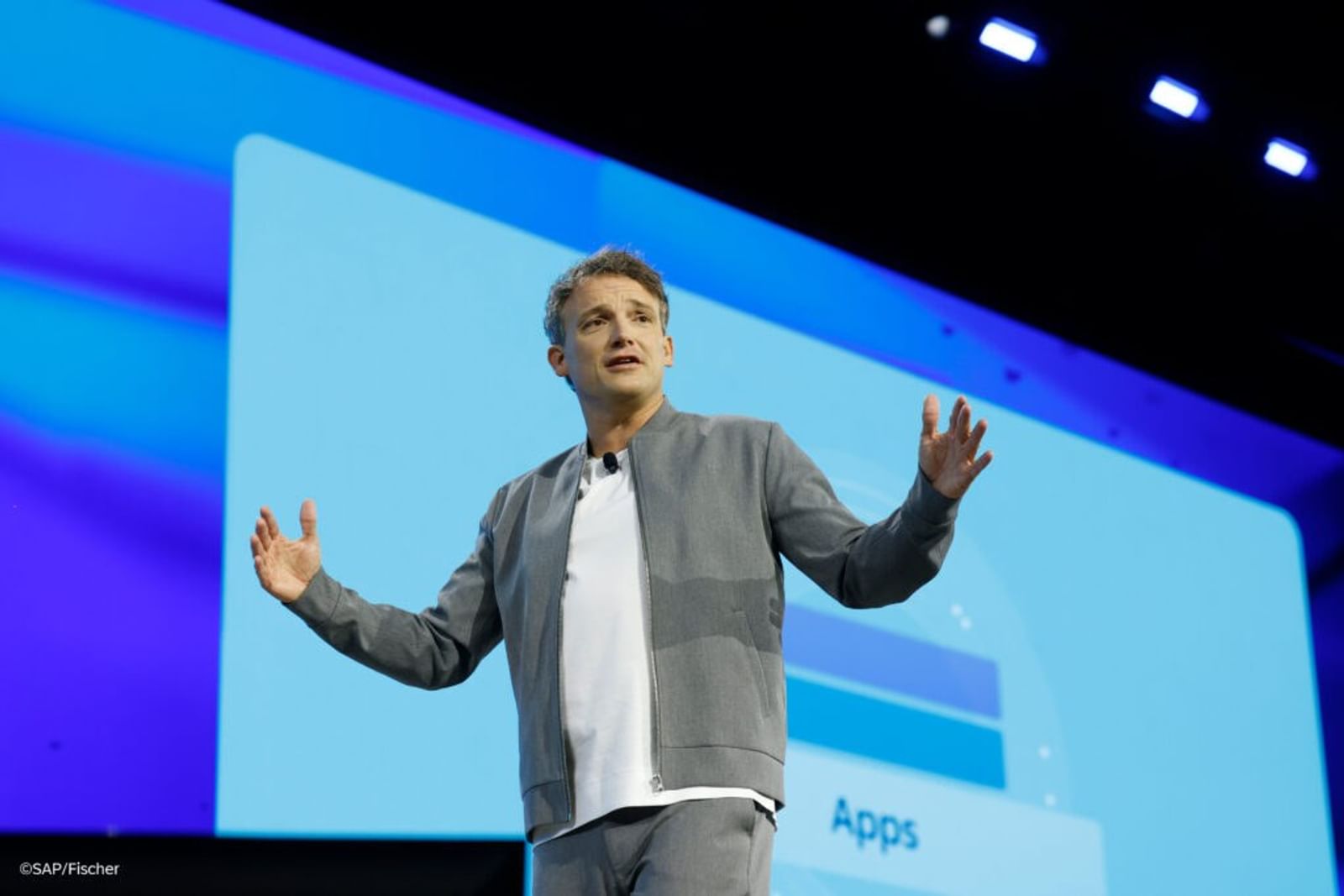
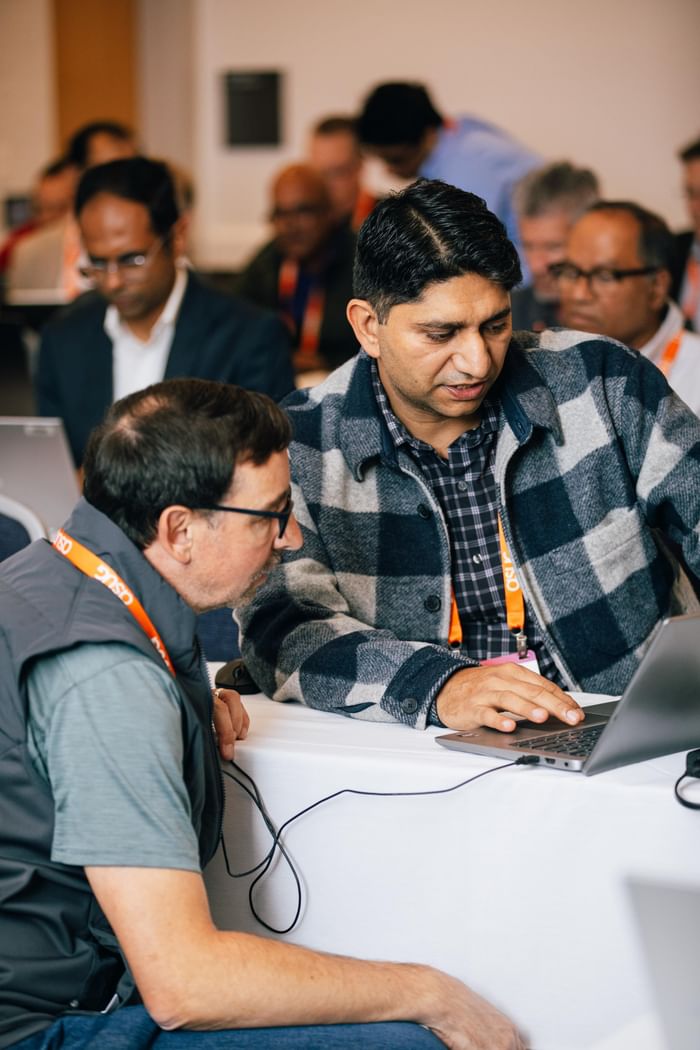
SAP executives, led by CEO Christian Klein, brought IT and business leaders together at this year’s SAP Sapphire & ASUG Annual Conference to demonstrate how SAP’s new “flywheel,” combining fully integrated cloud applications, mission-critical data, and embedded AI, can equip their customers’ enterprises to respond to macro-economic volatility.

At the Orlando event’s opening keynote, SAP unveiled innovations and partnerships while maintaining a high-level focus on the company’s vision of automated enterprises that can be managed primarily through interactions with Joule, which will be able to access cloud applications and data across both SAP and non-SAP applications.

“All of us face one problem—every company, no matter which industry or geography—and that problem is uncertainty,” said Klein. “Uncertainty about trade disruption, about new regulatory requirements, and about how AI will transform my business and impact my workforce.”

SAP can’t eliminate macroeconomic uncertainty, he said. “But you have my commitment that we will help your business become more resilient – especially in times like these. We will help you bring out your best.”

SAP Business Suite Unifies Applications, Data, and AI

The “flywheel” enables a more responsive ERP user experience, according to Klein, by bringing applications, data, and AI together as the foundation of an integrated business suite.

Described by SAP executives as a “suite-as-a-service” approach, this evolution of SAP’s engine for business transformation is intended to prepare customers to more effectively leverage AI, keeping data available and ensuring its end-to-end business process context remains intact—wherever it sits within an enterprise’s application stack.

Muhammad Alam, leading SAP Product & Engineering as a member of the Executive Board of SAP SE, discussed the relevance of the flywheel to SAP’s overarching intention to evolve the business application landscape, reducing the time and effort that customers devote to integrating heterogeneous applications and extracting then combining disparate data sets to unlock greater visibility of their enterprise-wide processes.

“We estimate that organizations can spend up to 80 percent of their effort and budget in putting together this fragile balance of applications and data, leaving only 20 percent of your resources to focus on value creation,” Alam said.

Given the comprehensive nature of SAP’s application portfolio, capable of running mission-critical processes end-to-end for customers, and the semantically rich business data accessible inside of these applications, SAP has enjoyed a competitive advantage when it comes to harnessing powerful AI tools for its customers’ business context, Klein explained.

With the SAP Business Data Cloud, announced earlier this year, that advantage is more pronounced than ever before; acting as a fully integrated data layer across an enterprise’s applications and processes while retaining that data’s semantical context, SAP BDC is an engine for end-to-end data harmonization, Alam said.

New intelligent applications within SAP Business Data Cloud will equip line-of-business leaders with advanced automation and orchestration capabilities across analytical and transactional workflows, learning from data and usage patterns to advise leaders on tasks particularly suited to automation.

Unveiled at SAP Sapphire, one such application was People Intelligence, within SAP Business Data Cloud, which will work within the SAP SuccessFactors human capital management (HCM) suite to provide AI-driven insights into workforce data. By asking questions around potential skills shortages, workforce composition, and compensation data, HR and business leaders can quickly receive strategic recommendations to guide their decision-making.

Additionally, SAP Business Data Cloud will offer three SAP solutions—SAP Sustainability Control Tower, SAP 360 Customer, and SAP Spend Control Tower—natively within its Core ERP Intelligence, Customer Intelligence, Finance Intelligence, and Spend Intelligence applications.

Klein additionally announced that, by the fourth quarter of 2025, SAP Business Data Cloud will become available on hyperscaler platforms including Amazon Web Services, Google Cloud, and Microsoft Azure.

Joule Is “Everywhere You Work”

Crucial to this vision of business AI across the enterprise is the expansion of Joule, SAP’s generative-AI copilot, into a “virtually omnipresent” digital assistant, Klein announced.

“We are making Joule available to you everywhere and giving you answers on everything,” he said. Bolstered by SAP’s acquisition of the WalkMe user-adoption platform, Joule will become available across both SAP and non-SAP applications, existing via an action bar that will monitor user behavior and proactively serve up recommendations in response.

Through SAP’s new partnership with Perplexity, which will see its answer engine embedded directly into Joule, the copilot will gain a contextual-search functionality—integrated with the SAP Knowledge Graph—that bolsters the relevance and reliability of its outputs.

Joule Meets the Agentic AI Explosion

SAP will deliver more than 400 AI scenarios by the end of the year, according to Philipp Herzig, CTO and Chief AI Officer at SAP.

Herzig vowed that the company’s AI embrace will ultimately “make every end-user 30 percent more productive” by establishing Joule as a unified user-experience frontend, leaving Joule agents to automate tasks across end-to-end processes on the backend.

Tune in to our latest episode of ASUG Talks, featuring an exclusive interview with Philipp Herzig, CTO and Chief AI Officer at SAP.

In addition to Joule for developers and Joule for consultants, both previously announced innovations that aim to apply SAP Business AI to individual workflows and job functions, Herzig stated that SAP has thus far delivered more than 1,600 skills to business users via Joule, strengthening its position as a game-changer for user experience.

This shift from “insight to action” to “reason and act,” as Herzig put it, is part of SAP’s strategy of equipping business users with AI agents that can serve valuable functions in their workforce.

This expanded library of Joule agents will streamline decision-making across the enterprise by working to reimagine business processes, while controlled via an AI agent hub housed within SAP LeanIX. That library encompasses out-of-the-box Joule agents, third-party agents, and custom agents that SAP developers can build via AI Foundation, which is billed by SAP as a one-stop-shop for building, extending, and running AI solutions at scale.

One of over 60 new and updated capabilities for AI Foundation, Herzig said, is a prompt optimizer, designed in collaboration with AI lab Not Diamond, to further aid developers in quickly creating more effective AI prompts, reducing prompt-engineering work previously required for complex use cases.

Want to continue reading this article?

Become a member and get access to all ASUG benefits including news, resources, webcasts, chapter events, and much more!

Log in

Not an ASUG member? Learn more