Log in to save this article and keep your favorite resources in one place.

This partner insight was authored by Kevin Clemons, Data Architect at delaware.
Utilities have no shortage of data.
Customer information, asset performance, work management, financials, operational data, and information from SAP and non-SAP systems are generated across the enterprise every day. The challenge is bringing that information together in a way that allows the business to understand what is happening, identify what is likely to happen next, and act on it.
As utilities modernize their technology landscapes, that challenge is becoming increasingly important.
AI, advanced analytics, and more intelligent decision-making all depend on one thing: trusted, accessible, and connected data.
For many utilities, however, that data remains distributed across multiple systems and platforms. Creating an enterprise-wide view can require significant integration, replication, and customization. That can make it difficult to move from simply collecting data to actually using it to drive the business.
Why the Data Conversation Is Changing
For years, utilities have relied on established data warehouses, analytics platforms, and point-to-point integrations to bring information together. Those approaches have served an important purpose, but the demands being placed on utility data are changing.
Organizations increasingly want to combine information from across the enterprise, perform advanced analytics, understand historical trends, and make data available to AI and other emerging technologies.
That requires more than another reporting tool. It requires a data foundation capable of connecting information across the enterprise while preserving the business context that makes the data meaningful.
This is where SAP Business Data Cloud enters the conversation.
SAP Business Data Cloud provides a path for bringing SAP data together and making it available for analytics, planning, AI, and broader enterprise data strategies. It can also play a role in architectures that include platforms such as Databricks and other hyperscaler technologies, giving utilities greater flexibility in how they build their modern data environments.
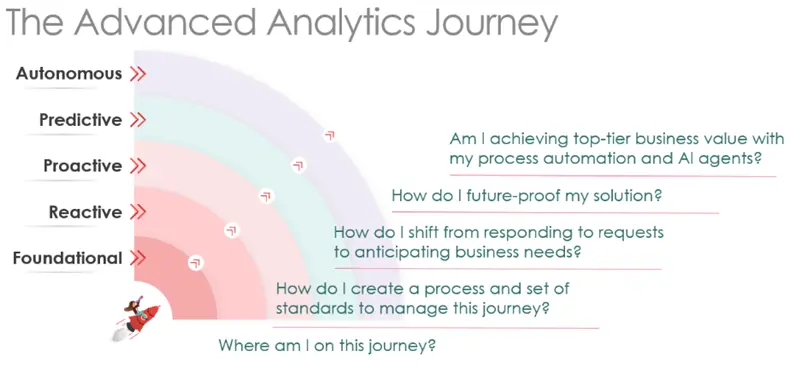
For utilities working through this evolution, delaware’s analytics practice has helped organizations assess where they are in their data journey and define a path forward, from basic reporting and data delivery to enterprise-wide predictive analytics and a governed foundation for advanced analytics and automated intelligence.
From Fragmented Data to an Enterprise View
Consider how many decisions across a utility depend on information that resides in more than one system.
An asset decision may require maintenance history, financial information, and operational data. A customer decision may depend on billing, service, and engagement information. A financial forecast may require information from operations, capital projects, and enterprise systems.
When those data sets remain disconnected, the organization is often left assembling the picture after the fact.
A modern data architecture changes that equation. Instead of treating data as an output of individual applications, utilities can begin treating it as an enterprise asset that can be shared and used across business functions.
That creates the foundation for capabilities such as:
- Enterprise-wide reporting and analytics
- Historical analysis and trend identification
- More informed operational and financial decision-making
- AI and machine learning use cases
- Greater access to trusted SAP data across the broader technology ecosystem
The technology matters, but the larger objective is giving the organization a consistent foundation from which to make better decisions.
Building the Foundation for AI
The conversation becomes even more important as utilities explore AI. AI is often discussed in terms of agents, automation, and new use cases, but the quality of those capabilities ultimately depends on the information available to them.
Disconnected, inconsistent, or poorly governed data limits what AI can reliably do. For utilities, the path toward AI therefore doesn’t begin with AI alone; it begins with establishing a data architecture that makes trusted business information available in the right context.
That is one of the reasons SAP Business Data Cloud deserves attention as part of a utility’s broader transformation roadmap. It provides an opportunity to think beyond individual analytics projects and instead consider how data can support analytics, AI, and decision-making across the enterprise.
The Question Isn’t Simply “What Is BDC?”
For utility leaders, the more important questions are:
- How should our data architecture evolve as our SAP landscape evolves?
- How do we make SAP and non-SAP data available across the enterprise without creating another generation of disconnected integrations?
- How do we establish the data foundation required for the analytics and AI capabilities we want to deploy next?
Those are architecture questions, but they are increasingly business questions as well. Because ultimately, the goal isn’t to centralize data for the sake of centralizing data — it is to turn that data into better decisions.
Continue the Conversation at SAP for Utilities
At this year’s SAP for Utilities, Presented by ASUG, delaware will continue this conversation with a real-world customer perspective on building a modern data foundation with SAP Business Data Cloud.
Our session will explore why Avista selected SAP Business Data Cloud and Databricks as part of its modern data platform strategy, the business and technology considerations behind that decision, and what other utilities can learn as they evaluate their own data architectures.
For utilities considering what comes next for analytics, data, and AI, the discussion is no longer only about where data lives. It’s about what your organization can do with it.
Whether your organization is beginning to assess its data foundation or actively evaluating platforms like SAP Business Data Cloud and Databricks, delaware can help you define a path forward that fits your landscape, your priorities, your business needs, and your timeline.
You Might Be Interested In

Log in to save this article and keep your favorite resources in one place.

Log in to save this article and keep your favorite resources in one place.

Log in to save this article and keep your favorite resources in one place.

Log in to save this article and keep your favorite resources in one place.