Log in to save this article and keep your favorite resources in one place.
Key Takeaways
- SAP showed AI agents handling meter-to-cash exceptions and interconnection requests, with a person making the final call.
- Panelists said utility data is not yet ready for AI, and Southwest Gas needed almost five years to finish restructuring it had postponed.
- Hydro One’s Wayne Logan would keep AI out of safety conversations, while Southwest Gas is exploring AI to protect technicians in the field.
- SAP for Utilities Excellence Awards recipients were announced.
- Another exciting announcement: Next year’s conference will be in San Diego.
SAP used the morning keynote on day two of SAP for Utilities, Presented by ASUG, to show what its autonomous utility looks like in practice. Joule Work took on tedious tasks, with AI agents triaging meter-to-cash exceptions and processing interconnection applications, and a person signed off at the end.
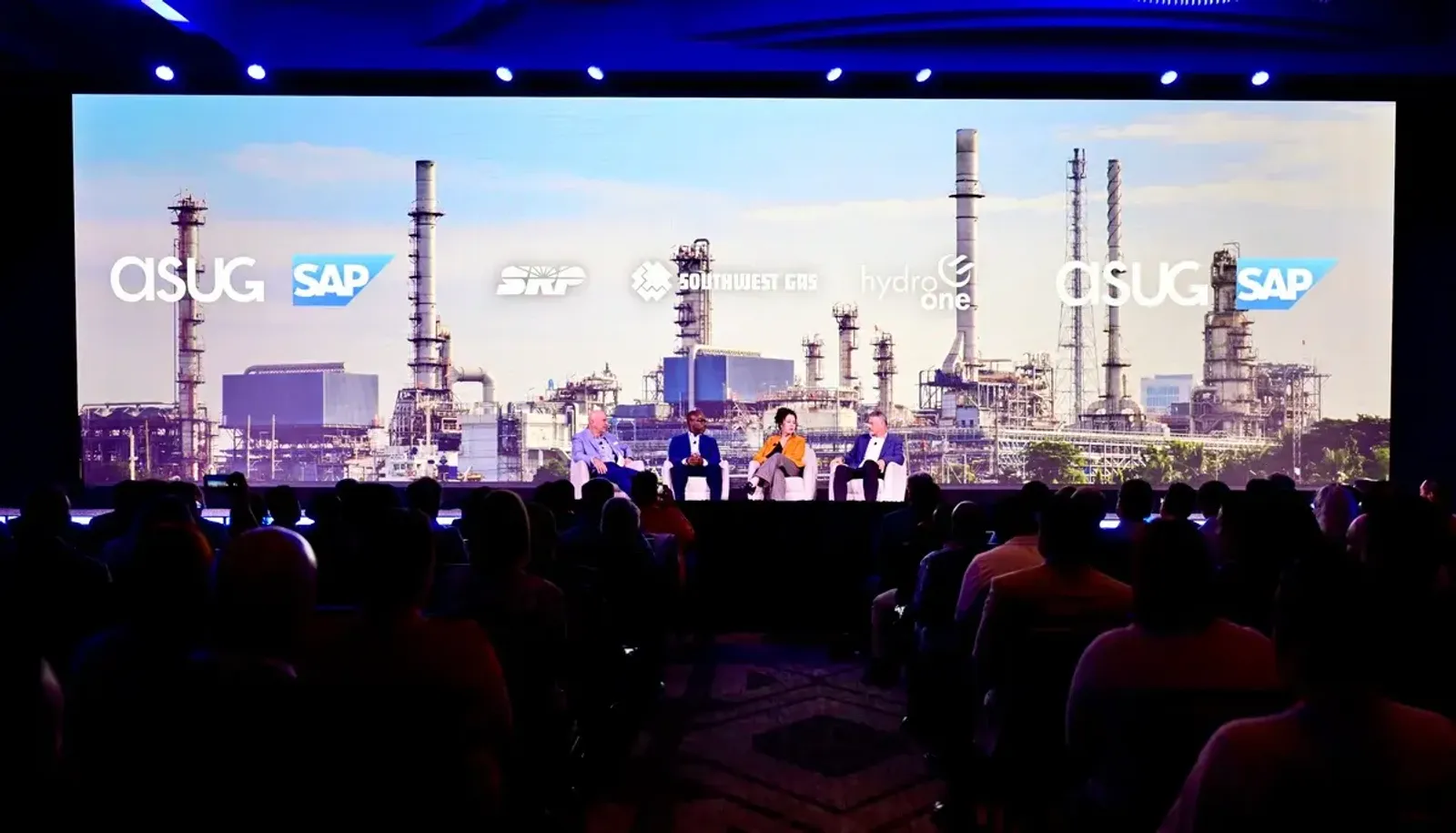
The afternoon keynote gave the stage to three customers. Leaders from Salt River Project (SRP), Southwest Gas, and Hydro One fielded questions the community submitted on migration, data, AI, and leadership. Their answers kept circling back to the same obstacles — among them master data that a panelist said is not yet ready for AI and employees who have yet to be trained to check what an agent produces.
On whether people stay in the loop, the sessions agreed. A planner still approved the schedule in SAP’s example, and a panelist stressed that he would keep AI out of safety conversations altogether. Matt London, Regional Vice President for Renewable Energy and Utilities at SAP, asked attendees to find the point in their own processes where humans should stay in the loop.
The Building Blocks of Industry AI
London grounded his presentation on a single scenario. A customer asks whether the utility can support an expansion by next summer, and a transformer’s maintenance could get in the way.
Working through it, he said, starts with an ontology, which spells out what the business means by its terms and how they relate, so that a customer has a contract, and a work order belongs to an asset. A knowledge graph then adds the specific facts, this transformer and this customer’s requested connection date, and shows which work has to happen first.
“Connected information is not automatically correct information,” said London, repeating the line for emphasis. Utilities still need to know where a fact came from, how current it is, and whether systems disagree, he added.
From there, agents take over pieces of the work, one assembling the maintenance findings into a work package, another checking equipment availability, with governance deciding how far they can go. London was specific about where that stops, noting that “a recommendation is not authorization.” A utility might let an agent prepare the work package, in his telling, but a planner still must approve the schedule, and anything touching safety follows the utility’s existing controls.
Two Demonstrations, One Pattern
Demonstrations from SAP’s lab followed. London told the audience to “look beyond the answer on the screen” and pay attention to where each answer’s business context came from, how much of the work the agents handled, and when a person had to make the decision.
DJ Taylor, Vice President of Delivery for Renewable Energy and Utilities at SAP, showed a command center for meter-to-cash exceptions in which AI runs the checks an analyst would otherwise perform across multiple transactions. Releasing the exceptions it flagged with high confidence freed up revenue, and Taylor described the approach as letting Joule do the work while “keeping the analyst in control.”
Navin Kumar Prasannam, of SAP’s Global Industry Business Unit for Utilities, followed with interconnection management. In his scenario, agents had processed roughly 800 applications and routed 11 exceptions, each with a recommended solution, to a program manager. “You see multiple agents working in tandem, all of it grounded on your business rules,” he explained, reiterating that the person still oversees the work and can intervene.
London closed by asking attendees to identify where a person must make the decision in their own processes, which he described as more useful than asking where AI can be added. “Taking an idea from the lab into daily operations takes more than technology,” he said, emphasizing that it also demands people who understand the business and leaders willing to challenge established processes.
A Candid Dialogue on AI Readiness and More
The closing keynote, moderated by Craig Dalziel, Chief Financial and Chief Operating Officer at ASUG, opened with the question of common migration mistakes. Sarah Peluso-Ibarra, Director of Customer Technology Support at Southwest Gas, named a few, all involving data. Utilities underestimate the strategy that data migration demands, she said, overlook legacy fields that were repurposed over decades, and misjudge how much restructuring SAP’s data model can require.
The legacy system at Southwest Gas tied one customer to one contract and one premise, while SAP’s model is one-to-many. When the utility moved to SAP in 2021, it postponed the restructuring of business partner data as too complex and risky for the project. That work was finished almost five years later, and she advised peers to take it on while implementation partners and project resources are still in place.
Gibs Saint Paul, Senior Director of IT Services at SRP, said his utility’s data is not yet where it needs to be for AI. He recalled a company hackathon where many use cases involved “having to massage the data just to get the agent working,” which he said speaks to the importance of master data governance.
Where AI Fits and Where It Stops
As AI adoption grows, Peluso-Ibarra said, utilities will need more creative thinkers and existing experts upskilled to verify what AI produces. She added that bringing employees along requires psychological safety.
Wayne Logan, Director of Enterprise Applications at Hydro One and technology lead on its current SAP S/4HANA implementation, said organizations still need people who see the big picture and people who can go deep into the details. He added that he would keep AI out of safety conversations, where an incident calls for human-to-human communication.
In the field, Peluso-Ibarra said Southwest Gas has given crews an assistant that searches hundreds of pages of procedures from a phone. A second use case, still in early development, addresses what she called the “cold knock,” an unannounced technician visit that can be met with threats.
She cited a recent American Gas Association survey that found safety issues, threats, and violence against natural gas utility employees have increased by more than 60%. The company, she added, is exploring how AI can pull together safety information from disparate systems before a technician arrives. “We want to make sure that every single employee gets home safely,” she said.
What Comes Next
Logan called for more change leadership over the next 12 to 18 months. “We talk a lot about AI, but we don’t talk about creating an AI-ready organization,” he said. Peluso-Ibarra said Southwest Gas has an opportunity to shore up its data governance and AI governance before pressing ahead.
In his parting advice, Saint Paul urged attendees to talk to their peers, saying there is “no reason to suffer in silence” when utilities share the goal of providing affordable, reliable service. Inside the organization, he called a strong partnership between IT and the business a requirement. The aim, he said, is to be “business-driven, IT-enabled.” ASUG closed the session by announcing that next year’s conference will be held in San Diego.
Excellence Award Recipients
The conference also recognized five utilities with SAP for Utilities Excellence Awards, presented across the Wednesday and Thursday morning keynotes.
- Utility of the Year (Large Enterprise): Southern California Gas Co.
- Utility of the Year (Mid-Sized): New Jersey Resources
- Industry AI Trailblazer Award: PPL Corp.
- Excellence in Customer Service: PSEG
- Excellence in Work and Asset Management: Southern California Edison
New Jersey Resources went live this year on SAP S/4HANA with IS‑U, completing a fully integrated end-to-end platform, and Southern California Edison was scheduled to take SAP Field Service Management live for nearly 4,000 field service resources the Monday after the conference.
“Behind every achievement we celebrate are people who did difficult work to make it happen,” said London.
You Might Be Interested In
Log in to save this article and keep your favorite resources in one place.
Log in to save this article and keep your favorite resources in one place.

Log in to save this article and keep your favorite resources in one place.

Log in to save this article and keep your favorite resources in one place.