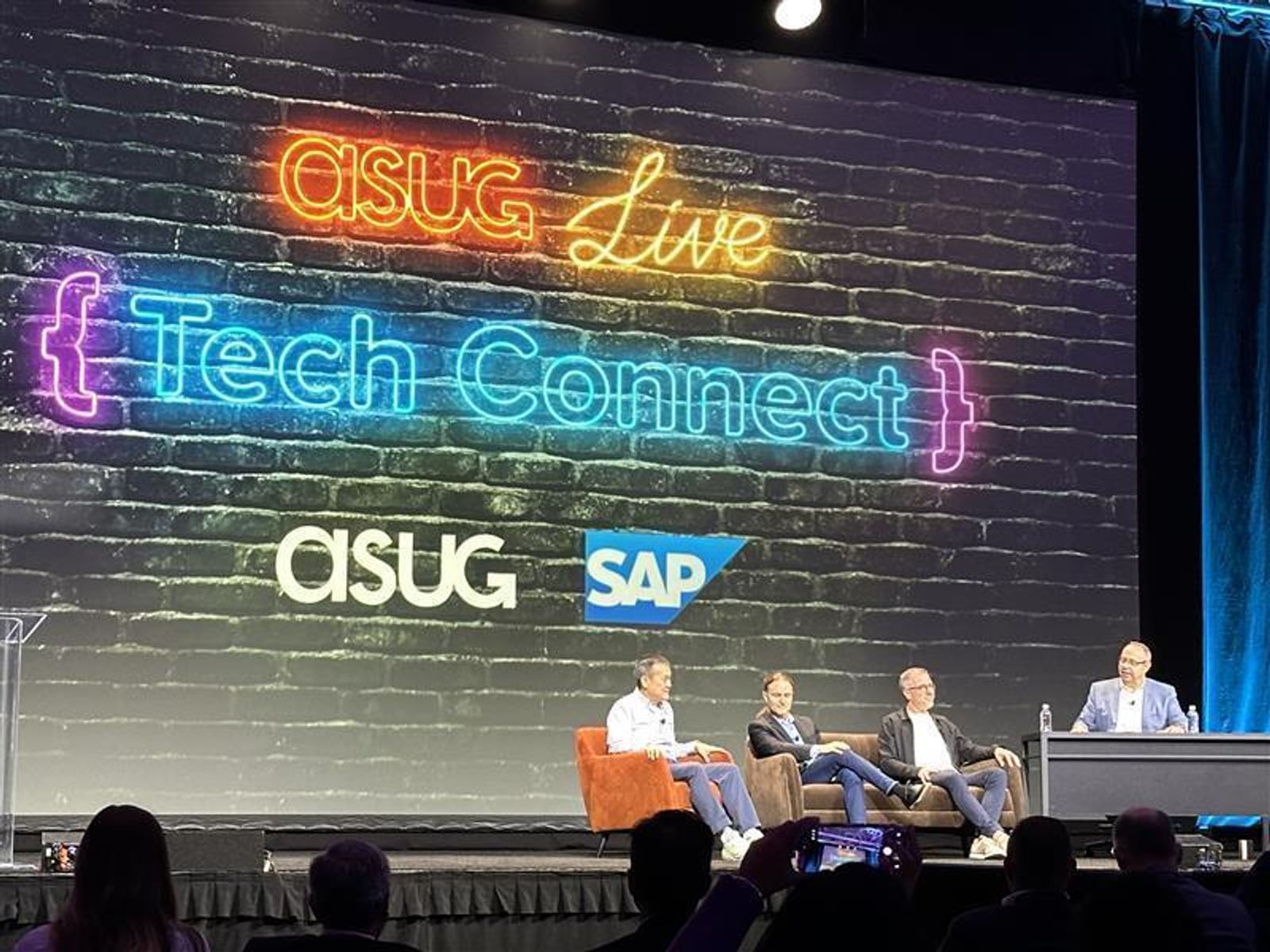
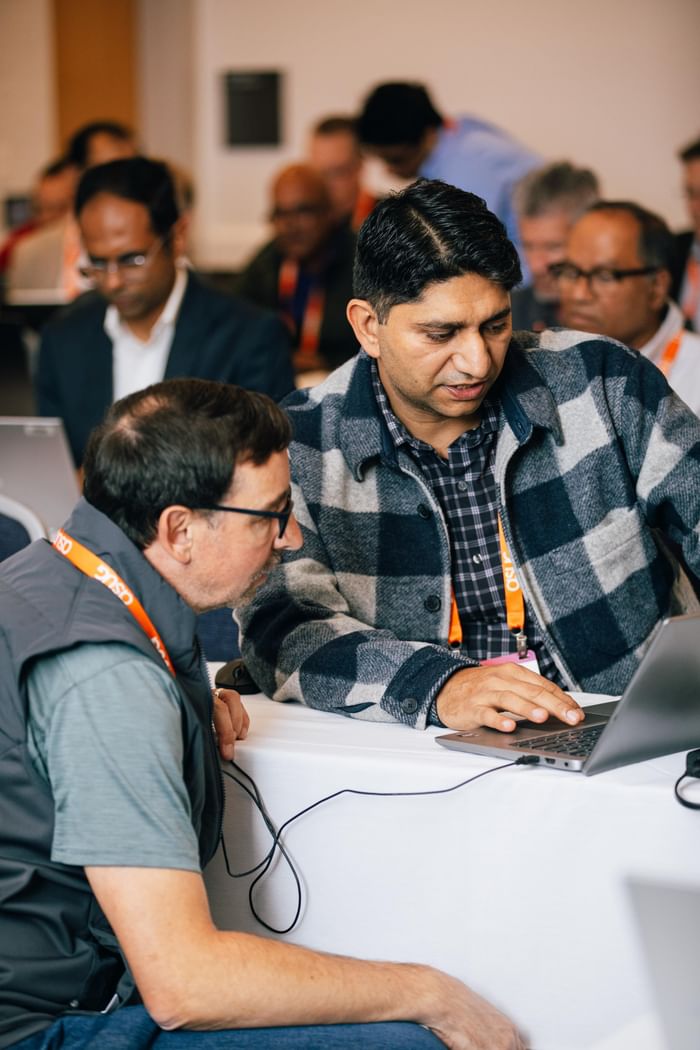
Bringing together the SAP practitioner community in Louisville, Kentucky, for three days of hands-on learning with SAP solutions, peer-led sessions on real-world implementations, and networking with industry partners, the third annual ASUG Tech Connect conference kicked off last week with a lively keynote conversation about the future of enterprise technology.

Focusing on major themes driving transformation—from cloud and AI to business change, innovation, and the professional upskilling required to make sense of it all—the keynote session featured ASUG CEO & Chief Community Champion Geoff Scott in conversation with leaders from SAP, Databricks, and the SAP customer base.

Introduced to the keynote stage by ASUG Partner Success Manager Chase Lennartz, Scott served as the keynote's host in a live talk-show format; he focused his opening remarks around transformation, AI, and business outcomes — and stressed that organization-wide transformation is only half of the equation. 

"Before we talk about transforming organizations, we really need to talk about how all of you transform yourselves as professionals, because the truth is none of these big technology strategies succeed without you all leading the way," he said. 

"Business transformation does not happen without professional transformation, and your organizations are ultimately going to be gated behind your ability to also think about things in new and innovative ways."

Updates, Announcements for SAP Business Data Cloud

ASUG Tech Connect coincided with SAP TechEd in Berlin, where SAP announced expanded developer capabilities for SAP Business Data Cloud along with SAP RPT-1, its first relational foundation model. Video-conferencing in from Berlin, Muhammad Alam, Member of the Executive Board of SAP SE and leader of the SAP Product & Engineering board area at SAP, shared key announcements and insights with the Louisville audience.

“Every week we hear two conflicting opinions: ​One says there’s a developer shortage. ​The other says AI will replace developers altogether. ​Both of these can’t be right,” Alam said. “​Here’s the truth: developers aren’t going away. They are getting supercharged.”

Following last month’s launch of SAP Business Data Cloud Connect for Databricks and Google Cloud, Alam shared that SAP is launching SAP Snowflake, bringing the full data and AI capabilities of Snowflake as a solution extension to SAP Business Data Cloud natively. He also shared that SAP will be providing its customers with the most context-rich agentic platform yet. 

With the Agent Builder in Joule Studio, as part of SAP Build, SAP users can create and extend ready-to-use agents quickly, in a visual low-code environment. SAP is also extending its VS Code for SAP Build and adopting MCP standards that ensure flexibility and choice in how developers set about leveraging SAP's ready-to-use agents and building their own.  

The final announcement from Alam involved the launch of SAP RPT-1 (pronounced “rapid one”), the first foundation model built specifically for structured business data. RPT stands for Relational Pretrained Transformer, and it is meant to deliver enterprise-grade accuracy and scale to build reliable, high-value agents based on individual SAP customer business data and processes. ​

“As developers, you are not on the sidelines of this AI revolution. You are the revolution. And we are here to supercharge you for what’s next,” Alam said.

"We know teams are already stretched thin, and backlogs are never-ending," he added. "We're not asking you to do more with less. We're giving you smarter tools — so you can do more, more quickly. Our strategy at SAP is very simple: best-in-class applications across the breadth of business processes: finance, spend, supply chain, HCM, customer experience, which then produce a harmonized, managed and governed data layer, which in turn powers world-class AI."

To read more about SAP TechEd, dive into our full report on the announcements

Continuous Learning for Future-Readiness

Reflecting on the importance of professional development in making business transformation a reality, Scott noted that AI is a tool, but it doesn’t solve every problem. “AI is not going to be valuable unless we have the skills to apply it responsibly, securely, and strategically in our businesses,” Scott said. “We also have to have the curiosity and courage to experiment and explore with these technologies to help broaden organizations and enable them to evolve and succeed.”

Scott welcomed Dr. Walter Sun, SVP and Global Head of AI at SAP, to the stage, asking him about the skills needed to excel professionally with AI to drive business outcomes.

Sun recommended being a “learn-it-all” (as opposed to a “know-it-all”). Upskilling can involve deep-dive trainings through Deeplearning.ai and learning.sap.com/AI, as well as attending events, Sun said by way of example. He also talked about starting small with AI and exploring various large language models (LLMs), considering more accessible and low-cost ones at first. Joule also helps ease users into the technology without diverting them outside of their core SAP applications, he said.

Scott asked Sun what the SAP customer base might not fully understand about the AI revolution. Sun responded by reflecting on AI prompts, emphasizing that AI is only as good as its instructions. “If you don’t give it the right instructions, it won’t do the right thing for you,” he said. It’s important that users prompt it correctly — and work to ingrain knowledge of this capability within their organizations. Sun highlighted SAP's Generative AI Hub, which offers more than 40 LLMs for users to leverage in improving their prompt-optimization skills. 

Future Predictions on the State of AI

Joining Scott and Sun on stage, Yaad Oren, Managing Director of SAP Development Labs U.S. and Global Head of Research & Innovation, spoke about how SAP stays ahead of fast-moving innovations — and what’s next for enterprise technology.

He explained that SAP looks to technological ideation currently coming out of academia and explores how it might apply to business, even 10 years down the line. SAP customers are consulted to help the company assess if such technologies make sense for their businesses, and SAP scales the pertinent technologies (especially for logistics and finance) into new products.

Oren walked the audience through the trends that are poised to disrupt tech:

  • Physical AI: Robotics for warehouse management and logistics are top of mind at SAP.

  • Quantum computing: For optimization of supply chain and logistics, there is potential for 100x improvement through the use of quantum computing, said Oren; SAP and IBM maintain a strong partnership in quantum, and SAP is developing algorithms and business processes to consider quantum alongside classical and AI compute. 

  • User experience (UX): Because Generation Alpha grew up using AI and will join the workforce in five years, they will soon bring different approaches to tech, Oren noted.

  • Data: The data platforms of today will differ greatly in just five years, Oren said, speaking to the rapid pace of innovation in compute and storage.

  • Cloud architecture: Along with data advancements, cloud architecture is on a continuous journey of growth.

  • AI: “What we have today is a generation of AI,” Oren said. Generative AI is dominating the tech market today, but there are more types of AI that are advancing in the coming years.

These new technologies are still new and are maturing, Oren noted. “This means the timeline is not really plan-able,” he said, advising that organizational leaders remain flexible and able to adapt their goals along with the technology available. Similarly, regulations change and can be difficult to anticipate. SAP can build a technology, but a regulation in one country might disrupt it. “I recommend to keep an open approach,” Oren added.

While planning can be challenging, sticking to the status quo when it comes to technology should not be the focus. When Scott asked about the risks associated with these technologies, Oren emphasized that “the main risk is the risk of not doing anything.”

A Word from SAP Support

Stefan Steinle, EVP and Head of Customer Support & Cloud Lifecycle Management at SAP, joined the keynote stage to discuss how SAP support plays a critical role in helping customers to run their business processes. 

“We learn a lot from our customers about our products,” Steinle said, adding that his team consistently asks SAP customers questions about how they use SAP products and what might be missing in terms of functionality, sharing the feedback with the SAP product and engineering teams for continuous improvement.

He shared common questions and concerns that his team hears from SAP customers — in particular the desire to reach a "north star," or a centralized location for numerous ERPs, LoB applications, and third-party apps, more efficiently. This is an important area of focus at SAP, and it requires Steinle's team pointing to the right services and support.

"We have absolutely understood that we need to help our customers along these transformation journeys," he said. "We have to help them with our service and support portfolio, making sure we have the right success plans for them. We have to help them with things like the RISE with SAP methodology and clean core." 

SAP Cloud Application Lifecycle Management helps SAP customers find that north star; Steinle said that SAP has expanded the scope of Cloud ALM to position it as the center of an SAP integrated toolchain, so customers can foreground Cloud ALM in executing their transformation initiatives. "We find that it is really a transformation execution platform, which helps our customers across the entire journey," he said.

Cloud ALM now incorporates an AI roadmap, including agents to create project reports, analyze system health, and improve end-user experience, Steinle said; there will be an issue detection and resolution AI agent announced soon to bolster these capabilities, he added.

Scott asked Steinle about his vision for SAP support experiences, to which Steinle said that he aims to ensure the support experience is proactive and seamless — and for the support team to work like an SAP partner who is always a step ahead, as opposed to simply reacting to technical problems as they emerge.

Tomorrow's Energy Industry, by Databricks and SAP BDC

Carlos Gomez, VP of Global Partners and Strategic Software Alliances at Baker Hughes, next took the stage opposite Will Bungener, North America SAP Sales Leader at Databricks, to discuss how Databricks is supporting energy technology company Baker Hughes with energy industry data integration. 

Across the energy and industrial value chain, challenges around data quality, legacy systems, and talent shortages have created various roadblocks to the type of data transformation that would allow energy companies to enhance "autonomous operations" through AI, Gomez explained.

At Baker Hughes, which provides products and services for the oil and gas industry, working to support these customers by enhancing digital service capabilities through technology is a priority — albeit one complicated by data integrity and quality issues.

"Data quality continues to be a major issue in a lot of what we do, whether that's because data is either siloed, there's dark data, there's unstructured data," he said. "Sometimes the data simply does not exist, so we need to create it from scratch to be able to eliminate those silos; as usual, there's legacy systems we need to deal with."

Ultimately, “we want to get to a place that enables data to be AI-ready,” Gomez said. Doing so for Baker Hughes' energy customers, where not only independently housed data but entire systems and companies need to be linked together, requires zero-copy sharing, platform accessibility, and holistic data integrity — a set of criteria that led the company toward partnering with Databricks and SAP Business Data Cloud. 

Through its Cordant technology—a modular, interoperable, AI-driven industrial enterprise solution designed to optimize assets, processes, and energy use at scale—Baker Hughes works to optimize asset performance management for energy customers, providing insights to customers that make their maintenance strategies more efficient and cost-effective.

"We're really talking about using AI to digest an autonomous set, a root cause analysis, so that with that output of an operational envelope, you are now able to better adjust on producing 1% extra amount of energy," Gomez said. "From that standpoint, you're literally talking about millions of barrels a day, millions of output of energy that we can be giving our customers and users out in the field."

Beyond the employee safety that visibility can support, energy and sustainability management is a prime focus area for Baker Hughes, which monitors its green ledger through collaboration with SAP and Databricks, with an eye to optimizing processes in support of ESG goals. 

All that optimization of asset strategy would be impossible without the data platform and capability Databricks and BDC provide. Creating custom integrations to improve asset performance has required fast, flexible, and scalable data. Where the necessary data transfers previously took months—even up to a year—Gomez’s team can now perform them in hours, helping Baker Hughes customers achieve ROI quickly.

Closing Statements on Data, AI, and the Future of the Enterprise

Taking the keynote stage for a lightning round of insights, thought leaders answered overarching questions posed by Lennartz around the future of enterprise technology.

Walter, what is the single biggest opportunity you see for SAP customers in the next year?

Walter Sun: "Three years ago, people were learning how to use LLMs, from consumer to enterprise. Two years ago, it was training and tools. A year ago, more tooling. This year is the year of agents... Understanding how to take agent technologies, as your junior assistant, and having them work in concert together with Agent2Agent and other technologies as well — that's what I think is big for this year.

Yaad, what excites you personally about the future of enterprise technology?

Yaad Oren: "It's about the symbiotic connection between human and a machine. We see a lot of innovation coming in AI about what's going on with reinforcement learning. If you all remember what we've learned about DeepSeek AI, and so forth, you can do bigger computation with smaller hardware. This is going to enable us to put more of those small brains around physical things, whether that's Edge, autonomous cars, a humanoid, or an assembly line. We're going to see great things coming from productivity perspective, in this symbiotic connection between machine and human."

Stefan, what's the one thing everyone should stop doing right now?

Stefan Steinle: "If there's one thing we have learned in customer support at SAP, which is valid for all of us here in the room, it's that we should stop doing things the way we've done them yesterday. AI offers so many opportunities to do things totally differently; we develop software differently, we run processes differently, end users work differently in the age of AI. I think we should stop optimizing what we have done yesterday and rethink how we do things in the future — creating tomorrow with the help of AI, in an AI-native way.

Will, looking ahead and into the future, what is one thing you're most excited about?

Will Bungener: It's the ability, it's the impact, as organizations unlock their SAP landscapes and are able to marry their SAP data with unstructured and semi-structured data, such that AI and the most advanced models can come in, to enable your organizations like they've never been able to be enabled before.

Carlos, as the sole customer on this stage now, what is your best advice to leave with everybody here today?

Carlos Gomez: I would say, with the pace of technology changing at the speed it is, it's all about keeping a growth versus fixed mindset. If you think about the Gutenberg Printing Press, it took us 500 years to fully utilize it because of illiteracy, right? Finally getting the world to be able to read. ChatGPT was adopted by a million users in five days. The speed at which technology is changing us is really based on us now, right? How we approach embracing technology is going to be how we differentiate ourselves, as well as the folks that we lead in our companies across the world.

Geoff, what is the one message you want to leave everyone here with?

Geoff Scott: I look at our ecosystem, at everything that's happening around us — high degrees of volatility and uncertainty. When we think through where we want to go with all of this, it has to be that change has never been this fast, and yet will never again be this slow. We're in a situation where we need to support each other; we need to learn from each other, connect with each other, and that's what we're all about here at ASUG: to help you have the skills and tools that you need to succeed as you move forward into 2026.

Want to continue reading this article?

Become a member and get access to all ASUG benefits including news, resources, webcasts, chapter events, and much more!

Log in

Not an ASUG member? Learn more