Log in to save this article and keep your favorite resources in one place.
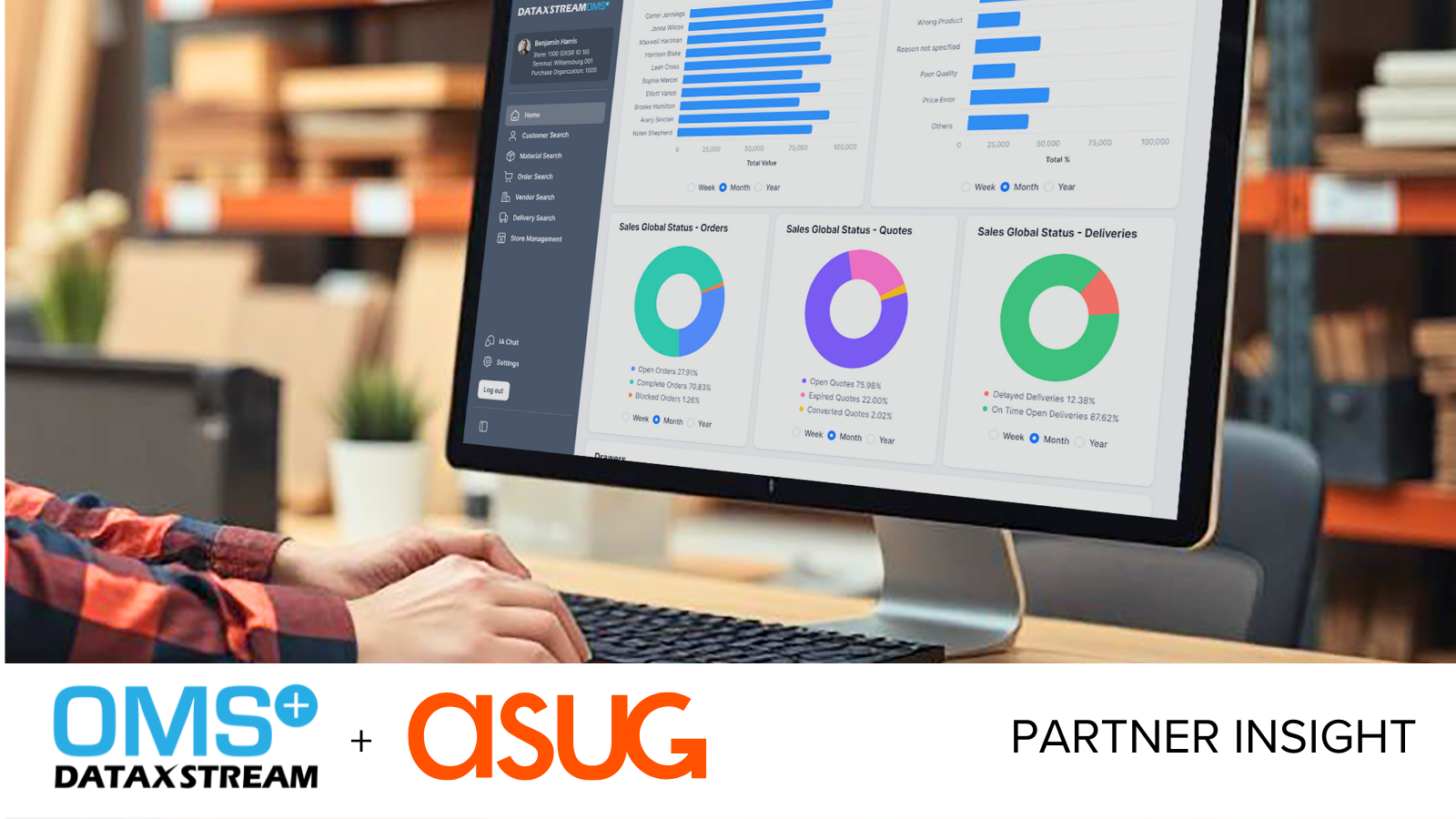
This partner insight was authored in collaboration with DataXstream.
Some SAP processes are easier to modernize than others. Order management often isn’t one of them. As companies migrate from ECC to S/4HANA or shift workloads from on-premise systems to cloud deployments, they face pressure to rethink sales workflows built around years of customization. Adjusting them without affecting operations remains one of the most difficult challenges.
Sales and distribution processes carry a level of complexity that infrastructure upgrades alone can’t resolve. Legacy systems often reflect decades of business rules, regional exceptions, and customer-specific conditions. Tools that only address individual parts of the process, such as CPQ applications or standalone payment engines, leave operational gaps. Out-of-the-box systems may require extra integration work, creating friction just as companies attempt to simplify their landscapes.
SAP’s push toward cloud-native ERP has introduced new options for flexibility and scale. The S/4HANA Public Cloud Edition offers capabilities previously limited to high-investment deployments. Yet, the transition raises new questions for enterprises with deep ECC roots or multiple SAP tenants. Moving core order processes into environments governed by clean core principles requires more than compatibility. It demands a new way of maintaining consistency across platforms without duplicating complexity.
SAP’s cloud-first approach dramatically broadens ERP accessibility, empowering small and mid-sized businesses to leverage solutions previously beyond their reach. DataXstream’s OMS+ is built to support the same shift SAP is making toward more accessible ERP. It gives mid-sized companies a simpler way to move forward, with pricing and deployment options that match the needs of businesses stepping into the cloud without the scale or budget of large enterprises.
OMS+ originated when DataXstream’s team recognized a recurring pattern: clients kept asking for the same custom sales solution. Rather than rebuild it repeatedly, they created a configurable product layer that could serve multiple SAP environments. Since then, OMS+ has matured through four generations, moving from on-premise to hybrid and now to full support for SAP’s private and public cloud models.
The platform addresses this tension by executing order processes directly inside SAP. Quoting, fulfillment, returns, and payments are all handled natively, using SAP’s own pricing structures, inventory logic, and sourcing rules. There’s no need to replicate workflows or synchronize data across disconnected applications.
The product supports the full sales lifecycle and adapts to various business models. Customer service agents, field sales reps, and retail clerks each get a role-specific interface built on a unified platform. Within a single view, users can access product availability, pricing conditions, sourcing options, and delivery constraints without navigating SAP’s standard transaction codes.
This functionality is made portable through a process abstraction layer that separates the front-end experience from the underlying system. As a result, the same workflows function across ECC, S/4HANA, and SAP’s public cloud with no need for redevelopment. That consistency extends across centralized and distributed deployments, allowing OMS+ to operate in hybrid environments with multiple SAP instances.
Because OMS+ continues to operate normally throughout system transitions, it allows organizations to migrate or restructure without interrupting core sales activities. There’s no need for stopgap tools or workaround processes during the changeover. Some enterprises also use OMS+ as a modular overlay across business units with separate ERP systems, where it acts as a unifying front end that does not require full-stack ERP harmonization.
Heavily customized sales and distribution processes pose significant migration challenges across industries, such as those experienced by a customer in commercial electric distribution, for whom more than 50% of all ERP customizations related to sales. Similarly, a customer in commercial component distribution faced similar hurdles, with 70 – 80% of custom logic concentrated in this area. OMS+ substantially alleviates this technical debt by 80% by standardizing approximately typical sales customizations, simplifying migrations, and reducing long-term maintenance burdens.
Once these core sales processes are standardized, the next challenge is tying them to the broader digital infrastructure — payments, shipping, and orchestration tools — that make modern fulfillment possible.
To support that modularity, OMS+ simplifies complex integrations by embedding essential third-party tools into its core, such as payment solutions (Fiserv, Stripe), shipping (ShipERP), and SAP’s own sourcing and orchestration components: Order Management Sourcing and Availability (OMSA) and Order Management Foundation (OMF). These integrations significantly streamline selling processes and unify multiple ERP systems.
OMS+ has also aligned early with SAP’s evolving approach to payment infrastructure. For example, the platform was already well-suited to SAP’s newer Digital Payments Add-on (DPA) model before the official guidance was even finalized. This forward compatibility reflects the product’s intentional alignment with SAP’s architectural direction, not just its interfaces.
Aligning closely with SAP’s clean core standards, OMS+ employs a dual-delivery model: a standardized public cloud solution ensuring strict clean core compliance at lower costs and a customizable private-tenant version catering to enterprises with extensive customization needs. Certification efforts are underway, with the OMS+ team working ahead of SAP’s enablement cadence, progressing toward formal recognition as a clean core-compliant solution.
Stability in the architecture layer also depends on how efficiently business users can execute day-to-day tasks. OMS+ supports this by automating high-effort, error-prone processes that typically slow down order management.
One example is material matching. When sales reps work with ambiguous or incomplete product references — common in emailed requests or spreadsheets — the system applies pattern recognition to locate the correct item. This shortens lookup time and reduces the risk of errors.
Consequently, material matching can cut search time by 60%, while automated email parsing reduces order processing from minutes to seconds.
Structured documents like PDFs and spreadsheets can also be parsed directly. Relevant details are pulled into the order form, reducing the need for manual data entry and cutting down on errors. Before an order goes through, the system checks for common issues like duplicates, incorrect pricing, or stockouts to help teams avoid delays or discrepancies.
With payment tools built into the sales process, DataXstream’s platform makes it easier to handle SAP’s financial workflows. Users can view credit status, outstanding invoices, and incoming payments in real time, which helps them stay informed and move faster.
Every automation feature in OMS+ is built around a clear outcome — whether it’s accelerating transaction speed, improving accuracy, or helping teams handle higher volumes with less effort. AI is applied only where it can deliver reliable value without compromising process control. This keeps the system stable at scale and usable across high-volume, compliance-sensitive industries.
OMS+ emphasizes user-centric design, featuring intuitive navigation, inline validation, and role-specific interfaces, achieving near-zero training requirements. As a result, most users can get up to speed in days rather than months, allowing organizations to onboard faster and respond more quickly to changes in staffing or structure.
As organizations continue to modernize and diversify their SAP environments, the role of order management is shifting from transactional execution to coordinated orchestration. OMS+ is positioned to become more than a fulfillment tool.
These enhancements are driven by deployment realities, not speculative use cases. Customers already rely on OMS+ in multi-tenant SAP environments with limited integration bandwidth. In those settings, it serves as a stabilizing control layer that ensures consistent execution across varied system architectures while adhering to SAP’s modernization principles.
The future roadmap includes predictive fulfillment logic, contextual user assistance, and support for composable ERP frameworks. Predictive AI and prescriptive logic will help guide decision-making in real time, offering suggestions based on past activity and current system conditions to improve fulfillment outcomes and coordinate complex sales operations.
For companies seeking modernization without fragmentation, OMS+ offers a way forward. It doesn’t replace ERP functionality but operationalizes it across landscapes that were never designed to function seamlessly together. By eliminating redundant customizations, preserving process continuity, and embedding intelligence into the order lifecycle, OMS+ resolves the challenges that make ERP modernization so difficult.
You Might Be Interested In

Log in to save this article and keep your favorite resources in one place.
Log in to save this article and keep your favorite resources in one place.
Log in to save this article and keep your favorite resources in one place.

Log in to save this article and keep your favorite resources in one place.