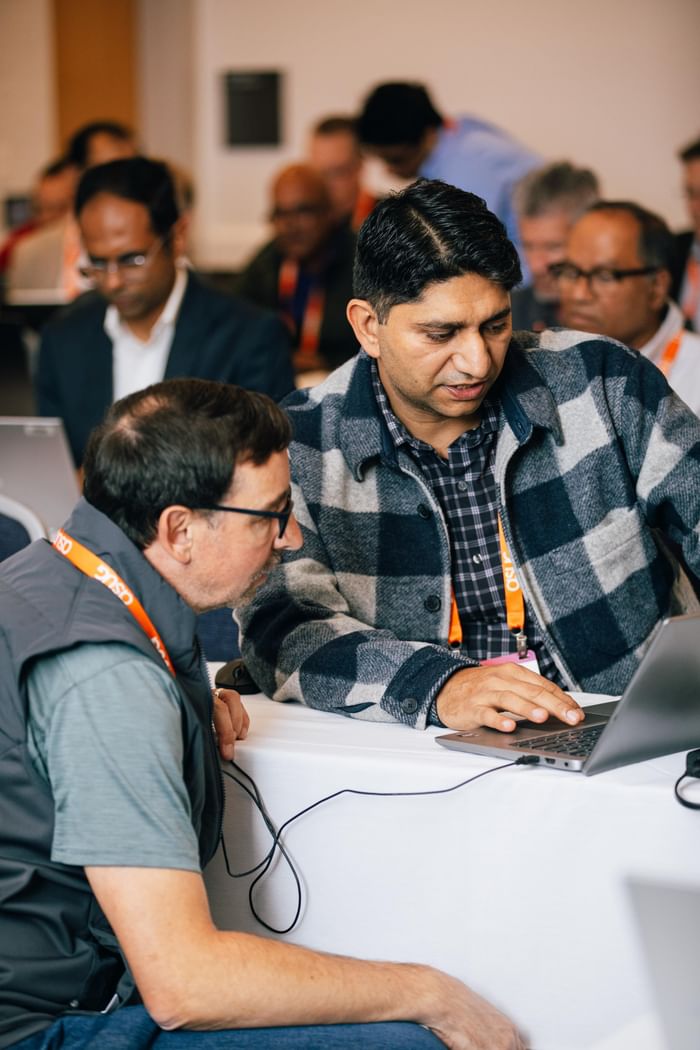
More than 1,500 utilities industry experts, professionals, and leaders convened in Denver, Colorado, last week for the SAP for Utilities, Presented by ASUG conference, marking the largest in-person gathering for this community to date.

Peer-to-peer networking was a critical component of the three-day event, which returned this year for its 18th edition, as attendees sought the knowledge and expertise to tackle seismic industry changes spurred by evolving customer expectations, growing regulatory and sustainability commitments, and unprecedented demand for essential services that their companies provide. 

As the conference got underway, Tuesday’s opening keynote address brought to the stage thought leaders from SAP, ASUG, and Xcel Energy:

  • Robert S. Kenney, President of Xcel Energy - Colorado, discussed Xcel’s $22 billion investment over five years to modernize the grid, its extraordinary success in reducing greenhouse gas emissions by 57% from 2005 levels, and its goal of achieving 100% carbon-free operations by 2050.
  • Michael Sullivan, National Vice President of Renewable Energy and Utilities at SAP North America, emphasized the importance of collaboration, technology, and innovation in addressing rising demand and complexities in the energy sector.
  • Jan Gilg, Chief Revenue Officer & President for SAP Americas and the SAP Global Business Suite organization, reflected on the need to reimagine operations to meet future demand.
  • Daniela Haldy-Sellmann, SVP and General Manager for Energy & Natural Resources Industries at SAP, and Viktor Kehayov, Chief Product Officer for SAP Field Service Management, shared how SAP is expanding its utilities portfolio with AI-driven FSM capabilities.
Unprecedented Demand, Transformative Solutions

Reflecting on the need for utilities to explore technology innovation, the keynote speakers all acknowledged that today’s industry leaders are navigating a perfect storm of challenges: rising demands on the energy grid—driven by the exponential growth of data centers and artificial intelligence, as well as wide-scale electrification and industrial expansion—alongside the added complexity of distributed energy resources (DERs), intermittent generation, and shifting sustainability mandates.

“We have unprecedented demand for all of our utilities, whether it's electricity, whether it's gas, whether it's water — unprecedented demand,” reflected Geoff Scott, CEO & Chief Community Champion at ASUG, in his opening remarks. “We have this whole AI future in front of us that will reshape our IT assets dramatically, then we have this amazing amount of rising costs for materials and labor that is driving a lot of our decisions as well… How do you move from uncertainty to certainty, and how do we get out of this spinning vortex?”

Robert S. Kenney, President of Xcel Energy – Colorado, took the stage to welcome attendees to his home state and discuss Xcel Energy’s leadership in the clean energy transition. The largest of the utility’s four operating companies, Xcel Energy – Colorado also represents the organization’s largest service territory by customer count, providing electricity to 1.6 million customers and natural gas to 1.5 million customers.

“We have some of the world's best resources for wind and solar power right here in our backyard,” he explained. “Colorado is famous for having over 300 days of sunshine, and our vast open plains and consistent wind patterns make it ideal for wind farms.”

With a commitment to be “as clean as we can, as fast as we can” without sacrificing reliability or affordability, Xcel Energy “serves Coloradans with an energy mix that is 45% renewable, carbon-free,” Kenney said. “That's a 57% reduction in carbon emissions from 2005 levels; we were among the first US energy providers to set a bold vision of being 100% carbon free by 2050 and the first to expand our goals to include net-zero natural gas and carbon-free transportation.”

Xcel Energy, which served as this year’s SAP4U Host Utility, is evolving in ways indicative of the significant challenges impacting utilities across the North American sector. As these organizations work to renew and enhance the energy infrastructure of decades past while continuing to deliver safe, reliable, affordable, and clean energy for customers, utilities face “growing demand for energy unlike anything we’ve seen in our lifetimes,” Kenney explained, citing “residential and commercial business growth, a renewal in onshore manufacturing, and the hyper-growth of the technology industry” as three factors now contributing to “load growth that is double and triple our historical load demand growth rates.”

In response, Xcel Energy is investing more than $22 billion in Colorado over the next five years to build a more resilient, flexible energy grid for the state; Xcel’s investments “will expand the power grid, accelerate clean energy options, further reduce greenhouse-gas emissions, and modernize our infrastructure to boost reliability,” Kenney said.

Technology innovation is essential in this rapidly evolving landscape, serving as “the backbone” of any energy provider’s ability to deliver reliable, resilient and sustainable power to millions of customers across the country, he added. “From the system used by our field operations that allow us to roll crews to the right place at the right time, to financial workflows that keep our projects on time and on budget, and mobile workforce management tools that trace service orders in real time, our technology systems are transforming how we work and the ways energy is generated, distributed and consumed,” Kenney said.

But “while transformation is sparked by new technology and technical upgrades, it is ultimately a flame to be fueled and sustained by the people who embrace and use the technology to drive operational excellence and to serve our customers better,” he said, pointing to the importance of in-person collaboration with providers like SAP and other utilities to fuel progress.

“We will continue to streamline our processes, launch new tools and modernize the way we work,” he said. “To make energy work better for everyone, that means continuing to invest in technology that empowers customers, supports our local economies, and helps us meet our ambitious clean energy goals. With strong partnerships and a shared vision, we will and can continue to build a smarter, cleaner and more equitable energy future.”

Collaboration as the "Center of the Bullseye"

Michael Sullivan, National Vice President of Renewable Energy and Utilities at SAP North America, set the stage for an on-stage Q&A with Scott by reflecting on utilities’ industry-wide challenge as “at the most fundamental level, a supply and demand problem,” albeit one with downstream consequences that require utilities to navigate an intricate web of complexity.

“The world needs more electrons than we can generate, transmit, and distribute,” he said. “Demand for natural gas is skyrocketing, and water—that most precious of resources—is not only facing the pressures of climate change; it’s also being put to work in new ways, cooling our data centers for example, and as a result we are managing a resource that is scarce.”

In this paradigm, “collaboration, as an ecosystem, is the center of the bullseye in terms of how we solve these problems,” he said. “We need to build the teams. And those teams aren’t just within our siloed organizations; they’re across the domains in our organization. We’re now in a world where customer operations, field operations, asset management, and finance are coming together in ways we’d talked about before theoretically but now are essential.”

In conversation, Sullivan and Scott noted the complexities of integrated planning in an ecosystem where generation, transmission, and distribution systems are being pushed to their limits. “We’ve got more generation capacity in the interconnection queue — double the capacity of the current nameplate generating capacity of the entire U.S. generating system,” Sullivan noted. “So, what do we do?”

As more distributed energy assets come onto the grid, optimizing customer engagement “requires a planning function that spans the entirety of the value chain,” said Sullivan, noting that SAP is working to solve this while ensuring affordability remains under control amid these evolutions of customer expectations and field service management.

For utilities to balance load growth with customer-owned DERs, demand-response programs are increasingly crucial, he added, noting “this intersection point between customer operations, asset management, and field operations” as one technology area especially requiring SAP's innovation.

Asked to reflect on the next inflection points in technology transformation for utilities, Sullivan acknowledged that “the economic value created by AI hasn’t been what was anticipated at first,” even as he stated that “the centrality of data” has allowed for major steps forward in terms of the development of generative-AI agents.

Powering America's AI Leadership

Next taking the stage was Jan Gilg, Chief Revenue Officer & President for SAP Americas and the SAP Global Business Suite organization, who reflected on accelerating energy demands and supply-chain bottlenecks precipitated by the mass expansion of data centers to fuel AI innovation.

With growing data centers expected to consume 68 gigawatts of power by 2027 (equivalent to two-thirds of the U.S. nuclear fleet) and new investments in data-center infrastructure expected to reach $1.4 trillion by 2030, “it’s fair to say that the utilities industry is powering America’s AI leadership,” Gilg declared.

To support utilities in that effort, he said, SAP’s flywheel of innovation—unveiled at this year’s SAP Sapphire—is intended to position the technology portfolio as an orchestration platform for applications, data, and AI. While AI can provide intelligent insights for consumers and providers, smart meter data can be unified with operational data, and applications such as SAP’s forthcoming DER platform will continue to strengthen utilities’ technology agility, Gilg explained.

To that end, Gilg shared customer examples including E.ON, leveraging cloud ERP within business transformation to more accurately trace billions in value flows; Pacific Gas and Electric Company (PG&E), embracing SAP Business Suite for simplification and standardization; and SA Power Networks, using SAP Business Technology Platform and AI to upgrade aging infrastructure and ensure reliable power delivery and safety of field employees.

Furthermore, he said, SAP’s investment in agentic AI to automate processes and embed analytics in operational processes is moving in directions that will directly benefit utilities, including through a dispatcher agent, a maintenance planner agent, and AI optimized for mobile functionality. “We want to bring in agents that can help you get rid of a lot of those isolated, simple workflows that you’re running often today, and simplify the landscape for you,” Gilg said.

More Transparency, Better Service

As the energy transition reshapes utilities’ operating models, SAP is positioning its SAP Field Service Management (FSM) solution as a key pillar of that change.

Daniela Haldy-Sellmann, SVP and General Manager for Energy & Natural Resources Industries at SAP SE, and Viktor Kehayov, Chief Product Officer for SAP Field Service Management, shared how SAP is expanding its utilities portfolio with AI-driven FSM capabilities that link asset management, customer service, and workforce optimization.

Haldy-Sellmann opened by describing the mounting pressures on utilities: the surge of distributed energy resources, the growing toll of extreme weather, and the rising demand from data centers. In her view, those forces demand more than stronger infrastructure. “They request more transparency, a better service, and more value for their money. And of course, they love to interact also digitally with the tools,” she said.

That new reality also redefines customers’ roles. Utilities are increasingly “turning [customers] from a pure consumer into also an energy-generating unit,” noted Haldy-Sellmann, which complements asset and workforce data in SAP Business Data Cloud.

To illustrate this, Haldy-Sellmann walked through the story of “Molly,” a grocery distributor who decides to install solar, storage, and heating. An AI self-service agent handles most of the interaction, then passes a complete summary to a live agent, who creates a tailored plan. From there, a smart meter order flows through the backend, generating work orders and dispatching a technician.

She went on to describe SAP’s business AI roadmap for utilities, which stretches across service case prioritization, sentiment analysis, automated billing, and distributed energy resource forecasting.

The Evolution of FSM

Kehayov shifted the focus to how FSM connects with asset management, asking the audience to picture a transformer about to fail with its warning signal buried in manual processes. In SAP’s model, the signal is captured in real time, enriched with context, and used to generate a work order automatically.

Dispatchers no longer need at least 16 steps; they can simply tell the system to “reschedule my schedule for the next two weeks,” and workloads are reorganized automatically.

Efficiency matters for people as much as for processes. Some dispatchers, he pointed out, arrive at work as early as 4:30 a.m. just to get schedules under control. “We can solve that. We can automate 80–90% of the mundane tasks for them, so they can focus on the exceptions,” said Kehayov.

Technicians are supported as well. FSM now delivers equipment histories, travel time estimates, and even suggestions for nearby jobs to maximize time in the field. “If you’re on site, you may be a couple of steps away from something else that you can still get done, and you get more productive,” Kehayov observed. To cut down on paperwork, technicians can dictate what they have done into a mobile device, and AI will summarize it into the record.

The momentum behind these capabilities is already clear. SAP’s FSM platform processes more than a million service jobs each month, and its AI scheduling agent has already scheduled over 6 million work orders. Overall, the system executes over 100 million business rules.

SAP is devoting about 20% of its engineering capacity to FSM. The roadmap calls for tighter integration with Cloud ERP, AI-driven tool recommendations, new geospatial map views for route optimization, and workforce management designed for both the “crew and crowd.”

Mobile remains another focal point. Some utilities want a lightweight deployment, while others need a mobile solution tightly integrated with ERP. Kehayov stressed that SAP will keep investing in both options so utilities can choose what fits. He closed on a personal note, reminding the audience that after 18 years at SAP, he is eager to shape FSM in close collaboration with customers and bring their feedback directly into the roadmap.

SAP is engaging utilities through advisory councils, including groups dedicated specifically to FSM and asset management, as well as co-innovation projects and early product testing. Peer learning from utilities is also shaping the agenda, while SAP’s Energy Park in Walldorf provides a venue to experience solutions firsthand.

Haldy-Sellmann closed the keynote by linking FSM and asset management back to real-world utility challenges. “The energy industry and utilities industry are in transition… transformation does look a bit different for each and every one of you,” she emphasized.

Through concrete scenarios and a focus on co-innovation, the leaders positioned SAP’s roadmap as a collaborative path forward rather than a set of disconnected tools. 

For more coverage of the SAP for Utilities, Presented by ASUG conference, stay tuned to the ASUG First Five newsletter.

Want to continue reading this article?

Become a member and get access to all ASUG benefits including news, resources, webcasts, chapter events, and much more!

Log in

Not an ASUG member? Learn more