A family-owned dairy products company based out of Denver, Leprino has been steadily advancing its SAP technology stack, a continuous process that requires alignment across various business units.
Over the past 10 years, Leprino has maintained an Enterprise Architecture Council (EAC), which plays a crucial role in guiding the organization’s IT decision-making process, aligning IT investments with overall business strategy as both the company and its technology stack continue to evolve.
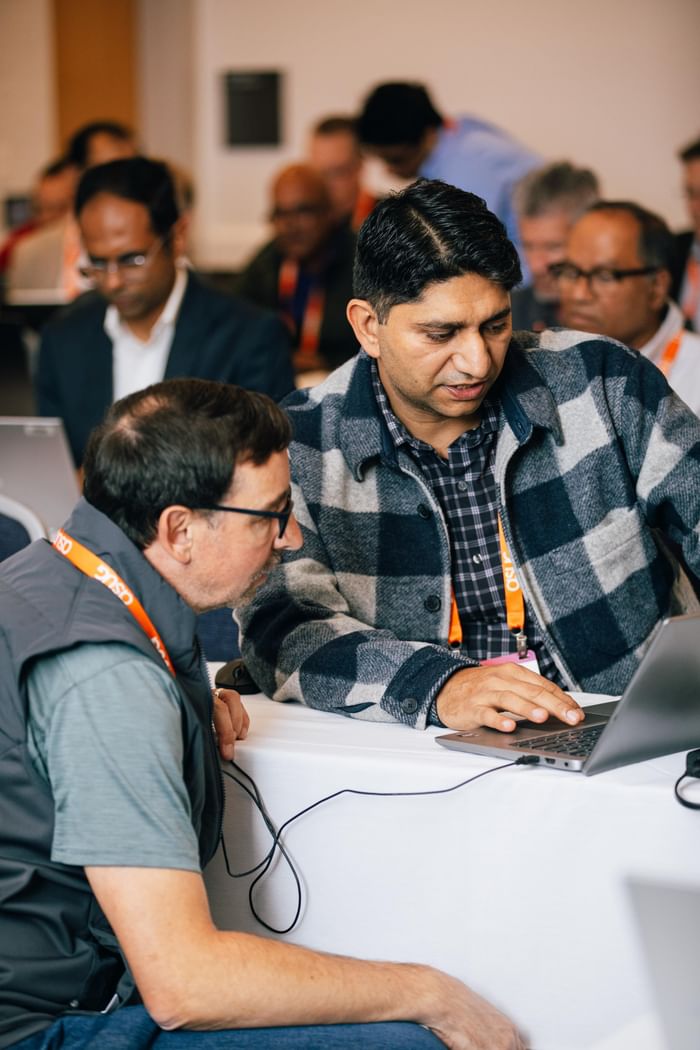
During a recent session at ASUG Tech Connect, a three-day conference that brought hands-on learning and expert insights to thousands in Louisville, Kentucky, Vedavyas Cuntheepuram, Senior Enterprise Architect at Leprino, walked the audience through the company’s history with SAP technology.
Reflecting on lessons learned along the way, Cuntheepuram shared resources and advice for other companies that are focusing on leveraging enterprise architecture as a guiding force for IT strategy. As a certified EA practitioner with more than 25 years of industry experience, as well as an ASUG Enterprise Architecture group volunteer, Cuntheepuram was eager to share insights and best practices.
Cuntheepuram covered the following lessons learned from 10 years in Leprino’s EAC:
Leadership alignment is the most critical step in establishing an EA group. Through the ups and downs of implementations, maintaining leadership support and buy-in is critical.
Maturity paths are also helpful in setting clear goals and milestones.
Cross-functional representation is also important, from as many areas of the business as possible.
Aligning with business priorities ensures that infrastructure and solutions support the business functions and priorities.
Communicating empathetically between key functions is one of the most important skills an enterprise architect can have.
Leprino’s EA Timeline
Leprino’s SAP journey started with its implementation of SAP ECC in 2009, followed by the adoption of several SAP technologies. Leprino most recently moved to SAP S/4HANA.
To achieve cross-business visibility and truly empower IT to support business needs, Leprino’s leadership, along with Cuntheepuram, established the Enterprise Architecture Council (EAC) in 2014. Creating roadmaps that spanned three to five years into the future, the EAC charted a clear path to enterprise-IT maturity through software implementations and capabilities, which also involved overseeing integrations across business functions.
“You need to start thinking about having a holistic picture of not only what the business impact looks like, but how it impacts your architecture,” Cuntheepuram advised attendees considering a similar journey. “You need to have an end-to-end view of what's going on.”
Leprino’s EAC continued to mature; by 2016, members of the council started to evaluate their own soft skills — a critical step for enterprise architects looking to bridge the gaps between business and IT stakeholders. Cuntheepuram acknowledged his tendency to communicate in a more hard-driving manner than others, which was a better tactic for reaching some groups in the organization than others. Another team member, with a more diplomatic communication style, could get through to other sets of colleagues very quickly. “Understanding the dynamics of your own group is key,” Cuntheepuram said.
By its fifth year in existence, EAC members had begun formally tracking progress against their objectives, goals, and tactics; in 2018, they started to iron out a larger architectural framework that would fit the organization.
For example, EAC members explored The Open Group Architectural Framework (TOGAF), but realized its principles were better-suited for larger enterprises. They were seeking to leverage EA practices without investing so heavily in tools and procedures. Instead, the EAC group looked to SAP AppHaus, which Cuntheepuram highlighted as featuring great content for leveraging AI.
In recent years, Leprino focused on cloud enablement and moving to SAP BTP; by 2020, the company could focus on evolving more holistically into an intelligent enterprise and implementing a framework to achieve that.
EAC Work Across the Business
Leprino’s EAC team has reviewed an average of 20 projects per year for 10 years. Identifying and addressing deviations from standards, enterprise architects at Leprino are focused on driving clean-core principles throughout the organization. EAC is involved throughout software implementation projects, often early in development, so the team can actively identify future problems and give guidance to prevent them well ahead of production.
EAC is also consulted on non-SAP applications. When there was a business function that wanted to stop using SAP and instead use a third-party application, EAC advised that while the third-party solution was a best-of-breed option, it was not the best fit for the organization based on its overarching roadmap. EAC was then able to make recommendations, supporting that business function in facilitating what it wanted to accomplish.
For integrations with other applications and vendors, a set of frameworks and structures for those integrations has been established by the EAC.
Leprino’s EAC is also involved in the execution phase of projects to ensure understanding, communication, and support for people working with technology directly — so that a go-live and subsequent adoption is as successful as can be.
Lessons Learned
“As a certified individual in the EAC, you want to do everything in the world from day one,” Cuntheepuram said. “But when we sit down, we realize that’s not always possible.”
One lesson he and his team learned early was that they didn’t have the time to document everything happening in their technology landscape, so instead they immediately began working with a project portfolio team and project management office to integrate their workflows and create a plan to document technology and processes as they went along.
Leprino’s EAC used definitions laid out in AppHaus’s Lean Enterprise Architecture Toolkit to apply an engineering mindset to understand, describe, and solve business problems, Cuntheepuram said. “Design Thinking” focuses on alignment of users and business, but “Architectural Thinking” focuses on alignment between business and IT. Leprino’s EAC team used these toolkits to inform their processes and frameworks moving forward.
Cuntheepuram put it well: “Clean architecture basically says, ‘What is the bare minimum, from an SAP perspective, that you need to be looking at? What are all the documentations that you need to create to ensure you have an end-to-end communication, as well as you are able to communicate properly with the business, as well as your production support?’”
The EAC team also aligned with leadership and business needs. “Business demands are the key. If business says we won't be able to invest in certain areas, we need to divert and align with them,” Cuntheepuram said.
Resources for EA Success
To conclude his presentation, Cuntheepuram highlighted key advice and resources. He recommended going into an EA journey knowing that IT will be complex to manage, with many in-process integrations that will arise along the way.
“You can’t manage everything,” he said. Having a base format and clear mechanisms to guide implementations will help. Reference architecture will also help in mapping out the enterprise architecture and show how the group will achieve implementation.
For resources, he pointed to the SAP Discovery Center, especially the Architecture Catalog. It has standard architecture references for SAP BTP, including information on how it works with AWS or Microsoft Azure. “You don't have to ask your developer or even any architect to start drawing those — you just start downloading,” Cuntheepuram said. “I go here and then give it to some other architect, and then they can start building.”
He also recommended looking at SAP Road Map Explorer to see upcoming changes and possibilities on the horizon.
As a volunteer in the ASUG Enterprise Architects Community, Cuntheepuram highlighted the content and sessions the group hosts, where EAs talk and gather feedback regularly. He even tapped the group in 2014 for feedback when starting Leprino’s EAC — helping to set the group up for success even 11 years later.
“Our journey at Leprino started in 2014 — without a framework, without reference architecture, without SAP alignment, without any of these key resources that enterprise architects have at their disposal today,” Cuntheepuram reflected. “Now, with these tools, training, and resources to govern your practice that SAP provides, there’s no better time to get started with building an enterprise architecture council at your organization.”
Understanding business processes, both in terms of their structure and their organizational impact, will only become more essential as cloud migration and AI adoption lead companies to streamline and consolidate areas of their business. Having an EAC in place to ensure effective communication between business and IT stakeholders will be a key factor in maintaining both awareness and supportability.
“Looking forward, AI is going to play a major role, with both upstream and downstream impact,” Cuntheepuram said. “Through the process maps and infrastructure definitions that come through our EAC tools, that impact will be easier for us to assess, manage, and optimize.”