More than 1,500 professionals from across the utilities sector gathered in Denver for the 18th annual SAP for Utilities conference, presented by ASUG. In his opening remarks on day two of the three-day conference, Michael Sullivan, National Vice President for Energy and Utilities at SAP, described an industry under pressure and a future that hinges on tighter collaboration with partners.
Sullivan invoked the theme of service, not just in the narrow sense of customer support, but as the guiding principle behind every interaction utilities manage. “We’re serving our customers, we’re serving our employees, we’re serving our co-workers,” he reminded the audience, connecting the daily responsibilities of utility leaders to the broader mission of reliability and resilience.
Sullivan noted that this year’s keynote would depart from the familiar success-story format. Instead of celebrating projects that had reached the finish line, he chose to highlight three customer journeys still in motion. Each case reflected “some pretty hairy problems and some pretty big challenges” where utilities, partners, and SAP are working side-by-side to overcome obstacles midstream.
By highlighting projects still underway, the keynote reflected a larger reality: in utilities, transformation is continuous. Growing demand from electrification, new regulatory pressures, distributed energy, and the rise of data centers are all straining existing infrastructure. Meeting that demand requires not only innovative systems and technologies but also new ways of collaborating across organizational and industry boundaries.
Customer Stories: Transformation in Motion
The first set of stories on stage demonstrated that transformation is rarely a straight line to success. Each utility featured is still in the thick of its program, working through complexity with partners and SAP in order to deliver reliable outcomes for customers.
SoCalGas: Building the Foundation
At SoCalGas, customer transformation leader Evan Goldman walked through the utility’s VISTA program, launched in 2022 to replace a customer system that had been running for more than 30 years. The first phase tackled routing, scheduling, and dispatch for four million annual service orders.
By April 2024, attention turned to the core CIS. Goldman stressed that this wasn’t an endpoint. “We’re not necessarily focused on the end state,” he elaborated. “We very much view the program as beginning. We’re building the foundation. We’re getting the technology right.”
A central decision was whether to adopt the first version of SAP Service Cloud for Utilities or to take on the less mature but more scalable second version. With lean contact center operations, Goldman worried about long handle times overwhelming staff if capabilities fell short. “Do we have enough confidence that those capabilities will be there in V2, or do we stick with V1?” he recalled asking.
That question became a forcing function for deep engagement with SAP. Goldman described product summits where requirements were mapped against release cycles, while SAP executives committed to accelerated delivery. Partners at Accenture joined to create a collaborative working model in which SoCalGas effectively stress-tested the roadmap in real time.
Tina Kuo, Senior Director, Customer Service for SAP Sales & Service Cloud at SAP, underscored the broader implications. “Whatever SoCal needs is actually what all of you will need as well,” said Kuo. By prioritizing SoCalGas milestones and shipping incremental updates every few weeks, the team was not only de-risking one project but creating features that would flow into the standard product for all utilities.
Salt River Project: Scaling Prepay with Reliability
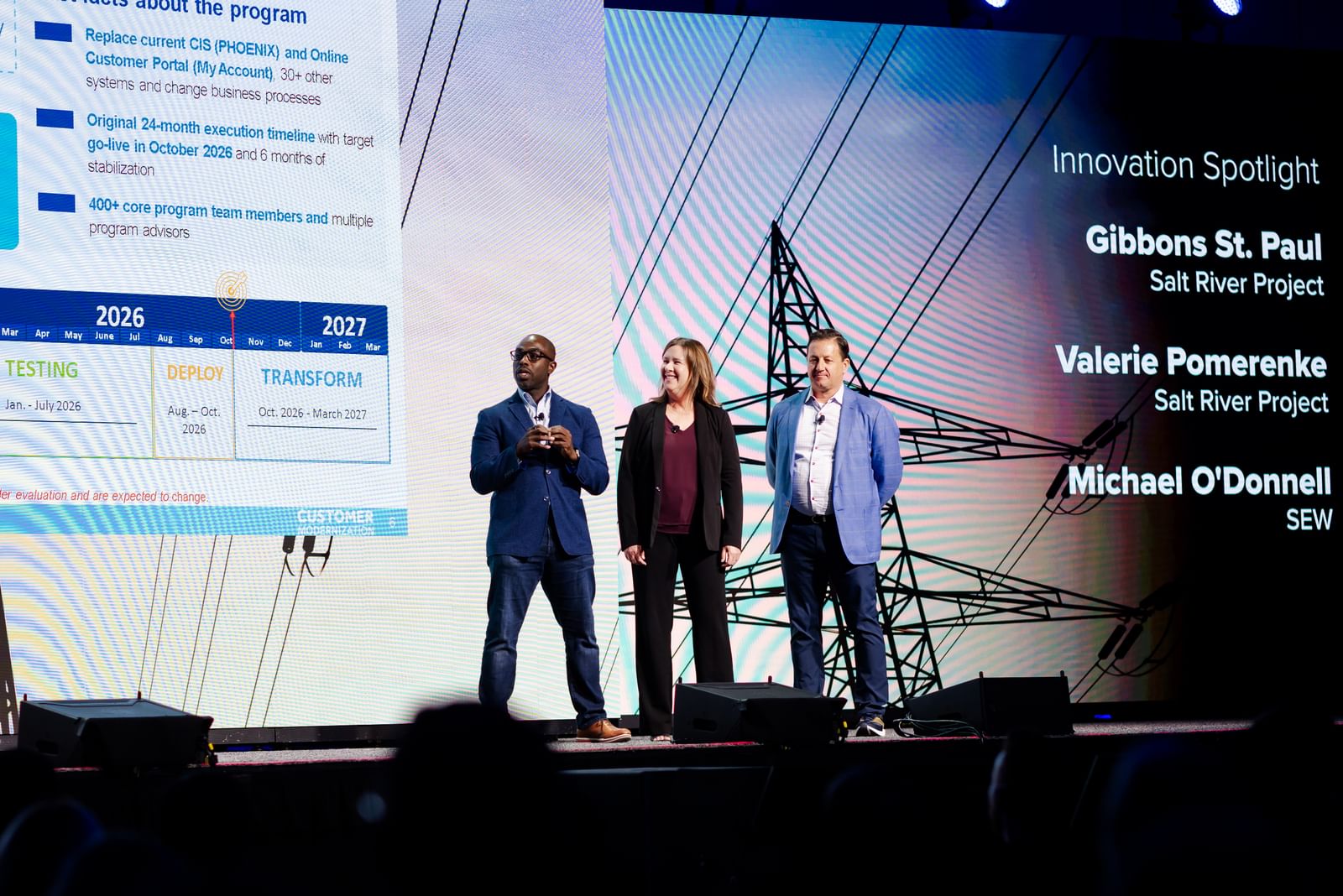
Salt River Project (SRP) in Phoenix brought a different challenge to the keynote stage. The utility is in the middle of a 24-month program to migrate from its mainframe to SAP S/4HANA on RISE. Gibbons Saint Paul, Director of Customer Modernization at SRP, emphasized that this initiative was not simply an IT exercise but part of SRP’s mission to deliver customer ease, data-driven operations, employee empowerment, and stability.
The Empower prepaid energy program illustrated what those principles look like in practice. Serving more than 150,000 customers — about 15% of SRP’s residential base — Empower is one of the largest prepaid offerings in North America. Valerie Pomerenke, Director of Customer Modernization Program, explained its appeal: “We get the highest ratings from our Empower customers because they love the program.” She highlighted how prepay options allow struggling households to pay down balances over time, while giving employees the satisfaction of offering a constructive solution.
The operational complexity is immense. Just one day before the keynote, SRP lifted its summer moratorium, and more than 61,000 customers carried negative balances. Reconnections had to occur automatically the moment a payment was received. “Customers make a payment. If they’re disconnected, their power will be right back on in under a minute,” said Pomerenke, underscoring the need for speed and reliability.
Meeting that standard required a coalition of partners, including EY, Bridgewater Consulting, TRC, and TMG, alongside Smart Energy Water (SEW) and SAP. “It really is around that collaboration, that alignment that happens between all of our different organizations and really putting that badge down at the door and just showing up for SRP,” emphasized Michael O’Donnell, Co-CEO at SEW.
PG&E: Co-Innovating on Interconnections
Pacific Gas and Electric Company (PG&E) closed the customer segment with its Propel program, a five-year greenfield journey to SAP S/4HANA. Christine Cowsert, Senior Vice President, Enterprise Business & Technology Modernization at PG&E, explained that while the program covers multiple workstreams, the most pressing challenge is the surge in interconnection requests. Rooftop solar installations, distributed generation, and data centers are straining PG&E’s ability to process requests efficiently.
Cowsert described the backlog bluntly: “We see a huge opportunity in standardizing this process, streamlining this process, speeding that process up for our customers so that we can get ahead of this curve.”
SAP Industry Advisor Jay Castleberry added that PG&E’s struggle mirrors what he hears from other utilities. “There’s a huge opportunity for us to actually collaborate and work with PG&E,” he said, suggesting that co-innovation could yield a standardized approach for the broader industry.
The goal is not a custom fix but a repeatable solution. “We didn’t want to just build this for PG&E,” said Cowsert. "We wanted to build a solution that the industry can use." In framing interconnections as a sector-wide challenge rather than a utility-specific pain point, PG&E and SAP are signaling a shift toward shared innovation that could accelerate transformation across North America.
Business Data Cloud and Business AI: SAP’s Strategic Vision
After the customer stories, the spotlight shifted to SAP’s global strategy for data and artificial intelligence. Jan Bungert, Chief Revenue Officer for Business Data Cloud & Business AI at SAP, described how utilities can move beyond siloed analytics toward a unified architecture designed for real-time intelligence.
His demonstration centered on a familiar scenario: walking into a negotiation unprepared. Using SAP’s Joule AI copilot, Bungert showed how an agent could assemble a full negotiation strategy by drawing on curated data products, connecting to external benchmarks, and applying organizational constraints such as supplier reliability. The point, he stressed, was that “without highly curated business data, you cannot run an agent.”
From there, Bungert outlined five differentiators of the Business Data Cloud:
- Data Products – Packaged, context-rich assets shipped by SAP, partners, or built in-house. These provide standardized connections across the SAP landscape and beyond.
- Zero-Copy Architecture – Eliminating the need to extract, transform, and reload data into separate lakes, thereby reducing errors and latency. As Bungert put it, “This is an ETL process that we will not need.” Utilities can no longer afford the delays and inaccuracies of traditional pipelines.
- Databricks Integration – Embedding Databricks within the SAP environment to combine SAP and non-SAP data for analytics and AI.
- Intelligent Applications – A new generation of apps built on standardized data layers, deployable by SAP, partners, or customers themselves.
- BW Migration Path – Providing a stepwise route for organizations to shift from legacy BW systems into the Business Data Cloud without disruption.
Bungert emphasized that this architecture does more than simplify infrastructure; it enables scale. By keeping data curated, connected, and immediately available, utilities can deploy agents and AI-driven processes without waiting on slow integrations.
He also underscored SAP’s open ecosystem approach. Instead of pushing a single proprietary model, SAP is giving customers access to leading large language models and the flexibility to swap them as the field changes. “What you want to do is choose the best LLM for your purpose and also exchange it,” said Bungert.
To support adoption, SAP is offering discovery workshops to assess customers’ current architectures and recommend modernization steps, along with innovation tournaments where teams can test AI use cases under real-world conditions. Bungert’s message was that SAP Business Data Cloud and Business AI are not abstract concepts. They represent practical pathways for utilities to turn fragmented data into intelligence at scale.
Perspectives on AI and Autonomy
The keynote concluded with a panel discussion moderated by Matthew London, Vice President for Energy and Utilities at SAP, bringing together Jan Bungert, Chief Revenue Officer for Business AI at SAP; Dr. Remi Raphael, Chief AI Officer at the Electric Power Research Institute (EPRI); and Julien Debard, Director of Energy and Utilities at Databricks. The conversation underscored the speed of innovation in artificial intelligence and the practical challenges utilities face in keeping pace.
Bungert opened by noting how quickly the technology landscape is shifting. “I have to redo my presentations every four weeks… stuff on the slides is already old,” he noted, emphasizing that no company has the luxury of waiting to experiment with new approaches.
Debard highlighted the industry’s maturity curve. For many years, utilities were reactive, responding to outages or equipment failures after the fact. Increasingly, they are adopting predictive capabilities through real-time monitoring. The next frontier, he said, is prescriptive analytics: “to prescribe what needs to be done so these events can be either reduced or completely avoided.”
Raphael, just weeks into his role at EPRI, focused on collaboration as the lever for industry-wide progress. Rather than each utility developing dozens of isolated pilots, he envisioned a joint approach. “Instead of 50 projects, it could be a project that engages 50 utilities. Bring the data together, bring the expertise and the knowledge together,” explained Raphael.
He cautioned that every utility is starting from a different point, so the path forward must be tailored. Chasing hype or overreaching too quickly risks wasting resources; success depends on aligning ambition with readiness.
The panel also tackled the question of how utilities will move from automation to autonomy. Bungert argued that high-quality, integrated data is the prerequisite, sharing an example of a German customer that replaced 300 customer service workflows with a single AI agent. The anecdote illustrated both the potential efficiency gains and the scale at which AI could reshape everyday processes.
Debard added that human oversight will remain critical. “We’re gonna have a human in the loop for a very long time,” he said, noting that AI agents are currently best at non-critical tasks such as document parsing or asset recognition. Raphael agreed, stressing that utilities should focus on pragmatic roadmaps and incremental wins rather than a one-size-fits-all vision of autonomy.
Together, the panelists reinforced that autonomy will not arrive in a single leap. It will be built step by step, anchored in collaboration, clean data, and a pragmatic balance between human expertise and machine intelligence.
A Shared Journey Forward
A single theme ran through the keynote: progress in utilities depends on collaboration. Whether in customer programs still underway or in SAP’s broader strategy for SAP Business Data Cloud and AI, the emphasis was on shared problem-solving rather than finished outcomes.
Sullivan’s framing of service — toward customers, employees, and communities — remained the anchor. Whether through faster reconnections at SRP, scalable service platforms at SoCalGas, or co-innovation on interconnections at PG&E, the keynote showed that success is measured not only by technology deployed but by the partnerships that make it possible.
As utilities confront unprecedented demand and complexity, the path forward is clear: service is the mission, collaboration is the method, and data and AI are the tools shaping the future.