Log in to save this article and keep your favorite resources in one place.
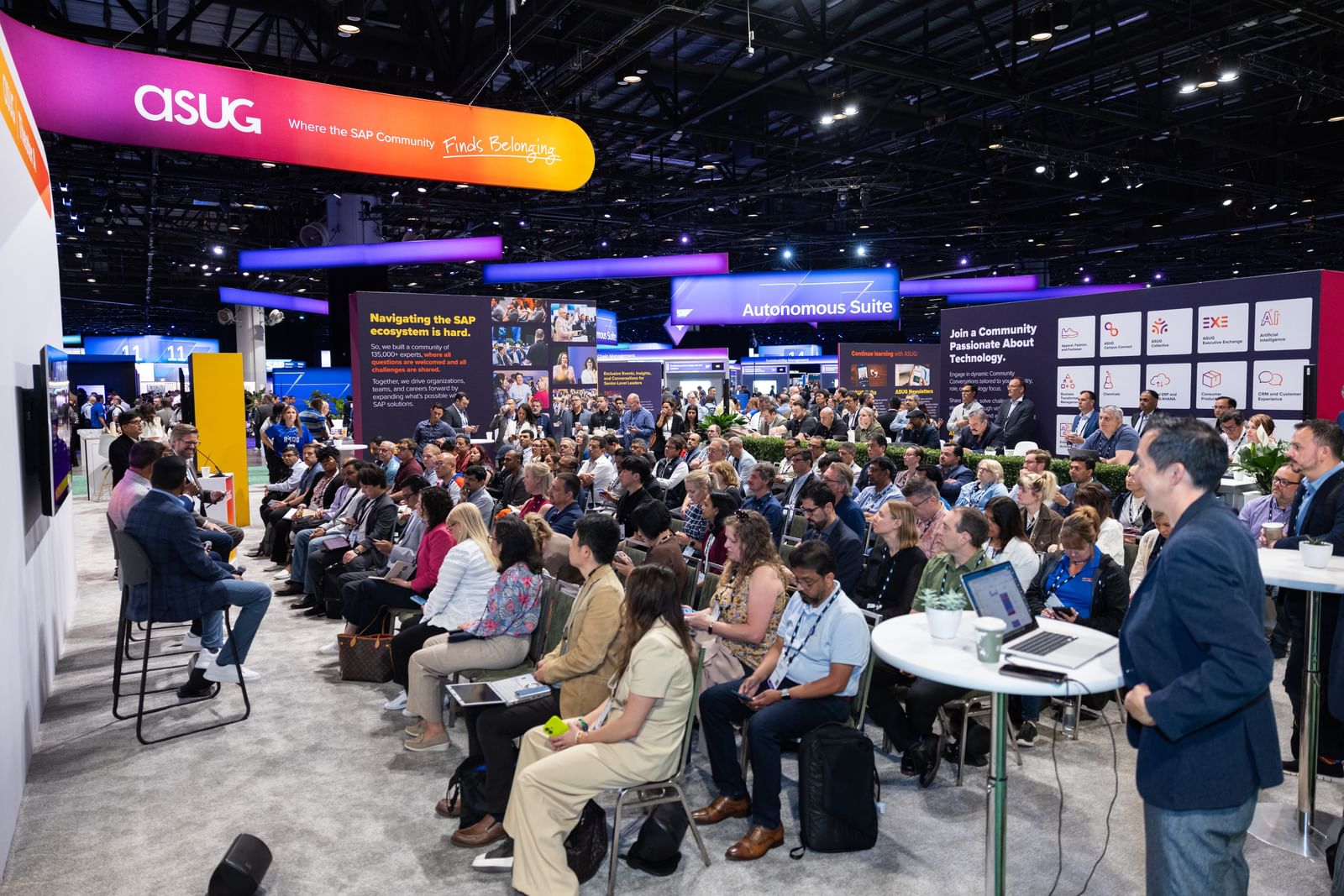
At SAP Sapphire & ASUG Annual Conference 2026, one message echoed across keynotes, demonstrations, and customer conversations: AI is no longer an experiment; it’s becoming a foundational layer of enterprise transformation, enabling SAP’s vision of the Autonomous Enterprise. But as the conference ended, the ultimate question for organizations became, “What’s next?”
As ASUG members unpack these announcements during subsequent ASUG Community Conversations, virtual post-conference recaps, and chapter meetings, the overall sentiment has become clear that customers want to explore the possibilities of the Autonomous Enterprise, but they are actively navigating the path from vision to execution, wondering how to actually make it real in their own technology landscapes. During the recent ASUG Community Conversation, SAP Sapphire & ASUG Annual Conference Highlights: AI, Roadmaps, and What’s Next, SAP experts explained these announcements and exactly what SAP is building, beginning with:
The Autonomous Enterprise: A strategic anchor combining the operational core (SAP Autonomous Suite) and Industry AI with a unified frontend and foundation. The core philosophy is simple: people set the strategic direction, while AI handles end-to-end execution with built-in governance.
Think of it like a self-driving car for business. The human sets the destination (strategy), and the AI handles the driving, steering, and braking (execution), while automatically following the rules of the road.
Joule, Joule Work, and Spaces: Moving beyond a basic chatbot, Joule is maturing through knowledge graph integration to provide deep business context. Launching in the second half of 2026, Joule Work introduces an intent-driven workspace with a generative UI (dynamically built screens) where users state a goal and the system orchestrates tasks across SAP and non-SAP systems.
Essentially, it’s a smart assistant that translates your goals in plain language into a custom screen in front of you, while handling all the behind-the-scenes processes.
AI Agents and Agentic Workflows: SAP announced 50-plus Joule assistants and 200-plus specialized, ready-made agents across finance, supply chain, procurement, and HR. Interoperable workflows allow these agents to coordinate in real time to solve complex cross-silo problems, working together in real time to solve business challenges. It works much like a professional sports team, where each AI agent plays a specific position, finance, supply chain, procurement, or HR, focused on executing its own part of the game. Interoperable workflows function as the coach and playbook, coordinating these agents in real time and adjusting strategy as conditions change. Together, they respond dynamically on the field to solve complex, cross-silo business challenges and drive the organization toward its goal.
Business Data Cloud and Tabular Prediction: To supercharge AI decision-making, SAP highlighted a unified data foundation integrated with third-party data lakes. This includes the acquisition of Prior Labs to advance Tabular Foundation Models, infusing next-generation predictive capabilities like RPT 1.5 across core business processes. The aim is to have AI analyze all your data to predict issues before they occur.
How Do We Get There? The Path from Experiment to Execution
Since Sapphire, ASUG members have been working together to synthesize this information. While the potential of AI, Business Data Cloud, Joule, intelligent applications, and agentic workflows is undeniable, SAP customers are wondering how to get there.
“The transition from traditional task forces to a single, dynamic experience has proven to be an immediate success, but members are actively trying to connect the vision SAP presented with the practical reality of what is available today.” — ASUG Member
For many ASUG members, AI is increasingly becoming part of larger transformation efforts, including cloud migration, process modernization, and enterprise architecture planning. The narrative has rapidly shifted from “What is AI and will it matter?” to “How do we operationalize, govern, and scale AI responsibly to drive business value?”
Live polling during the recap session showed a community evenly divided by the practical friction of adoption. Audience sentiment was split almost equally between understanding the high-level AI vision but not knowing where to start, feeling pressure to keep pace with innovation, and searching for a clear path from standalone pilots to integrated workflows.
ASUG members cited a persistent knowledge gap that creates hesitation to scale AI. When asked what they want to explore further with ASUG, members overwhelmingly prioritized AI strategy and governance, followed by data readiness, process transformation, and ERP modernization.
Polling data and member feedback point to a clear bottleneck. The community is asking a few critical questions:
Data Readiness: “If our underlying enterprise data is a mess, won’t an autonomous system just make bad decisions faster? What are the baseline standards we need to hit before we even think about turning this on?”
Workforce Capacity: “Managing AI is being treated like a ‘second job’ for teams already maxed out finishing cloud migrations. How do we budget time and train people to actually work alongside these agents?”
Governance and Safety: “A lot of us feel like we have ‘zero governance,’ with teams randomly experimenting. What guardrails — like an AI Agent Hub or verification seals — keep IT from losing control once hundreds of agents start executing tasks?”
Practical Proof: “Stop showing us high-level slides. Can you show us step-by-step case studies of ordinary processes that have successfully gone autonomous, along with the safety guides they used?”
The Road Ahead: A 30, 60, and 90-Day Roadmap to Execution
During the Sapphire Recap Community Conversation, SAP experts, including Cloud Transformation Leader Anurag Barua, AI Architecture Advisor John Astill, Chief Enterprise Architect Martin Mysyk, AI Product Management lead Matt Horenkamp, Global VP Wassilios Lolas, and Senior Director of Customer Advocacy Rich Huhn, addressed these burning questions with concrete frameworks, balancing long-term strategy with immediate, actionable advice and a practical, phased timeline.
Days 1 – 30: Build the Foundation — Identify Quick Wins
Core Questions Answered: What does true data readiness look like, and how do we build it? How do we operationalize AI without disrupting day-to-day operations?
The consensus for the first month is clear: move past internal committees and focus on low-hanging fruit with provable ROI.
“The best AI is boring — because you don’t see it. It’s just solving problems. Look at what’s achievable now and show leadership the value, rather than chasing visibility.” — John Astill, AI Architecture Advisor, SAP
Your Immediate 30-Day Action Items:
- Run a Joule Readiness Check: Utilize this official SAP service to clear foundational technical barriers before activating capabilities.
- Adopt Joule for Consultants: Follow Horenkamp’s advice and start leveraging Joule for Consultants immediately as a fast, low-lift entry point. Customers note they’re already using it to get thorough answers faster than going through traditional account teams.
- Request the Discovery Edition: Go to www.s4hana.com and request SAP Signavio Process Insights, discovery edition to run an automated assessment against your existing systems and build a data-backed value case.
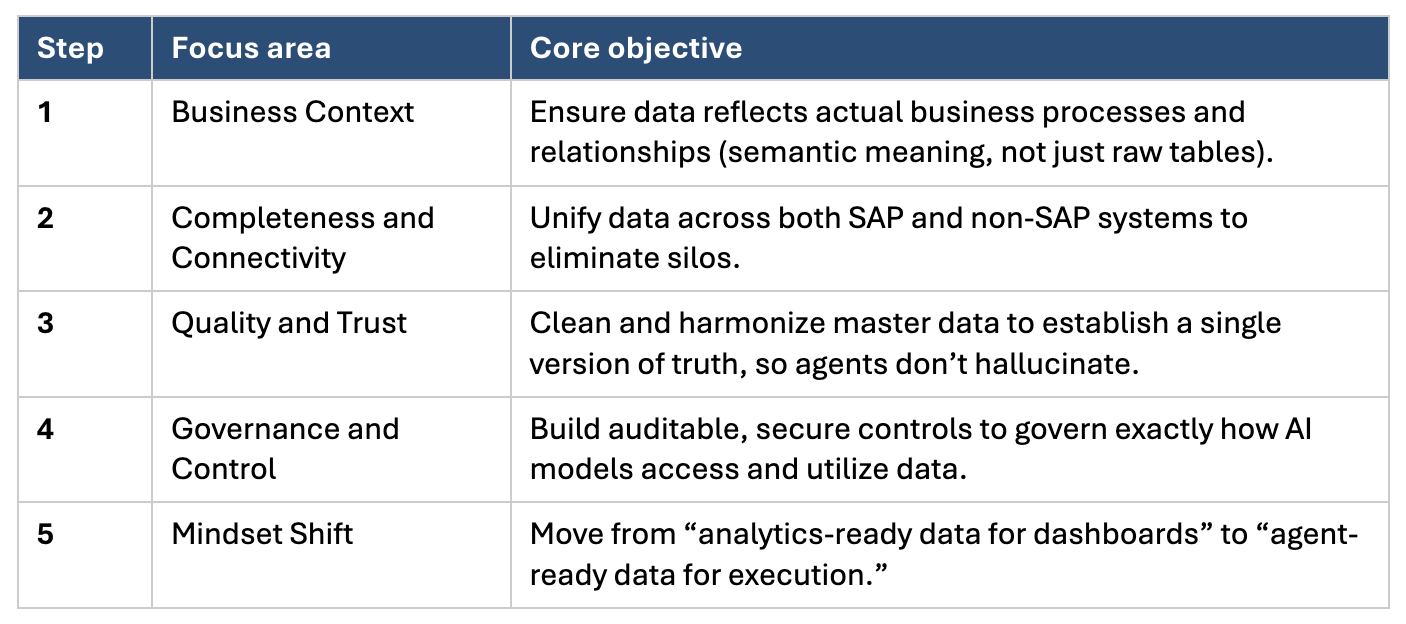
- Initiate Data Focus Area 1 and 2 (Business Context and Connectivity): Begin your data assessment by ensuring your data reflects actual business processes and relationships (semantic meaning, not just raw tables). Unify data across both SAP and non-SAP systems to eliminate silos.
Days 31 – 60: Stand Up Governance and Establish Accountability
Core Questions Answered: How do we govern an entire “zoo” of automated AI agents? How do we handle change management and support?
With the explosion of autonomous capabilities, governance cannot be an afterthought. Across the Enterprise Architecture and Business Transformation community conversations, participants were perfectly candid about where things actually stand, with one attendee stating, “We have zero governance. Legal is saying one thing, compliance another. People are just experimenting.”
Operationalizing AI requires a structured human framework to prevent fragmented, parallel, or “shadow” AI initiatives. Month two focuses on controlling it at an enterprise scale without stifling innovation using newly introduced tools.
Your 60-Day Action Items:
- Establish an AI Center of Excellence (CoE): Create this governance committee right away to define accountability.
- Map Your Inventory via the AI Agent Hub (Built on LeanIX): Work with Lolas’s framework to leverage this central repository to discover, catalog, and map every agent, LLM, and MCP server in your organization to specific business processes, avoiding duplicate work.
- Deploy the Verification Seal and Process Atoms: Enforce trust mechanisms managed within the Agent Hub and executed via the SAP Integration Suite, ensuring that “no assessment, no seal, no identity” applies to any agent. Turn unwritten organizational rules and highly granular process guidelines into strict, auditable guardrails that agents must follow.
- Initiate Data Focus Area 3 and 4 (Quality, Trust, and Control): Clean and harmonize master data to establish a single version of truth so agents don’t hallucinate. Build auditable, secure controls to govern exactly how AI models access and utilize data.
Days 61 – 90-plus: Clean the Core and Scale Process Transformation
Core Question Answered: How do we operationalize, scale, and realize long-term business value?
By month three, organizations must balance the human element with massive technical overhauls, shifting the data mindset entirely from tracking the past to executing for the future.
Your 90-Day Action Items:
- Clean the Core: Actively clean up and retire custom code. Reducing customization directly lowers the risk for upcoming AI rollouts.
- Pilot High-Momentum Use Cases: Prioritize fast-ROI use cases surfaced by your earlier process assessments, such as automating overdue billing, optimizing cash collection, or managing contract compliance.
- Activate Process AI Signal: Implement this automated monitoring layer to continuously check agent execution and confirm it is behaving exactly as intended.
- Execute Data Focus Area 5 (The Mindset Shift): Complete the data readiness framework by moving your teams from analytics-ready data for dashboards to agent-ready data for execution.
- Validate with SAP Teams: Continuously engage with your account teams and roadmaps to secure tailored recommendations rather than planning in a vacuum.
Summary: The 5‑Step Data Readiness Assessment Framework
To support this roadmap, Horenkamp structured the data challenges shared by Jim Loar of BASF Corporation into a clear, foundational checklist to run across your 30, 60, and 90-day timeline:
SAP Sapphire & ASUG Annual Conference raised the vision of the Autonomous Enterprise; now it’s up to each organization to build the data foundation, governance, and workforce readiness to turn that vision into something real. Luckily for the SAP community, ASUG will be there every step of the way.
Connect with ASUG for Support:
- Watch the Full Session: Access the on-demand recording of this Sapphire Recap to share insights directly with your leadership team.
- Engage with Your Chapter: Join upcoming local ASUG Chapter meetings to discuss these exact AI strategy, architecture, and change management threads with peers navigating the same journey.
- Join Us at ASUG Tech Connect: Dive deeper into these architectural building blocks live. Save the date for ASUG Tech Connect: Build What’s Next on SAP BTP — Together, happening Nov. 2 – 4 in Fort Worth. Keep an eye out for registration deadlines to secure your spot!
You Might Be Interested In

Log in to save this article and keep your favorite resources in one place.
Log in to save this article and keep your favorite resources in one place.

Log in to save this article and keep your favorite resources in one place.

Log in to save this article and keep your favorite resources in one place.