Log in to save this article and keep your favorite resources in one place.

This Partner Insight was authored by Giles Whiting, CEO at Decisions.
With Business AI, Joule, and agents that plan and act, SAP is moving quickly beyond assistants that answer questions. As compelling as that roadmap is, most estates look nothing like it. Yours might run ECC alongside S/4HANA, depend on integrations nobody fully owns, carry an acquisition never fully absorbed, and be a year or more into a cloud migration.
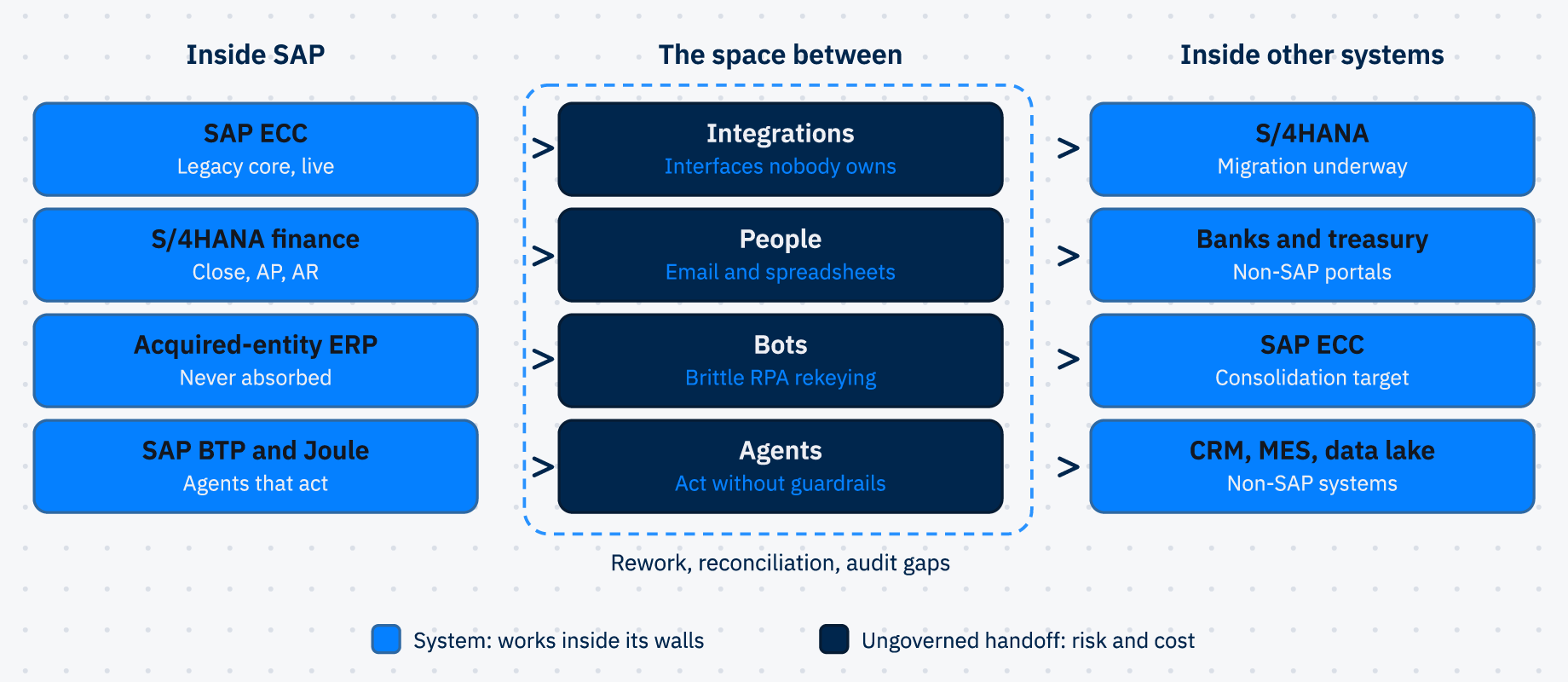
That distance between the roadmap and the estate under your feet is one of the most important problems in enterprise SAP, and I would argue it is widely misdiagnosed. We tend to treat it as a systems problem — too many systems, the wrong systems, systems not yet modernized. But the systems, by and large, work. SAP is exceptional at what happens inside SAP, and your non-SAP applications are usually effective within their own four walls too. The inefficiency and risk tend to live in the seams between them.
Where Landscapes Actually Break
A seam is any handoff, any point where work, data, or a decision crosses between systems or actors:
- An order leaves SAP for a logistics or warehouse system.
- A posting pauses for human approval.
- A decision in one system depends on a rule maintained in another.
- One bot hands work to another bot or agent with limited context about what came before.
No single application owns those handoffs, which is why things go wrong there. A policy gets applied in one system and quietly ignored in the next. An exception falls into a manual queue and sits for three days. When a landscape becomes difficult to operate, the usual culprits are handoffs that are invisible, inconsistent, and hard to audit end to end.
For years, humans absorbed that friction: someone in finance knew to check the second screen; someone in the warehouse knew which spreadsheet was real. That informal glue held the estate together.
Agentic AI is about to put far more pressure on it.
Agents Multiply the Seams
Gartner predicts that 40% of enterprise applications will include task-specific AI agents by the end of 2026, up from less than 5% in 2025. Not every agent will act autonomously or cross multiple systems, but as more gain the authority to trigger workflows and call applications, they introduce new handoffs with SAP, with everything SAP connects to, and with one another.
Agents tend to arrive team by team, each solving a local problem well. This is how “agent sprawl” happens: every agent added without a shared way to coordinate and govern it becomes another actor in the seams. Deploy enough of them that way, and what scales fastest is the ungoverned space between your systems.
This is exactly the problem agentic orchestration exists to solve: coordinating agents, models, people, workflows, and systems under a shared control layer instead of allowing each component to operate in isolation.
Gartner also predicts that more than 40% of agentic AI projects will be canceled by the end of 2027 because of escalating costs, unclear business value, and inadequate risk controls. Many of those problems, I would argue, surface in the seams, where agents meet the systems, people, data, and policies around them. Add powerful actors to a landscape whose handoffs were never formally governed, and you can get faster mistakes at a scale difficult to trace.
What Universal Orchestration Is
In February 2026 research on the universal orchestrator, Gartner predicts that by 2029, 90% of enterprises deploying AI agents across multiple application platforms will run them through an abstracted orchestration layer that governs agents, bots, and humans within a business process. In other words, the layer that governs the seams is becoming standard infrastructure.
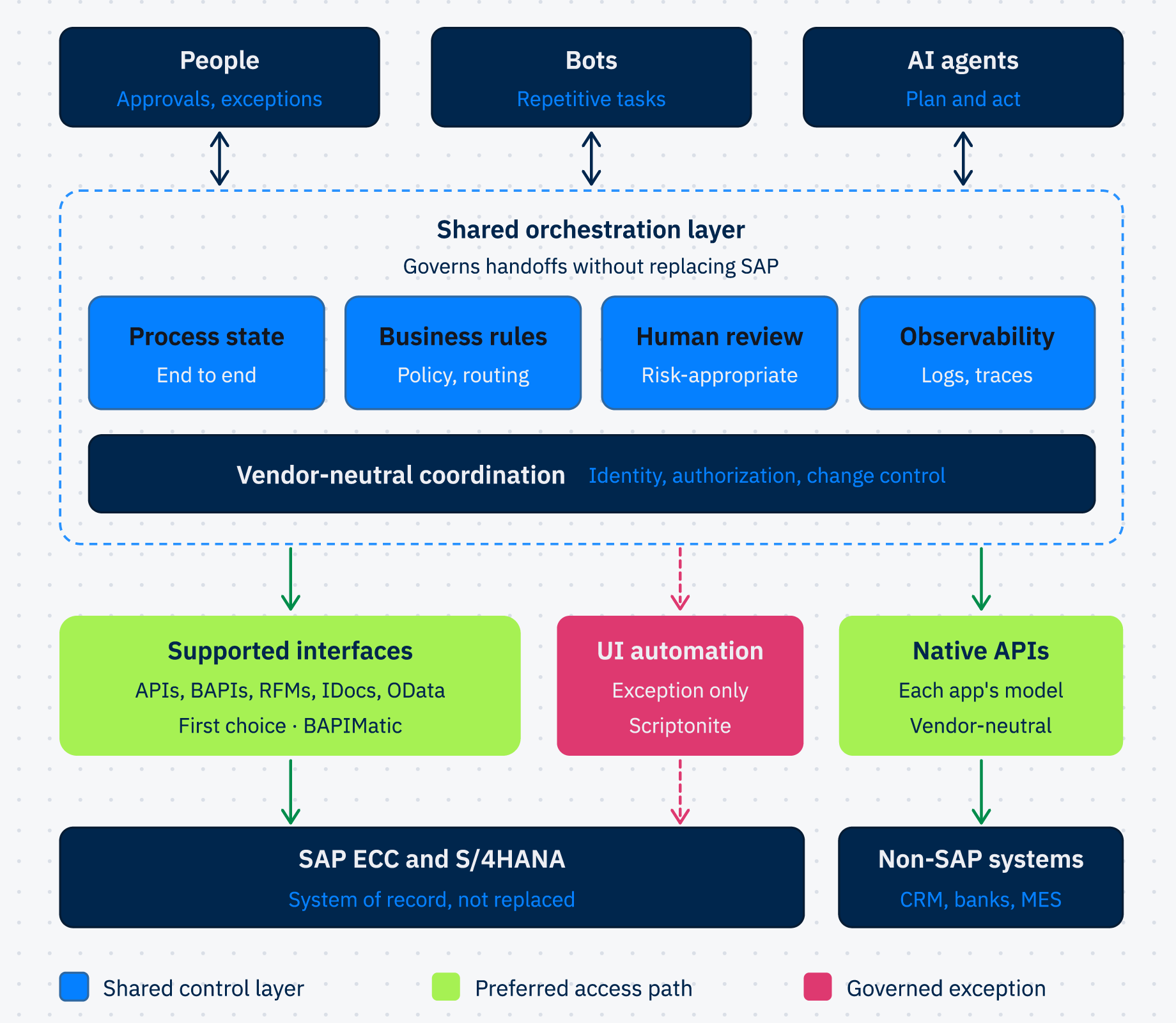
None of this means replacing S/4HANA, SAP BTP, Joule, or the migration roadmap, or handing every core process to one new platform. SAP should keep doing what SAP is unmatched at. Universal orchestration coordinates the decisions, business rules, workflows, human approvals, agents, and systems that must work together, serving as connective tissue rather than a competing brain.
Force all orchestration into one execution environment, and you can create lock-in and brittleness; leave it ad hoc, and you recreate the ungoverned seams agents will strain. An explicit, governed layer lets SAP and everything around it operate as one business process instead of a collection of loosely connected tools.
Where SAP’s Own Orchestration Capabilities Fit
Joule Studio is expanding agent, application, and workflow building across SAP and third-party systems. SAP AI Agent Hub is positioned as a centralized, vendor-agnostic command center for SAP, custom, and third-party agents. SAP Integration Suite connects agents, applications, data, and processes across SAP and non-SAP environments. Any credible architecture should use them where they fit.
The case for an independent layer rests on a simpler fact: no single platform owns the entire enterprise estate. A real business process may span SAP and non-SAP applications, agents from several vendors, legacy automation, deterministic decision logic, long-running workflows, and human work owned by different teams. The independent layer earns its place when the organization needs one place to maintain process state, apply shared policy, manage exceptions, and trace the outcome across those boundaries.
What Governing the Seams Looks Like in Practice
A rules-first universal orchestration layer should give cross-system handoffs four things they lack on their own:
- A shared policy and decisioning layer: Business rules live in one consistent source of intent instead of being re-implemented inside every workflow, agent, and integration. The same policy guides a human, workflow, bot, or agent, with controls tailored to each actor’s authority, access, and risk.
- Human checkpoints where they matter: Approvals, escalation paths, and exception handling are defined before automated or agent-driven work reaches a sensitive decision, and the layer routes work to a person when conditions require it.
- End-to-end observability: A consolidated trace of inputs, outputs, handoffs, decisions, and approvals lets a multi-system process be audited as one business outcome rather than reconstructed from disconnected logs.
- Neutral coordination: The layer works across models, agents, applications, and automation technologies, so a component can change without rebuilding the policy, exception handling, and governance around the process.
What Governing One Seam Looks Like
Consider a supplier bank-account change submitted through a third-party portal. It must be validated, checked against policy, routed for additional review when risk indicators are present, written to SAP, and communicated to procurement and payment systems. If each step is handled independently, the organization has to reconstruct the outcome from several systems and hope the same policy was applied throughout.
A governed layer maintains that request’s state from beginning to end. Shared rules determine what documentation is required and when a human must review the change. After approval, the layer calls a supported SAP interface, confirms the response, updates downstream systems, and escalates a failure instead of allowing the request to disappear into a queue. The steps move faster, but the deeper value is that the business can show which rule was applied, who approved the change, what SAP returned, and how an exception was resolved.
To begin, pick one consequential seam and ask: Who owns the handoff? Where does the governing policy live? What happens when the next system or agent fails? Can we trace the outcome without manually rebuilding the story from multiple logs?
Governing the Seams the Way SAP Intends
A control layer is only as trustworthy as its respect for each system’s native security and operating model. For SAP, supported interfaces — APIs, BAPIs, RFC-enabled function modules, IDocs, OData, events, and approved integration services — should be the first choice, used within appropriate identity, authorization, and change-control boundaries. UI automation is sometimes unavoidable, particularly in older environments without a suitable interface, but it should be a controlled exception rather than the default, with credentials tightly managed, permissions limited, transactions tested, and actions logged and traceable.
The approach is more efficient, reducing re-keying and reliance on fragile screen automation and shadow integrations, and it is lower risk because cross-system actions run through approved access paths and controls SAP administrators already understand.
We live by this principle in our own Decisions for SAP Solutions work. BAPIMatic drives high-volume SAP data operations through BAPIs and RFMs where appropriate, while Scriptonite provides governed SAP GUI automation when a native interface is impractical. The principle is bigger than any one product, though. Use the most stable, supportable access path available, and govern the exceptions deliberately.
The Question Every SAP Organization Should Ask
As SAP expands its Business AI and agentic capabilities, organizations will have more execution options. Whether those investments scale safely, though, depends on a different question: Who governs the space between my systems?
Most enterprises have capable systems and promising AI but no consistent way to coordinate them across organizational and technical boundaries. As agents take on more work, that gap becomes harder to absorb through manual oversight, disconnected integrations, and institutional knowledge. Universal orchestration exists to close it.
The next phase of enterprise AI will be won by organizations that coordinate increasingly capable agents with the systems and people already running the business. The vision is the easy part now. Governing the seams is the work.
Explore how Decisions brings rules-first universal orchestration to SAP and connected systems, or schedule a demo to see it in action.
Giles Whiting is CEO at Decisions.
You Might Be Interested In

Log in to save this article and keep your favorite resources in one place.

Log in to save this article and keep your favorite resources in one place.

Log in to save this article and keep your favorite resources in one place.

Log in to save this article and keep your favorite resources in one place.