Log in to save this article and keep your favorite resources in one place.

Download the full interview here.
Business AI requires more than access to data. It requires the right data: clean, relevant information that AI systems can reliably use to learn, reason, and act.
That was a recurring theme at SNP Transformation World 2026, where SNP CEO Jens Amail argued that companies preparing for AI should be just as deliberate about what data they leave behind as what they bring forward during an SAP transformation. Selectively migrating historical data can give companies a stronger foundation for business AI, but the data they do bring forward has to meet a much higher standard. As Amail put it, even 99.9% accuracy falls short when the outcomes after cutover need to be 100% accurate, compliant, and auditable — precise enough for a company to close its books down to the penny.
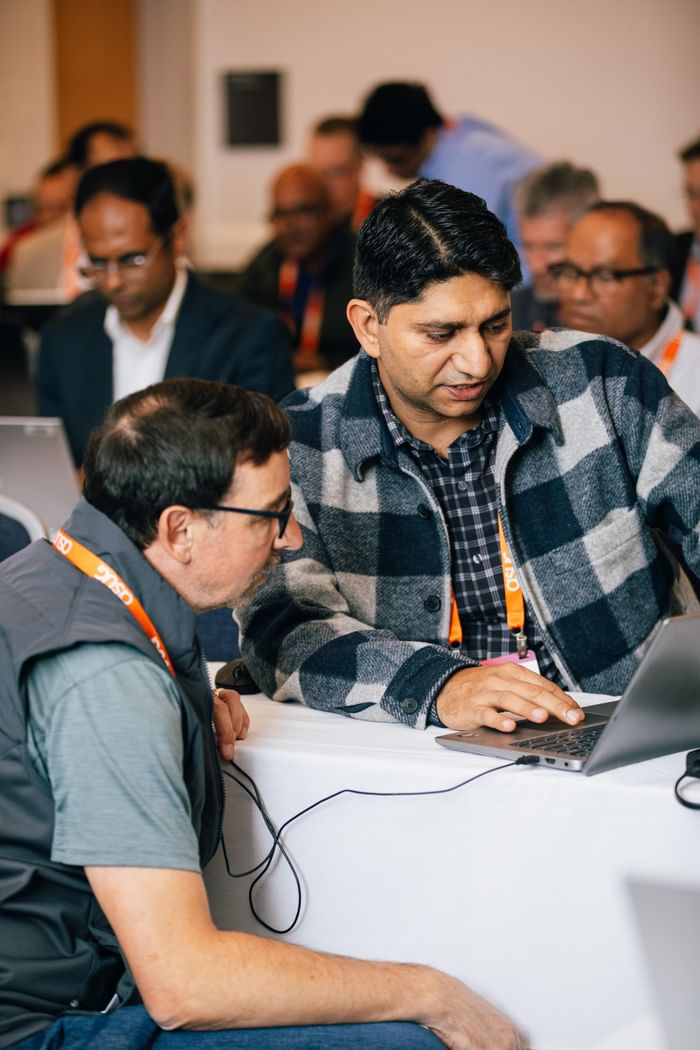
During the event, ASUG CEO and Chief Community Champion Geoff Scott sat down with SNP Executive Vice President and Chief Partner Officer Lutz Lambrecht to discuss what AI changes about the data transformation conversation, how companies can avoid carrying decades of unnecessary complexity into their next systems, and why transformation cannot end at go-live.
This interview has been edited and condensed for length and clarity.
Q: Members are weighing a lot of competing signals right now around AI, cloud, and transformation. Where does data transformation land in that mix?
Geoff Scott: To get the most benefit from AI, your data house has to be in order. AI agents have to sift through enormous amounts of information and make sense of it. If your SAP estate is messy, the odds of an agent coming back with the right answer go down.
As a community, we haven’t always been particularly disciplined about archiving. Organizations have put everything into SAP and left it there for as long as possible. That becomes a much bigger problem in the age of AI, because you’re now asking AI to make sense of all of that accumulated information.
Lutz Lambrecht: Everybody talks about using AI to accelerate business transformation. We also use AI to accelerate the data transformation that makes the broader transformation successful.
That means analyzing and classifying the data, but also determining what actually needs to move. In a greenfield transformation, for example, companies can discover that a significant amount of their historical data is no longer relevant to the business they operate today. If you can leave that behind, improve the quality of what remains, and then keep that data clean going forward, you’re starting the new environment from a much stronger position.
Q: Why did so many customers land on brownfield, and what did that leave behind?
GS: Greenfield requires companies to answer some difficult questions about how they actually want the business to operate. That takes time, and it requires stakeholders to align on processes and priorities. When organizations can’t reach that alignment, brownfield can become the easier path.
The risk is doing only what is necessary to move from ECC to S/4HANA without addressing the underlying data and process issues. You can end up with an S/4 environment that carries much of the same complexity as the ECC environment it replaced.
AI makes the consequences of that much more visible. Companies may now discover that data they chose not to clean or rationalize is affecting the output of their AI systems. In some cases, they’re confronting work they thought they had already completed as part of the original transformation.
Q: From an SNP perspective, how do you solve for that?
LL: It starts with understanding what is actually there. Kyano gives customers an overview of their data landscape so they can determine what needs to move and what doesn’t. The goal isn’t simply to reduce data for the sake of reducing it. Different types of information have different business and regulatory requirements. A company might need a certain number of years of financial data, for example, but a different amount of logistics data. You can make those distinctions and migrate what is relevant.
We had one customer go from roughly 130 terabytes of data to just 30 during a project. The important point is that those 30 terabytes represented the data the business actually needed. At the same time, data-quality capabilities are built into the process, with thousands of rules available to improve the quality of the information that remains.
Q: How should customers approach the data side of a greenfield or brownfield decision?
LL: Whether you go greenfield, brownfield or somewhere in between, the data question is the same: What does the future business actually need? That decision doesn’t have to be dictated by the approach you choose for the overall transformation. You can selectively migrate data in a greenfield project or a brownfield project.
Our job is to make sure you bring over only the data that’s relevant and that it arrives clean. And because a transformation is one of the few moments when you touch all of your data, it’s also the opportunity to build the strongest possible data foundation for AI.
Q: Transformation World’s Partner Day put the major SIs in the room. Are they picking this up?
LL: Yes. We’re seeing partners increasingly look at how they can embed SNP’s tool chain into their own methodologies. After Partner Day, another partner agreed to integrate our tool chain into theirs. Deloitte has invited us to its Innovation Center in Bangalore to look at how we can bring our methodologies together, while IBM has already done this, and PwC is looking to do the same. That’s significant because it means SNP’s tools can become part of the standard methodologies these partners use to deliver transformation projects.
Q: SAP describes autonomous enterprise as a vision. How is that landing with the customers you talk to?
LL: You have to start with the reality of the SAP customer experience. Customers are asking how the autonomous enterprise fits into their strategy and how difficult it will be to get there.
I feel like there are three types of SAP customers. You have the early adopters that are investing across S/4HANA, RISE, BTP, and BDC. They don’t mind making early investments in newer SAP platform solutions such as Joule, and they also want to stand on the stage at Sapphire and share the customer journey of their SAP implementations.
Then you have a large middle group operating mixed environments: they use SAP, but they also use Salesforce, ServiceNow, Microsoft, AWS, GCP, and other technologies. And then there are customers that still use SAP but have deliberately minimized their relationship with the company or moved to third-party support like Spinnaker or Rimini Street.
A lot of the industry conversation naturally speaks to that first group. But many customers are sitting in the middle with complex, hybrid landscapes. They aren’t necessarily going to reimplement everything at once.
That’s where I see the opportunity for SAP’s autonomous enterprise strategy, and where SNP can help bridge the gap. The goal should be to meet customers where they are, including those operating mixed landscapes, without requiring every customer to completely reimplement its environment before it can move forward.
For customers, the fundamental questions are: Where am I today, how do I get where I want to go, and what will it take in terms of complexity, risk, and cost? That’s where “find it, fix it, keep it clean” comes in. By helping customers establish an AI-ready data foundation, we can give them a path to take advantage of AI and agents regardless of which of those three groups they fall into.
Q: SNP delivers both directly and through partners. How does that model work for the customer?
LL: Partners are critical for scale, and we have more than 300 people enabled at partners who can deliver services using our software. If we want to scale, we need that ecosystem.
At the same time, I believe it’s important for SNP to continue delivering projects directly. That gives us firsthand customer feedback that we can use to continue developing the software. You don’t want to lose that connection to what customers are actually experiencing.
GS: My analogy is that I’m okay if you’re on the pirate ship, but I want you to leave the treasure. I don’t want the systems integrator to come in, do the work, and then leave with all of the knowledge and capability the customer needs to operate its own environment.
Q: Where should the line sit between what a company keeps in-house and what it hands over?
GS: Customers have sometimes gone too far in giving responsibility to systems integrators and leaving themselves with little internal capability beyond project and vendor management. I’d like to see companies reassert more ownership over their SAP landscapes. Partners bring tremendous expertise, but the customer still needs to understand and own the things that make its business distinctive.
LL: That distinction is important. If you’re talking about a standardized process that essentially every company has, outsourcing it may make sense. But if it’s a process that is unique to your company or represents something you do better than your competitors, then it’s a mix of both. My financial accounting, my payroll, I’m giving away to ADP. There are functions I’m perfectly comfortable standardizing or handing off. But if the way I run logistics is a source of differentiation for my business, I would never give away ownership of that.
Q: You’ve described Kyano® Manage as ongoing. Who’s doing that work today?
LL: That’s an area where I think there is a significant opportunity. If you look at traditional application managed services, the focus is usually on the applications. But who is continuously looking at the underlying data?
For us, clean and relevant data has to become an ongoing discipline. That is the thinking behind Kyano Manage: the transformation shouldn’t be the only time a company assesses and improves its data.
GS: You can’t clean it once and walk away. You have to put a process around it.
Q: How do you establish trust with a customer taking this on?
LL: We say we have a near 100% success rate, and it’s true. It’s proven. We have never failed. The transitions are sometimes bumpy and sometimes totally smooth, depending on how well we work together with the partner and how well they are enabled. From a trust perspective, we’ve never had an issue — because we have that history behind us. We’ve done this 16,500 times in 30 years.
GS: That complexity is the reality of most SAP implementations. When you start to bring in AI, you realize that things don’t always line up correctly because these project timelines are often out of sync. You might run SAP across a number of plants and have individual instances that have developed over time. How are you going to make that work if you have systems running independently at every plant? You could be at this forever.
LL: And the business doesn’t stand still while you’re doing it. You start the project and, in the meantime, the customer decides they’re going to buy or sell a company. Not a single project stays exactly as it starts.
Q: What about companies whose systems still carry the history of every deal they’ve ever done?
GS: Carve-outs are another inhibitor to AI adoption. When I was CIO at JBS, we had originally spun out of ConAgra 16 versions earlier, so our underlying SAP environment was still a ConAgra environment even though we hadn’t been part of the company for 10 years. Now you’re trying to become an AI-enabled business while carrying an SAP system that has been pieced together through six different acquisitions.
LL: That’s a good example of slicing and dicing the data along a different dimension. You might decide to cut off everything older than 10 years, then apply different timeframes to different areas of the business. If that allows you to reduce your data by 60 or 70%, that’s 60 or 70% less data to migrate and test, fewer opportunities for something to go wrong, and lower cloud consumption. Most importantly, the data you’re left with is more representative of the business as it operates today. Then you’re in a much better position to bring AI into the picture.
You Might Be Interested In

Log in to save this article and keep your favorite resources in one place.
Log in to save this article and keep your favorite resources in one place.

Log in to save this article and keep your favorite resources in one place.
Log in to save this article and keep your favorite resources in one place.