Log in to save this article and keep your favorite resources in one place.
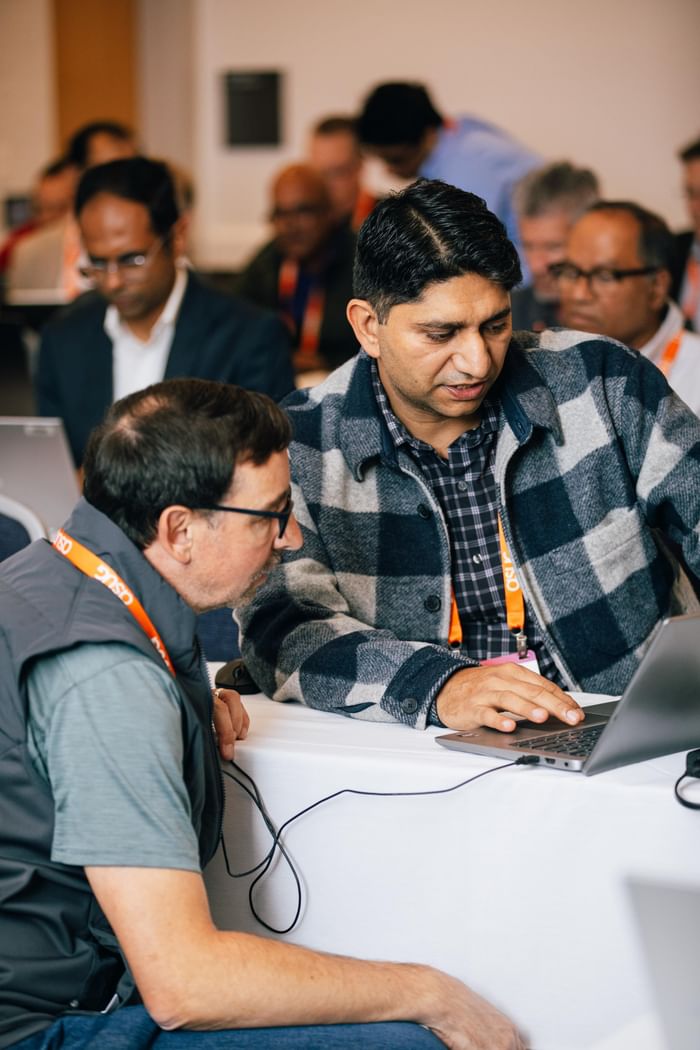
More than 1,000 utilities industry experts, professionals, and leaders gathered in Miami, Florida, last week for the SAP for Utilities, Presented by ASUG conference.
Connection and networking were critical components of the event, which returned this year for its 17th edition, as attendees sought knowledge and expertise to tackle seismic industry changes spurred by evolving customer expectations, growing regulatory and sustainability demands, and ever-shifting technology solutions.
The importance of facilitating the energy transition took center stage as speakers and attendees discussed how technology solutions — such as SAP S/4HANA, cloud environments, and artificial intelligence (AI) — play a key role in helping utilities’ leaders transform traditional power generation, grow renewable generation and storage capacity, and harden the electric grid.
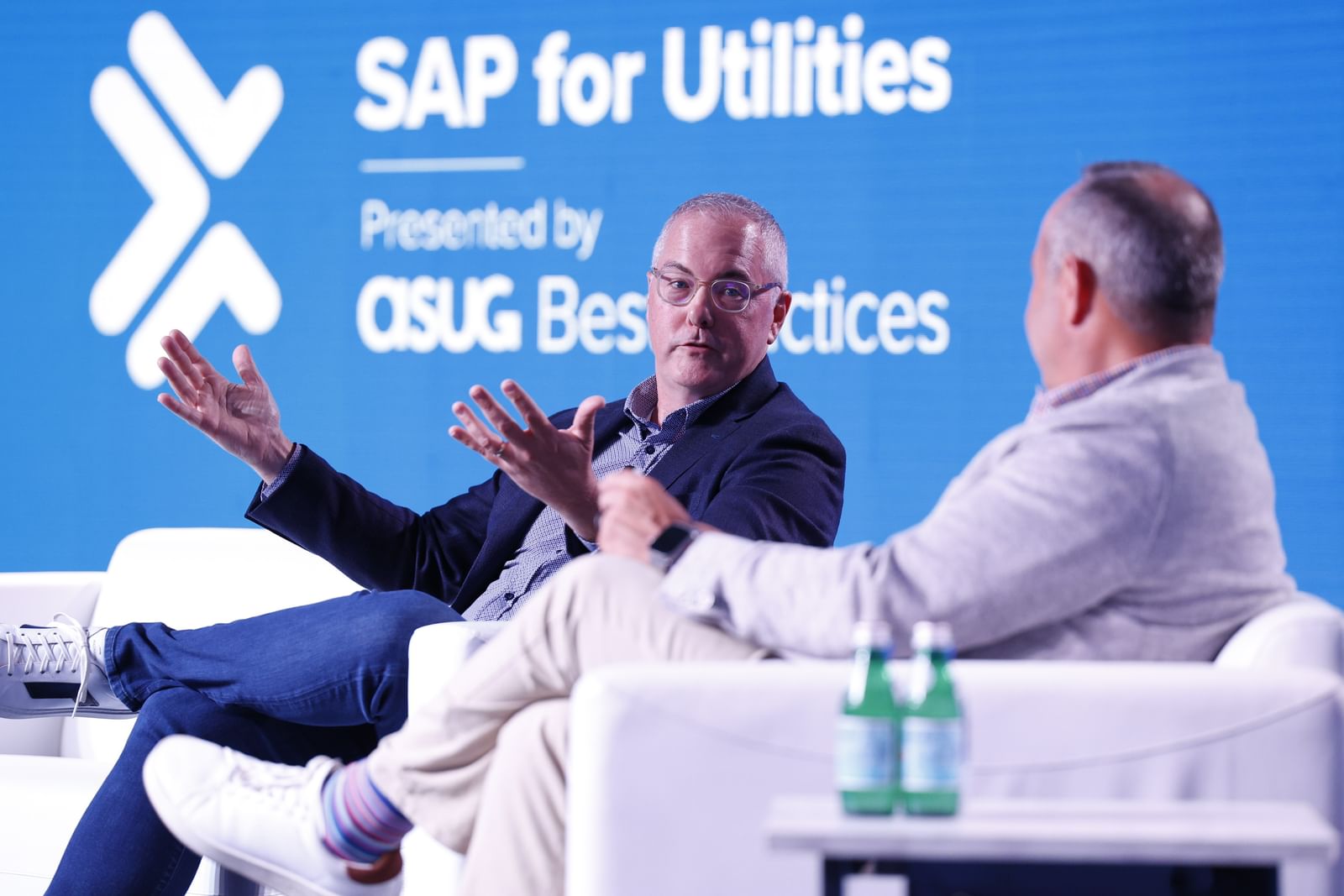
“This energy transition we’re navigating is a shared mission,” Michael Sullivan, National Vice President of Renewable Energy and Utilities at SAP North America, told attendees during a fireside chat with Geoff Scott, ASUG CEO & Chief Community Champion. “We’re a part of something bigger than ourselves, and even the small parts we play matter significantly in the long run.”
Read our exclusive interview with Sullivan on process optimization, data interoperability in the cloud, and much more.
SAP for Utilities, Presented by ASUG provided critical networking and knowledge sharing experiences, for attendees to learn how their peers are tackling industry challenges and leveraging SAP technologies to improve operations and drive innovation.
“ASUG is not just about today’s utilities community. It’s about connecting with each other and learning from each other year-round,” said Scott, further underlining the long-term nature of the “tectonic shifts” the utilities industry is experiencing.
Confronting Modern Utilities Challenges
Among the event’s themes was the imperative to overcome industry-specific hurdles by leveraging evolving enterprise technology. As the effects of climate change become more apparent, and regulatory standards necessitate optimization of inefficient technology systems and business processes, many organizations are determining how best to facilitate a transition to sustainable energy while also updating aging grid infrastructure.
These tasks will require monumental effort, potentially span generations — and at times can seem insurmountable. However, during his celebrity keynote, Mick Ebeling, CEO and Founder of Not Impossible Labs, emphasized that “everything that surrounds us right now that’s possible was at one point impossible.” He encouraged attendees to empower their teams to tackle challenges that, though daunting, could ultimately change the face of their industry, and to do so by maintaining faith in the long-term value of having lofty ambitions.
Referencing the remarkable projects Not Impossible Labs has worked on — including helping an artist paralyzed by ALS to draw again and designing low-cost prosthetic arms for double amputees — Ebeling discussed how encouraging teams to creatively approach seemingly impossible tasks will lead to major breakthroughs.
Read our exclusive interview with Ebeling on redefining the art of the possible and Not Impossible Labs’ track record of excellence.
During their fireside chat, which kicked off the conference’s second day, Scott and Sullivan discussed specific industry hurdles and changes that attendees are experiencing while reflecting on the importance of industry-wide networking and communication to solve industry-wide issues.
“We should all be thinking about that confluence of new technology, this massive challenge of energy transition we’re all set up to solve, and that we have this great community to do it with,” Sullivan said. Specifically, Sullivan singled out several technology shifts taking place in the industry. As utility companies move to the cloud, implement SAP S/4HANA, and leverage solutions like AI, setting a foundation within one’s business to effectively leverage those solutions is critical.
According to Sullivan, the adoption of a clean core data model is vital to enterprises seeking to use these solutions. Additionally, Sullivan discussed the decarbonization of energy resources. Given the increasing impact of climate change across all industries, utilities are at work considering how to build more sustainable, energy-efficient grids — and leveraging AI will be critical to meeting this challenge.
“The AI you’re using today is the worst AI you’ll ever use,” he reflected. “This is going to accelerate.” That said, abiding by principles of responsible, relevant, and reliable AI will be essential for utilities seeking to extract value from generative-AI investments, and the position of SAP is that AI will only be useful if it is ingrained in specific business contexts and processes.
“The value from AI is not automatic,” Sullivan said. “The value will be achieved at the intersection of business process and data.”
Utilities of the Future
Operations, information, software, bitcoin mining energy consumption, and advanced distribution management systems (ADMS) came into focus during a subsequent panel, moderated by Mark Hollis, Industry Executive Advisor at SAP, that reflected on the intersection of these topics while sharing expert insights into how utilities can prepare for a fast-evolving future.
“Our ceiling should be the next generation’s floor, which is where we’re heading if we do this correctly,” Hollis reflected.
For more than a century, energy flowed in one direction; now, with renewable energy such as solar and battery storage directing power back into the grid, that’s no longer the case. Distributed energy represents a significant shift for utilities, and accounting for multi-way power flows through flexible energy generation and storage capabilities will require complex strategies and processes to connect renewable energy projects to the grid.
Jason Handley, General Manager of the Distributed Energy Group, Duke Energy, is focused on connecting new electricity generators to the electric grid and optimizing the distribution interconnect process. “It’s no longer a utility sending energy down the line,” he explained. “It’s about coordinating that back-and-forth.”
Read our exclusive interview with Duke Energy on the importance of cross-organizational collaboration and change management strategies in leveraging RISE with SAP for digital transformation.
To manage the interconnection process safely and reliably, utility-connected distributed energy resource (DER) projects must be assessed to determine what new transmission equipment or upgrades may be required for a project to connect to the grid.
Collaborating with a regulatory commission, Duke Energy is focused on evaluating these projects through a series of impact studies, known as Definitive Interconnection System Impact Studies (DSIS), to identify potential system constraints, transient instabilities, and overdutied equipment associated with connecting generation to the transmission system.
Handley noted that “deploy, deploy, deploy” can be a challenging imperative for utilities that have been historically measured through customer-service metrics. Meanwhile, keeping pace with the demand to connect renewable energy projects to the grid can’t come at the expense of reliability. But the interconnection process will require utilities to collaborate on a set of standards and practices for connecting DER projects to the electric grid.
“We, as an industry, have to coalesce around DER standards, to understand product compatibility, how we roll out software, and how we expand field service management capabilities,” Handley said.
This presents another area for innovation. Brian Hoff, VP Product Management, GE Vernova, is focused on energy production and manufacturing through sustainable energy solutions, intended to accelerate the energy transition. A major component of success with the energy transition, Hoff stated, will involve grid orchestration via a fit-to-standard approach to software and systems. In working with more than 800 utilities customers, Hoff has come to believe that “everybody has similar problems, and we’re more similar than we realize.”
Adam Swick, Chief Growth Officer at Marathon Digital Holdings, a cryptocurrency mining firm, reflected on the transformative potential of bitcoin mining within the energy sector. With 13 data centers across four continents, Marathon has partnered with utilities to manage its own hugely energy-intensive processes. One recent pilot project: recycling heat from data centers to warm a community in Finland. “Given the power intensity of the compute, we produce recoverable heat,” Swick explained, reflecting that beyond the environmental and economic benefits of heat recycling, he sees this project as indicative of the role that digital data centers have to play in creating a sustainable future. Heat recycling could also open a new revenue stream for Marathon, a win-win as the cryptocurrency mining firm explores its future in the utilities space.
The Importance of Organizational Change Management
As utilities brace for the future and adopt new technology solutions to help overcome modern challenges, they must first ensure their organizations are ready to embrace new solutions. Throughout the conference, the importance of proper, well-funded organizational change management (OCM) strategies was emphasized.
During large-scale digital transformation projects, OCM plans are often an afterthought, which results in end user confusion and an unsatisfactory solution rollout. However, end users are critical to countless utilities operations, including asset maintenance and installation. Ensuring these employees understand how digital transformation projects impact their roles, and the right way to utilize new solutions in the field, is essential for modernization to succeed.
In a session focused on the Salt River Project (SRP) customer modernization program, Jessica Barchak, Business Integration Manager at Salt River Project, and Valerie Pomerenke, Director of Customer Modernization at Salt River Project, emphasized the importance of dedicated OCM strategies and resources played in the program.
“It’s never too early to bring in your OCM lead,” Barchak told attendees, underlining that these strategies often take a large amount of work during the pre-planning phase. As enterprises engage OCM professionals early, Barchak suggested that enterprises be prepared to start dedicated OCM resources — such as websites, trainings, and FAQs — early to head off confusion.
Moving Forward Together
Throughout the conference, across deep-dive learning-lab sessions and customer-story presentations alike, attendees gained insights into how they can leverage SAP technology to embrace the future and improve the North American utilities industry. However, to galvanize lasting change, utility companies must remain committed to learning from one another.
The SAP for Utilities, Presented by ASUG conference gave attendees a platform to share experiences, and a venue to learn from their peers. Marc Rosson, Enterprise Architect at Snohomish PUD, noted during one of the sessions that peer-to-peer knowledge sharing is critical for the entire sector to confront future challenges.
Read our exclusive interview with Rosson, a noted utilities thought leader, on the state of the utilities industry.
The utilities industry must work together in order to move forward and drive significant change, whether in terms of power generation, electric grid interconnection, or broader operational efficiency, he said.
“We are currently figuring out how utilities can participate in solving these generational challenges the world is facing,” Rosson separately told ASUG. “It’s exciting to be a part of the industry that’s solving problems. I’m optimistic about the future, and I’m excited to be doing my part.”
Stay tuned to ASUG for more utilities-specific stories in the coming weeks.
You Might Be Interested In

Log in to save this article and keep your favorite resources in one place.

Log in to save this article and keep your favorite resources in one place.

Log in to save this article and keep your favorite resources in one place.

Log in to save this article and keep your favorite resources in one place.