Heartland Dental collaborates closely with supported doctors and their teams to provide non-clinical administrative support, enabling doctors and their teams to focus on delivering the highest-quality dental care to their patients. Across 39 states and the District of Columbia, more than 23,000 team members provide over 30 unique business and administrative services to nearly 1,900 supported practices, enabling more than 3,200 dentists to maintain complete clinical autonomy while elevating the patient experience.

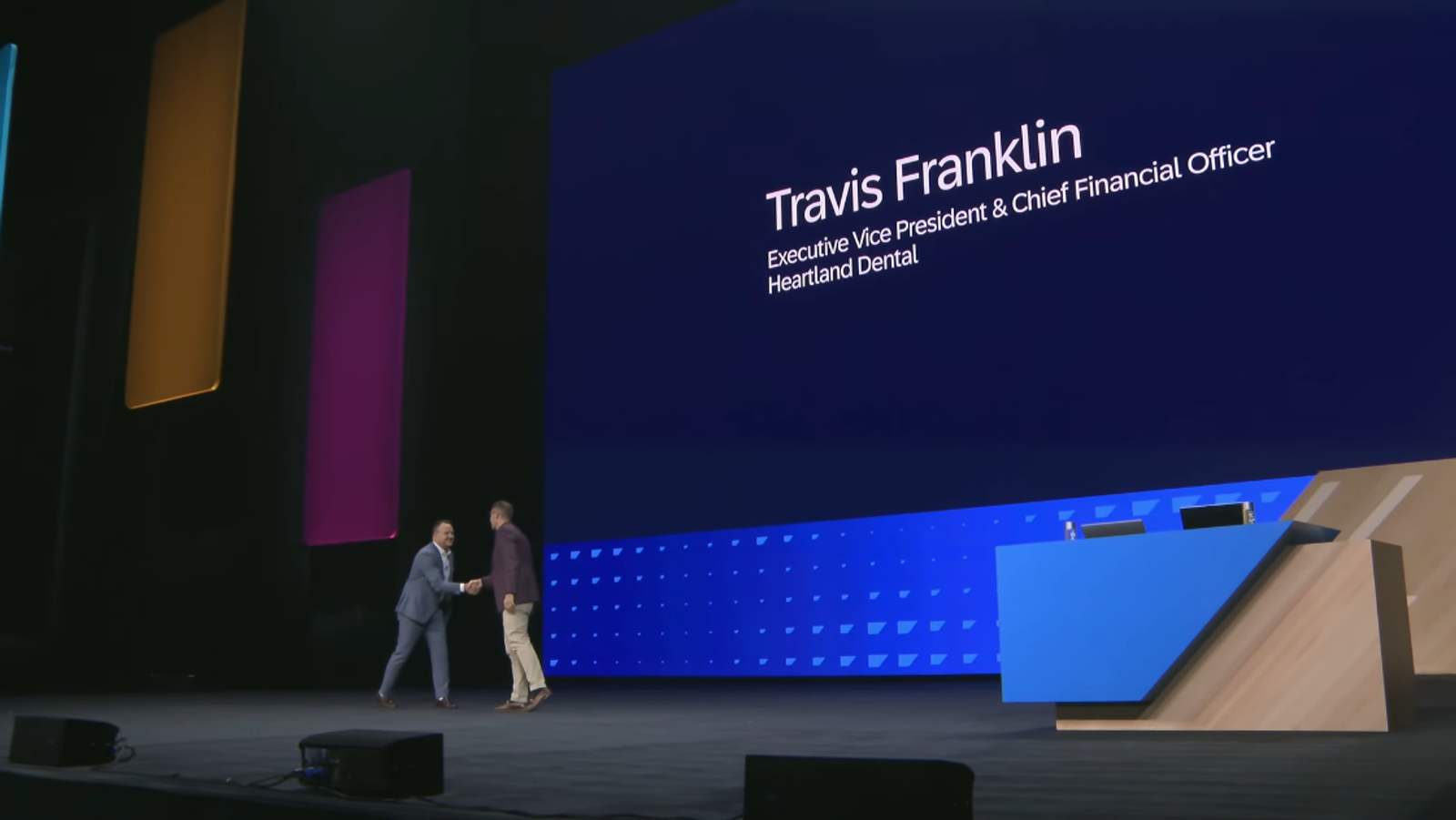
As the company scaled, growth began to outpace infrastructure. Each department ran its own technology, data, and analytics. “We were creating silos across the business,” Travis Franklin, Chief Financial Officer at Heartland Dental, told ASUG in an interview conducted at this year’s SAP Connect conference in Las Vegas.

Reconciliations took too long, and leadership teams struggled to align on a single source of truth. The friction made one point unavoidable: Heartland Dental could not continue to grow without dependable, governed data.

The Spark: An End-to-End Mindset

At SAP Sapphire & ASUG Annual Conference in Orlando, a group of company leaders saw a model for appropriately presenting operational and analytical data—an “intelligent enterprise” with SAP HANA at the core, Franklin recalled. The takeaway wasn’t about buying point solutions; it was about connecting processes and data end-to-end to eliminate silos and drive value across the entire enterprise.

Accounting, finance, and IT leaders leaned in with an operational mindset: numbers exist to run the business, not just to record it. The team began with the supported dentists’ needs and worked backward from there. Every system and policy had to serve the supported practice first. Transparency became the mechanism for trust, Franklin emphasized: “Use accurate data, share it with operational partners, explain the ‘why,’ and help business leaders and supported practices make better decisions.”

Start with the Problem, Not the Tool

Franklin recalled the guidance that shaped his approach: “Somebody told me when we first started doing this, ‘Start by defining the problem you want to solve, and then how do you reverse-engineer it back? Don't consider the current ways you do it. You have to come in with a fresh mindset.’” Technology will amplify good processes—and automate bad ones if governance is skipped. Leaders documented processes end-to-end, engaged cross-functional teams early, and built buy-in before automation.

Build the Foundation: Data before Technology

Heartland Dental combined data on SAP HANA and standardized reporting through SAP Analytics Cloud. The company committed to SAP S/4HANA to align accounting & finance and operational teams in one environment with common data elements, consistent processes, and shared definitions.

Data governance with proper data definitions was the unlock criteria, as it standardized data across the enterprise. By way of example, there had been seven competing definitions of “new patient” at Heartland. Today, the organization has one consistent definition. That clarity shortened debates, sped up decision-making, and enabled real comparability across thousands of supported practices.

Early Wins that Built a Flywheel

Momentum came from targeted, practical wins:

  • Procure-to-pay with SAP Ariba. What had been fragmented, manual purchasing became a standardized three-way-match workflow. Compliance strengthened, transparency improved, and leaders gained real-time visibility into spend and supplier performance.
  • Incentive/commission automation with SAP Incentive Management (formerly CallidusCloud). A monthly grind in spreadsheets became an automated process. "We had 25 people handling work that is now orchestrated by a smaller core team of about five, and those team members were redeployed into other roles across the organization—analytics, process improvement, and strategic initiatives,” Franklin explained. These shifts allowed the organization to benefit and focus that talent on higher-value work that would deliver greater enterprise impact. No layoffs were conducted as part of this change.

    Each success reinforced trust in shared data and accelerated the next wave of change.

    Elevate Skills, Don’t Eliminate Roles

    While systems evolved, Franklin stayed clear on one principle: sustainable transformation depends on people, not platforms. Automation was never a code word for downsizing. Heartland Dental instead focused on skill escalation, moving people from transactional work into analysis, process improvement, and strategic projects. The approach preserved institutional knowledge and made adoption easier: the people who knew the processes best helped design the new ones.

    Design for the End User

    If a change didn’t simplify life for a supported doctor and the office team, it didn’t move forward. SAP Build Work Zone now brings the right information into a single workspace, reducing system-hopping and turning fragmented steps into coherent workflows. "It's pushing the supported dental office and field operations team members the data they want instead of them having to go find it," said Franklin.

    The cultural effect: when data and processes are unified, collaboration improves and problems get solved faster. Heartland’s operating mantra (work hard, work smart, work together) became tangible in its tools.

    Turn Analytics into Operational Excellence

    With governed data and integrated systems, SAP Analytics Cloud powers forecasting, segmentation, and practice insights that are easy to consume on any device. Distributing trusted insights—rather than dashboards for their own sake—helps departments and leaders run more efficiently and gives the enterprise a stronger planning backbone. The cumulative impact is evident in improved operational efficiency and more consistent outcomes across the supported network. Heartland’s accounting & finance team shifted from simply reporting results to partnering with operational partners to shape them.

    The Next Chapter: Cloud and AI

    By 2025, Heartland Dental began its move to SAP S/4HANA Cloud, public edition, to further standardize processes, shorten close cycles, and provide a consistent, real-time view of performance. AI already enhances routine tasks, like receipt capture in SAP Concur, automated expense matching, and lease-term extraction to speed renewals.

    The rule remains: automation creates value only when the underlying data is sound.

    Too many organizations buy technology first and worry about data later. Heartland Dental reversed that sequence. With accounting & finance, operations, marketing, and HR anchored to shared definitions and governed data, visibility improved and decisions got faster.

    Lessons for leaders

    • Start with the problem. Reverse-engineer from the outcomes you need.
    • Get early wins. Small successes create a flywheel for change.
    • Co-create with your people. Adoption is easy when teams help design what they’ll use.
    • Prioritize data governance. Technology without quality data has limited value.
    • Think end-to-end. Unified data platforms break silos and encourage collaboration.
    • Elevate, don’t eliminate. Use automation to move talent into higher-value work.
    • Design for your customer. In dentistry, that means the supported doctor and their team.
    • Align leadership, then empower execution. Strategy from the top, excellence throughout.

    Heartland Dental’s transformation was successful because senior leaders aligned on a clear strategy while exceptionally talented teams executed it with precision. The result is an intelligent enterprise built on trusted data – one that empowers people with operational insight and preserves the complete clinical autonomy of supported dentists. When you put reliable information in the hands of the people who need it, in a form they can actually use, great things happen.

    Interested in More Executive Insights?

    Fill out the form below to apply for the ASUG Executive Exchange program, a unique community of executive leaders where connections, lessons, and best practices are shared.

    Want to continue reading this article?

    Become a member and get access to all ASUG benefits including news, resources, webcasts, chapter events, and much more!

    Log in

    Not an ASUG member? Learn more